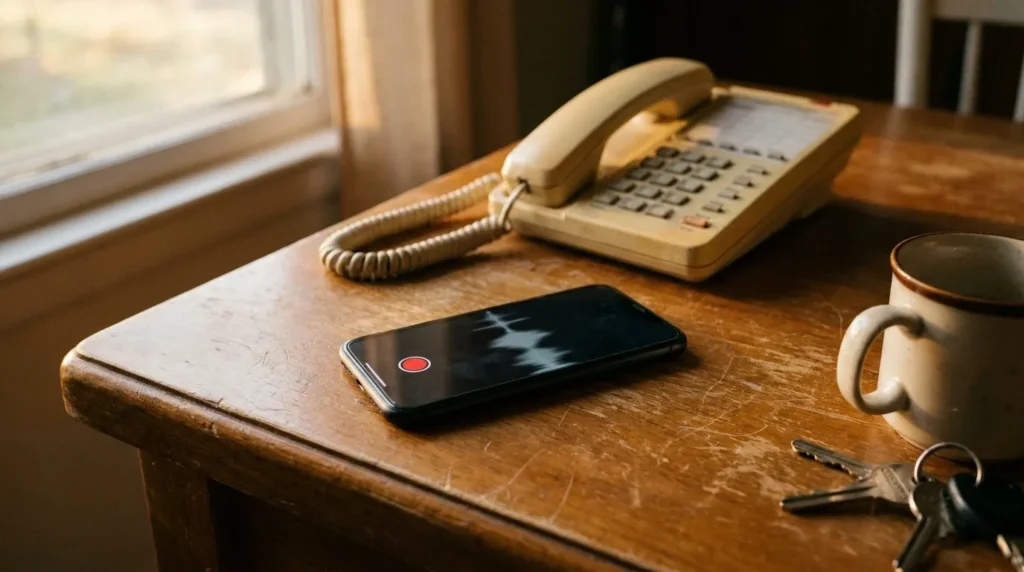
On May 6, 2008, a father kept calling the cell phone of his son’s mother and kept getting voicemail. One call connected with nobody speaking, and through the open line he heard his five-year-old crying while two adults yelled at him and one threatened to beat him. He used the voice memo function on his own phone and recorded it. Eight years later New York’s highest court had to decide whether that recording was a felony or evidence. The answer turned on a single phrase in the state’s eavesdropping law, the same phrase that governs whether anyone in New York can press record on a phone call: consent of at least one party.
The short answer, and the statute behind it
New York lets a participant record; it punishes the outsider
New York is a one-party consent state, and the definitions in Penal Law § 250.00 show exactly where the line sits. “Wiretapping” is “the intentional overhearing or recording of a telephonic or telegraphic communication by a person other than a sender or receiver thereof, without the consent of either the sender or receiver.” A person on the call is a sender or receiver, so recording their own call falls outside the definition.
In-person talk has its own term. “Mechanical overhearing of a conversation” is “the intentional overhearing or recording of a conversation or discussion, without the consent of at least one party thereto, by a person not present thereat.” A participant who records a meeting at a kitchen table is present and consenting, which takes it out of the crime.
Texts, emails and other data get a third definition: intercepting an electronic communication “without the consent of the sender or intended receiver thereof.”
Under Penal Law § 250.05, unlawfully engaging in any of the three is eavesdropping, and “Eavesdropping is a class E felony.” A felony sits a long way past a parking ticket, which is why the definitions are worth reading word by word.
How the three definitions line up
A side-by-side reading of the New York text, the federal floor and California
The comparison below is built only from the statutory text and the court opinions linked in this post.
| Situation | NY Penal Law 250.00 | Federal, 18 U.S.C. 2511(2)(d) | California Penal Code 632 |
|---|---|---|---|
| A participant records their own phone call | Not wiretapping: recorder is a “sender or receiver” | Lawful if the recorder “is a party to the communication,” unless the purpose is criminal or tortious | Unlawful for a “confidential communication” without “the consent of all parties” |
| A participant records an in-person conversation | Not mechanical overhearing: recorder is present and a party | Same party exception | Same all-party rule for confidential communications |
| An outsider records with one participant’s permission | Permitted: “consent of at least one party” or of “either the sender or receiver” | Permitted where “one of the parties to the communication has given prior consent” | Still requires all parties |
| An outsider records with nobody’s permission | Eavesdropping, class E felony (250.05) | Unlawful; penalty up to five years | Unlawful |
| Penalty headline | Class E felony | “fined under this title or imprisoned not more than five years, or both” (2511(4)(a)) | Fine up to $2,500 per violation for a first offense, plus possible jail |
The federal column comes from 18 U.S.C. § 2511, which makes interception lawful for a private person “where such person is a party to the communication” or “where one of the parties to the communication has given prior consent,” with one large exception: “unless such communication is intercepted for the purpose of committing any criminal or tortious act.” The California column comes from Penal Code § 632 (the 2024 code as published by Justia; the Legislature’s own site did not load during research).
California’s rule only reaches a “confidential communication,” defined as one “carried on in circumstances as may reasonably indicate that any party” wants it kept among the participants. It excludes “a communication made in a public gathering” and conversations where the parties could reasonably expect to be overheard or recorded.
Calls that cross into an all-party state
One end of the line in Mount Sinai, the other end in Los Angeles
Phone calls ignore state lines, and so do the arguments about which law applies. The Reporters Committee for Freedom of the Press, in the introduction to its recording guide, counts “About 11 states” that “primarily have all-party consent requirements for recording”: California, Delaware, Florida, Illinois, Maryland, Massachusetts, Michigan, Montana, New Hampshire, Pennsylvania and Washington. It notes that Michigan’s rule applies at least to third-party recorders, and it adds partial cases, including Connecticut and Nevada, which require all-party consent for phone calls only. Its advice to journalists is to “err on the side of caution and assume that the stricter state law will apply,” because courts disagree on whether the recorder’s state or the recorded person’s state controls.
The leading example is California’s. In Kearney v. Salomon Smith Barney, decided July 13, 2006, brokers at an Atlanta branch were alleged to have recorded calls with clients in California without telling them. Georgia allows a participant to record; California does not. The California Supreme Court split the remedy. For past conduct, it chose to “apply Georgia law with respect to SSB’s potential monetary liability,” so no damages. For the future, “California law is applicable in this setting,” and out-of-state businesses dealing with Californians “are on notice that, with regard to future conduct, they are subject to California law.”
The court also described what 632 forbids with some precision. The statute does not bar a party from recording; it “simply prohibits such a party from secretly or surreptitiously recording the conversation.” Announcing the recording at the start of the call is the plain way to stay on the right side of every column in the table.

The recording made by someone not on the call
A parent’s consent, standing in for a child’s
Back to the father with the voice memo. In People v. Badalamenti, decided April 5, 2016, the Court of Appeals faced a recording made by someone who was not a party: the father was listening through an open line, and neither adult in the apartment consented. Under the plain definition of mechanical overhearing, that is the outsider case.
Writing for the court, Judge Fahey held that a parent or guardian “may vicariously consent on behalf of the child to the recording,” provided the parent has a “good faith, objectively reasonable basis to believe that it is necessary” to serve the child’s best interests. It found “there was an objectively reasonable basis for this belief” on those facts, and the recording came in as evidence.
The holding is narrow. It covers a parent acting for a child’s welfare, judged by an objective standard after the fact. It does not hand spouses, roommates or business partners a general license to record conversations they are not part of.
At work: notice rules and the camera line
The employer’s phone system has its own paperwork
The participant rule applies to employees and employers like anyone else, but New York adds a notice duty for employers who monitor. Civil Rights Law § 52-c requires an employer with a place of business in the state that monitors employees’ “telephone conversations or transmissions, electronic mail or transmissions, or internet access or usage” to give written notice upon hiring, get an acknowledgment, and post the notice where employees can see it. The notice must say communications “may be subject to monitoring at any and all times and by any lawful means.” The attorney general enforces it, with maximum civil penalties of $500 for a first offense, $1,000 for a second and $3,000 for a third or later one. Processes that manage traffic volume and are not targeted at an individual, used solely for “computer system maintenance and/or protection,” are excluded. The earlier post on employer monitoring of email and chats in New York covers that statute in detail.
Cameras have a separate hard line. Labor Law § 203-c says “No employer may cause a video recording to be made of an employee in a restroom, locker room, or room” designated for changing clothes, “unless authorized by court order,” and bars any use of such a recording. The text speaks only of video. Audio in those rooms falls back on the eavesdropping definitions.
Where people get burned
The ways a legal recording turns into a felony, a lawsuit or useless evidence
Leaving a phone recording in a room after walking out. Once the recorder is “not present thereat” and no participant consented, a recording that started lawfully can fit the definition of mechanical overhearing. Being the owner of the phone does not make someone a party to the conversation.
Recording for a bad purpose. The federal exception disappears when a call is intercepted “for the purpose of committing any criminal or tortious act.” A one-party recording made to blackmail someone loses the protection that made it legal.
Assuming the other caller is in New York. A customer, landlord or relative in California, Florida or Pennsylvania may be protected by an all-party law, and Kearney shows a California court applying its own law to a recorder in another state.
Expecting an illegal recording to win a case. CPLR 4506 provides that the contents of a conversation overheard or recorded through eavesdropping, “or evidence derived therefrom,” generally “may not be received in evidence in any trial, hearing or proceeding before any court or grand jury,” with an exception for a case against the eavesdropper. A secret recording that crosses the line can be worthless in the very dispute it was made for.
Employers skipping the notice. Monitoring a company phone system can be lawful and still violate 52-c if the written notice and acknowledgment never happened.
The case against recording just because it is legal
One-party consent settles the criminal question and nothing else
The strongest argument against casual recording in New York is that the law answers a narrow question. The Penal Law says whether a recording is a crime. It does not say whether the other person will speak freely again, whether a client in another state can sue, or whether a judge will think the tape was made in good faith. About eleven states, by the RCFP’s count, primarily require every party’s consent, a policy choice that a secret recording of a private conversation is wrong even when one participant agrees to it, and the people on the other end of a New York call did not vote on New York’s choice.
There is also the federal “tortious purpose” exception, which turns intent into an element. A person recording to protect themselves and a person recording to set up a claim against someone may press the same button, and only one of them is clearly covered.
The harder point sits underneath. A recording of someone’s voice is raw material long after the call ends, a problem the earlier post on AI voice cloning law traces through state statutes. The one-party rule in § 250.00 has not been revised since September 22, 2014, the most recent revision NYSenate.gov shows. It decides who may press record. Who may do what with the file afterward is a different question, answered elsewhere or not at all.
A father with a voice memo got a recording into evidence because a court read consent into a five-year-old’s interests. How many recordings sitting on phones across the state today would survive the same reading?
Sources
- New York Penal Law § 250.00, definitions: https://www.nysenate.gov/legislation/laws/PEN/250.00
- New York Penal Law § 250.05, eavesdropping: https://www.nysenate.gov/legislation/laws/PEN/250.05
- 18 U.S.C. § 2511 (Cornell LII): https://www.law.cornell.edu/uscode/text/18/2511
- California Penal Code § 632 (Justia, 2024 code): https://law.justia.com/codes/california/code-pen/part-1/title-15/chapter-1-5/section-632/
- Reporters Committee for Freedom of the Press, Introduction to the Reporter’s Recording Guide: https://www.rcfp.org/introduction-to-reporters-recording-guide/
- Kearney v. Salomon Smith Barney, Inc. (Cal. 2006): https://law.justia.com/cases/california/supreme-court/2006/s124739.html
- People v. Badalamenti (N.Y. 2016): https://nycourts.gov/reporter/3dseries/2016/2016_02556.htm
- New York Civil Rights Law § 52-c: https://www.nysenate.gov/legislation/laws/CVR/52-C*2
- New York Labor Law § 203-c: https://www.nysenate.gov/legislation/laws/LAB/203-C
- New York CPLR 4506: https://www.nysenate.gov/legislation/laws/CVP/4506
For informational purposes only — consult a licensed attorney or financial advisor.