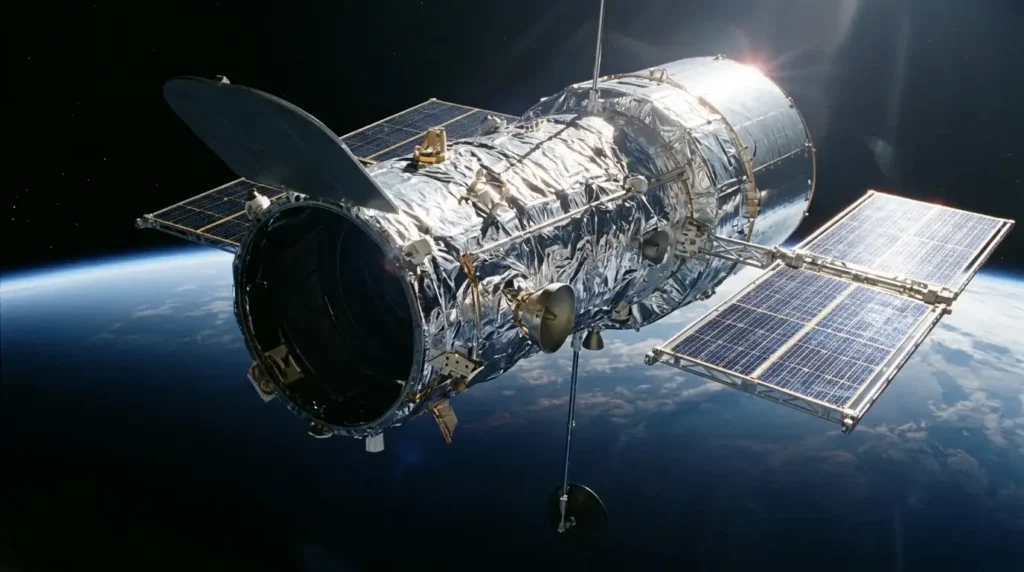
In May 2009, the last crew to visit the Hubble Space Telescope fixed a device to its base so that, one day, something could come back and take it down. NASA’s archive describes the hardware plainly: it was attached to facilitate de-orbiting when the telescope is eventually decommissioned. Seventeen years later the agency has started asking who might use that fitting, and for which of three very different jobs.
On October 29, 2026, NASA issued a Request for Information on in-space servicing for Hubble. It asks companies what they could do in three areas: raise the telescope to a higher orbit, service it, or carry out a safe controlled re-entry or orbital disposal. Responses are due by 3 p.m. EST on Monday, November 30. An RFI is a question to the market. It carries no mission, no contract and no money, and the NASA announcement does not describe any of those.
A telescope with no engine
Drag is winning, slowly, and Hubble has nothing to push back with
NASA’s announcement states the core problem in one line: “Hubble does not have a propulsion system to maintain its own orbit”. Atmospheric drag keeps lowering it. The agency’s analysis says Hubble is likely to re-enter in the 2033 to 2034 timeframe, which is why NASA expects any mission to need to fly by 2032.
That 2032 date is the hard edge of this whole story.
The altitude has been sliding for years. Hubble went up in 1990 aboard Space Shuttle Discovery, according to The Register, starting above 600 km and now sitting well below 500 km. The same February report cites a plot posted by astronomer Jonathan McDowell suggesting that, without a boost, Hubble could re-enter as early as 2028, and it blames heightened solar activity, which puffs up the upper atmosphere, for at least part of the faster fall. NASA’s own window of 2033 to 2034 is later. The two estimates do not agree, and the gap between them matters, because a telescope that comes down five years sooner than planned leaves five fewer years to build anything that could catch it.
A car with a dead engine can still be towed. Somebody has to own a tow truck that works at 500 km, and the one NASA paid to go after its Swift observatory this year never hooked on.
The orbit math behind all of this, drag aside, is the same Kepler-and-Hohmann arithmetic that x9m8’s Orbit Lab simulator runs in a browser: a higher orbit takes energy to reach, and once reached, it decays more slowly because the air up there is thinner.
Five house calls, then none
For 16 years, astronauts kept Hubble alive by hand
Hubble is the rare satellite built to be worked on. NASA’s Missions to Hubble page lists five servicing missions:
- SM1, December 2–13, 1993, installed instruments that corrected for the flaw in the primary mirror.
- SM2, February 11–21, 1997, added two instruments that widened the wavelengths Hubble can see.
- SM3A, December 19–27, 1999, split off from a planned SM3 after a gyroscope failure, because Hubble needed at least three working gyros to do science.
- SM3B, March 1–12, 2002, replaced the solar panels and installed the Advanced Camera for Surveys.
- SM4, May 11–24, 2009, flown on Atlantis, the final visit. NASA’s page calls it the mission in which Hubble “was reborn.”
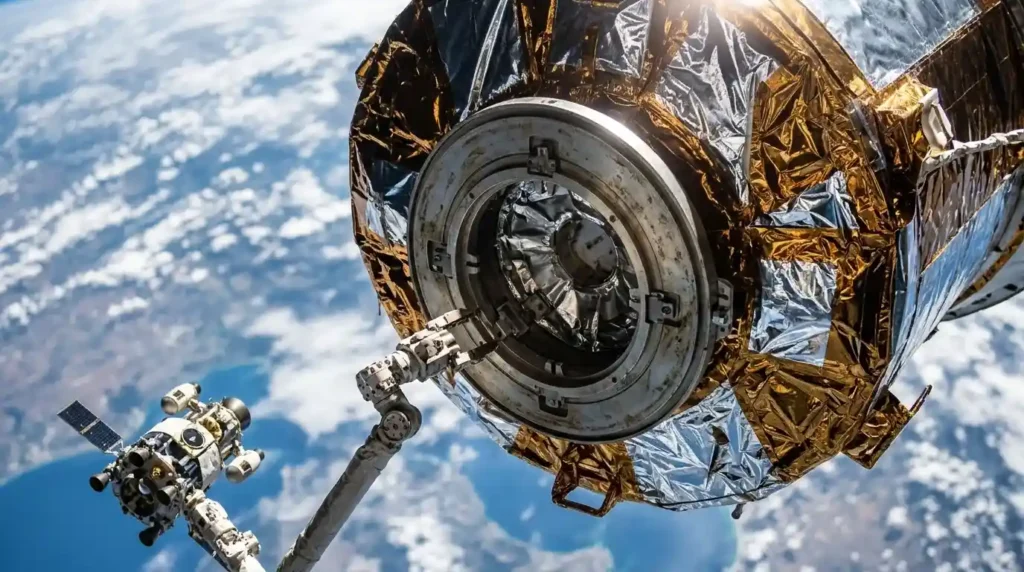
New Space Economy’s summary of that final mission lists the work: Wide Field Camera 3 and the Cosmic Origins Spectrograph installed, two instruments repaired, batteries, gyroscopes, a fine guidance sensor and a computer swapped, insulation added. It also describes the attachment device left behind for a future rendezvous and disposal. The Register calls that hardware an adapter left for a future visiting spacecraft, and notes that Hubble, unlike many satellites, was designed to be captured and serviced in orbit.
Every one of those five visits came by shuttle, with a crew.
Since 2009 nobody has touched it. The Register reports that Hubble moved to single-gyro operations in 2024, that three of its six gyros have failed, and that a fourth shows signs of wear. No crew has gone back to swap anything, and the hardware keeps aging anyway.
The 2022 study that went nowhere
SpaceX and the Polaris Program already asked this question once, for free
The RFI is not the first time a private company has offered to give Hubble a push. In 2022, NASA and SpaceX signed an unfunded Space Act Agreement to study whether a Dragon spacecraft could dock with Hubble and raise it to a higher orbit. SpaceX proposed the study together with the Polaris Program. NASA’s release set the study at up to six months, at no cost to the government, and put Hubble at about 335 miles up, in an orbit that was slowly decaying. It said a reboost “could add multiple years of operations” to the telescope’s life.
The same release drew a firm line: “There are no plans for NASA to conduct or fund a servicing mission or compete this opportunity.” The study was also non-exclusive, so other companies were free to propose their own.
The Register reports that Jared Isaacman mooted boosting Hubble in 2022 and that the idea was ultimately rejected. Isaacman is now NASA Administrator, and in this autumn’s announcement he says “Hubble still has important science ahead of it” and that NASA should look at cost-effective ways to extend its life. Nicky Fox, who leads NASA’s Science Mission Directorate, adds that commercial industry has advanced in capturing and servicing satellites in orbit, and that “we are eager to explore the breadth of possibilities to boost Hubble to a higher orbit” while NASA develops the flagship mission to follow it.
A man who once floated the job now runs the agency that would have to buy it. Nothing in the announcement says what that changes, and the RFI is still only a set of questions.
The fork, laid out
Three options in the RFI, side by side, with the gaps left showing
Each cell is drawn from a linked source, and where the sources are silent the cell says so.
| Raise the orbit (boost) | Service the telescope | Controlled re-entry or disposal | |
|---|---|---|---|
| What NASA’s RFI says it is | A mission to lift Hubble higher and extend its science life (NASA) | Work to enhance Hubble’s capabilities (NASA) | A safe, controlled re-entry, or disposal in orbit (NASA) |
| What it requires | A separate spacecraft, since Hubble has no propulsion (NASA); the 2022 concept had Dragon dock and move it (NASA 2022) | A visiting spacecraft that can do hands-on work; all five earlier servicing visits used the shuttle and astronauts (New Space Economy) | Something to attach to Hubble; SM4 left a device at its base to make de-orbiting easier (NASA GSFC) |
| What it would buy | “Multiple years of operations,” per the 2022 study release (NASA 2022) | Not quantified in any source fetched | A planned end instead of an uncontrolled fall; NASA has long said it plans to safely de-orbit or dispose of Hubble (NASA 2022) |
| Timeline | Mission needed by 2032 (NASA) | Same 2032 limit applies to any mission (NASA) | Before re-entry, which NASA puts at 2033–2034 and one outside analysis at as early as 2028 (The Register) |
| Known risks | The 2026 Swift boost attempt failed before capture (NASA); Hubble is on one gyro with three of six failed (The Register) | Same capture risk as a boost, plus whatever work is done on the hardware; no source fetched sizes it | Not described in any source fetched |
| Cost | No figure in NASA’s RFI announcement; the 2022 study itself cost the government nothing (NASA 2022) | No figure in any source fetched | No figure in any source fetched |
The blank spots in the table are the honest part of it. NASA’s announcement gives no cost for any option, says nothing about risk, and does not rank the three. That is what the responses due November 30 are for.
What happened to Swift
A $30 million robotic rescue launched in July and never reached the patient
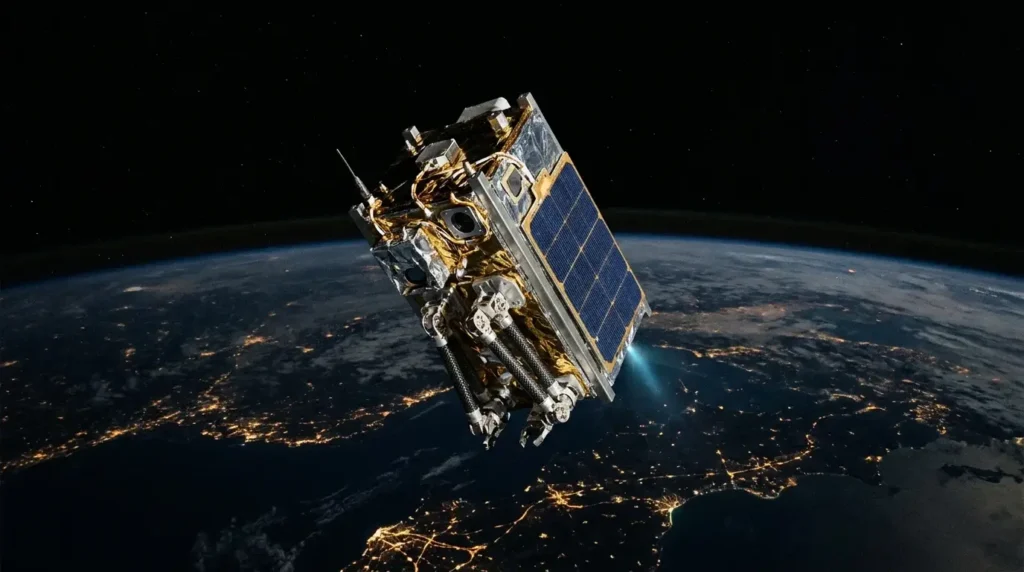
The strongest argument against reading too much hope into this RFI flew earlier this year, and it fell back down in September.
NASA’s Neil Gehrels Swift Observatory was dropping too fast for the same reason Hubble is, extra drag from an active Sun. On September 25, 2025, according to SpacePolicyOnline, NASA signed a $30 million contract with Katalyst Space to design, build and launch a robotic spacecraft called LINK that would grab Swift and lift it. LINK launched on a Pegasus XL on July 3, 2026, a little over nine months after the signing.
It never made the grab. NASA’s lessons-learned summary says LINK suffered intermittent communication losses and orientation-control problems once checkout began. The mission was cut back to technology demonstrations of the xenon thruster and three robotic arms, NASA ended its involvement on September 3, and LINK re-entered on September 25. NASA expects Swift itself to re-enter by the end of 2026. Katalyst’s Kieran Wilson told SpacePolicyOnline the trouble began with “an unresponsive RCS valve, causing the spacecraft to spin up”, followed by a failed power switch that cost the reaction wheels. The arms and electric thrusters worked.
Shawn Domagal-Goldman, director of NASA’s Astrophysics Division, called it “a high-risk, high-reward mission” from the start.
Optimists still have a real argument. Swift was never built to be caught; Hubble was, and it carries hardware left specifically for a visitor. A $30 million rush job learned things a larger Hubble effort could use. A fair reader can also turn that around: if a small, cheap, fast attempt could not dock with a satellite, the confident version of a Hubble rescue is still a sales pitch with no flight behind it. Both readings rest on the same single flight.
Money, and the clock under it
The RFI is silent on money, and a former NASA science chief is not
Hubble’s problems are not only orbital. John Grunsfeld, a former astronaut and retired associate administrator of NASA’s Science Mission Directorate, told The Register in 2025 that the telescope faced death by a thousand cuts, with Hubble’s funding already down about 30 percent once inflation is counted. NASA’s RFI announcement does not discuss money at all.
That leaves a strange arithmetic. A boost needs a spacecraft that does not exist yet, bought with money nobody has offered, flown by 2032 at the latest, to dock with a telescope that has been running on a single gyroscope since 2024. Disposal needs most of the same hardware and buys no science. Doing nothing is also a choice, and it ends with Hubble coming down wherever drag sends it, on no one’s schedule.
Hubble’s successors keep arriving in the meantime. The Nancy Grace Roman Space Telescope returned its first test image in September, and NASA’s announcement frames the Hubble question alongside work on the next flagship.
The handle at the base has been waiting since 2009. On November 30 the agency finds out who, if anyone, wants to reach for it, and for which of the three jobs. Which one would be worth the money?
Sources
- NASA Science, “NASA Explores Potential Commercial Servicing for Hubble Telescope” (Oct. 30, 2026; updated Nov. 3, 2026): https://science.nasa.gov/missions/hubble/nasa-explores-potential-commercial-servicing-for-hubble-telescope/
- The Register, “Hubble in a death spiral that could end as early as 2028 without a reboost” (Feb. 25, 2026): https://www.theregister.com/2026/02/25/hubble_orbit_decay/
- New Space Economy, “NASA Seeks Commercial Options for Hubble Servicing and Reboost” (Oct. 31, 2026): https://newspaceeconomy.ca/2026/10/31/nasa-seeks-commercial-options-for-hubble-servicing-and-reboost/
- NASA, “NASA, SpaceX to Study Hubble Telescope Reboost Possibility” (2022): https://www.nasa.gov/missions/hubble/nasa-spacex-to-study-hubble-telescope-reboost-possibility/
- NASA Science, “Missions to Hubble”: https://science.nasa.gov/mission/hubble/observatory/missions-to-hubble/
- NASA Goddard archive, “Servicing Mission 4”: https://asd.gsfc.nasa.gov/archive/hubble/missions/sm4.html
- NASA Science, “NASA Highlights Lessons Learned From Swift Boost Mission” (Sept. 28, 2026): https://science.nasa.gov/missions/swift/nasa-highlights-lessons-learned-from-swift-boost-mission/
- SpacePolicyOnline, “Swift Rescue Mission May Not Have Succeeded, But No Regrets” (Sept. 23, 2026): https://spacepolicyonline.com/news/swift-rescue-mission-may-not-have-succeeded-but-no-regrets/
- x9m8, “Orbit Lab: Kepler’s Laws, the Real Planets and a Hohmann Transfer to Mars”: https://x9m8.com/orbit-lab-kepler-laws-planets-hohmann-transfer-mars/
- x9m8, “Roman Space Telescope’s First Test Image: Why Green Rings Mean It Works”: https://x9m8.com/roman-space-telescope-first-test-image-green-rings/