Preprint, version 1 (October 2026). Not peer reviewed. This is the author’s manuscript, prepared for submission to a peer-reviewed journal. Download: PDF · Word · reproducibility package (zip) · code on GitHub with code, results and the two independent audits.
Cite as: Kalafatis, P. (2026). What chrome buys: A meta-analysis of paired chrome-free and chrome leather tests [Preprint]. x9m8.com. https://doi.org/10.5281/zenodo.23859817
Peter Kalafatis
Independent researcher, x9m8.com, New York, NY, USA. Correspondence: x9m8x7@gmail.com
Version 1, October 2026.
Abstract
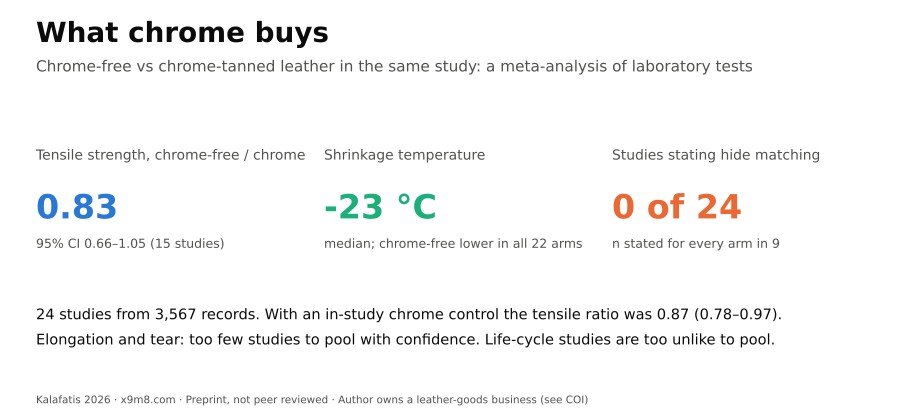
Chrome-free tanning is promoted as an alternative to basic chromium sulfate, but its cost in physical performance has not been estimated across studies. I searched OpenAlex and Europe PMC (3,567 records), screened 429 titles and abstracts, sought 185 reports and assessed 65 full texts. Twenty-four studies measured a chrome-free and a chrome-tanned leather with the same test in the same study. Only 15 reported usable tensile data, and fewer any other outcome. In a two-level random-effects model, chrome-free leather had 0.83 times the tensile strength of its chrome comparator (95% CI 0.66–1.05; 29 contrasts); 0.91 (0.81–1.03) without one study using an external chrome benchmark, and 0.87 (0.78–0.97) in the 12 studies that tanned their own chrome control. Elongation (1.04, 0.88–1.22) and tear load (0.93, 0.82–1.05) were pooled, against protocol, from fewer studies and were close to parity. Shrinkage temperature was lower in all 22 chrome-free arms, by a median of 23 °C, although in 21 of them the chrome value lay above the 100 °C range of ISO 3380 or was reported only as a lower bound. No study stated matched hides, nine stated the number of test pieces for every arm, and 11 of 24 tested their own agent. Life-cycle and effluent studies mostly favoured chrome-free routes but could not be pooled. The record supports a modest strength penalty and a clear thermal-stability penalty, not parity, and is too thin and loosely controlled for stronger claims.
Keywords: leather; chrome-free tanning; wet-white; vegetable tanning; chromium; tensile strength; shrinkage temperature; meta-analysis; life cycle assessment; systematic review
Social media summary: Chrome-free leather was less heat-stable in every paired test (median 23 °C); its strength was perhaps a little lower; the evidence is thin.
1. Introduction
Most leather is tanned with basic chromium sulfate. The trivalent chromium it leaves in leather can oxidise to hexavalent chromium, a skin sensitiser, and the European Union restricts hexavalent chromium in leather articles (Hedberg et al., 2014). Chrome tanning also leaves chromium in effluent, sludge and shavings. These are the main reasons tanners and brands have tried chrome-free systems: vegetable tannins, aldehydes such as glutaraldehyde, synthetic and triazine-based agents, silicates and zeolites, other mineral salts such as aluminium and zirconium, and combinations of these.
The trade-off is usually stated in general terms. Chrome-tanned leather is described as stronger, softer and more heat-stable, and chrome-free leathers are described as approaching it. Individual studies report whether a new agent “matches” chrome, but the comparisons are scattered across trade and regional journals, use different hides, units and test methods, and nearly half are written by the people who developed the agent being tested. A meta-analysis by Nugraha et al. (2025) pooled 13 studies of vegetable tanning, but its comparator was mimosa, a vegetable tannin, not chrome. Narrative reviews tabulate reported shrinkage temperatures and strengths across tanning systems, but without a systematic search or pooling (Hassan et al., 2023; Ding et al., 2025). To the author’s knowledge, no synthesis has pooled within-study contrasts between chrome-free and chrome-tanned leather.
This paper asks three questions. First, when a study tanned or tested a chrome-free leather and a chrome-tanned leather with the same methods, how did tensile strength, elongation at break, tear load and shrinkage temperature compare? Second, does the answer depend on the class of chrome-free agent or on how the comparison was set up? Third, what do the studies that measured both routes say about chemical hazards, effluent, life-cycle impacts and end-of-life behaviour? The first two questions were answered by meta-analysis where the data allowed it; the third by a structured narrative review, because those studies are too different to pool.
2. Methods
2.1 Protocol
The question, effect measures, censoring rules for shrinkage temperature, moderators and a threshold for pooling were set in a scoping brief dated 21 October 2026, before full-text extraction began. The brief stated that if fewer than about 15 studies gave extractable means with standard deviations for both arms on an outcome, that outcome would be downgraded to descriptive analysis. The protocol was not registered. Reporting follows PRISMA 2020 where it applies (Page et al., 2021).
2.2 Searches
OpenAlex was searched on 21–22 October 2026 with 12 free-text queries (the top 200 records of each were kept) and 10 Boolean title-and-abstract queries, one per class of chrome-free agent (glutaraldehyde, oxazolidine, THPS, zeolite and silicates, triazine, aluminium, zirconium and titanium, dialdehydes, syntans, vegetable tannins, and generic “chrome-free” or “wet-white” terms), each combined with leather, chrome or chromium, and a physical outcome term; all results of these were kept. Europe PMC was searched with three Boolean queries combining leather, chrome-free terms, chrome or chromium, and physical, chemical or environmental outcome terms. The exact query strings are in the reproducibility package. Records were deduplicated by DOI and, where a DOI was missing, by normalised title.
2.3 Eligibility and screening
A study was eligible if it reported, for leather from the same study, at least one of tensile strength, elongation at break, tear load or shrinkage temperature (Ts) for a chrome-free tanned leather and for a chrome-tanned leather, measured with the same method. “Chrome-free” was defined operationally as no chromium tanning or retanning agent, as declared by the authors. Semi-chrome and chrome-retanned arms were excluded. Studies were excluded if the comparator was another chrome-free leather, if the chrome values were taken from another publication, or if the chrome values were given only in a figure.
Screening had three stages. A rule-based pre-screen removed records whose title and abstract did not mention leather or tanning, chrome, a chrome-free agent and a physical outcome (records without an abstract were passed through). The remaining titles and abstracts were screened by hand against the criteria, and full texts of the included records were sought. Full texts were obtained from open-access sources only; closed-access articles were not retrieved. All screening and extraction were done by one reviewer (an AI system working under the author’s direction; see §2.10), with no duplicate screening.
2.4 Data extraction
For each chrome-free arm and outcome I recorded the mean, standard deviation (SD), number of test pieces (n) for both arms, the unit, the table or text location of each value, the agent and its class, the substrate, and the processing stage tested. Values were extracted only from text or tables that could be read; no value was read off a figure or estimated. Where a study gave the pooled standard error of the mean and n, the SD was derived (one study). Where a study gave the individual replicate values, means and SDs were computed from them (one study). Arms that could not be extracted are listed with reasons in the package: two vegetable arms of Gómez-García et al. (2026), whose results table was not captured in the retrieved copy, so only the mimosa arm was readable; tensile strength in Atinafu and Teferi (2026), reported as ranges; and a commercial agent in Qiao et al. (2025) whose composition was not stated. At study level I recorded whether n was stated, whether hide or side matching was stated, how the chrome comparator was obtained (tanned in the study; bought as commercial leather; or described as an external benchmark), and whether the authors had developed or optimised the chrome-free agent tested (“developer”). Chrome Ts values were coded as exact and within the 0–100 °C range of ISO 3380 (International Organization for Standardization [ISO], 2015), exact but above 100 °C (measured in a glycerol bath or similar), or reported only as a lower bound (for example “> 95 °C”).
Agents were grouped into seven classes: vegetable; aldehyde (glutaraldehyde, formaldehyde, dialdehyde polysaccharides, starch-based); synthetic (syntans, triazine derivatives, THPS, poly(carbamoyl sulfonate) and similar); combination (vegetable with a synthetic, aldehyde or mineral co-agent); zeolite or silicate; non-chrome metal; and other.
2.5 Effect measures
For tensile strength, elongation and tear load the effect measure was the log ratio of means, lnRR = ln(x̄CF/x̄Cr), with sampling variance SDCF²/(nCF x̄CF²) + SDCr²/(nCr x̄Cr²) (Hedges et al., 1999). The ratio is unit-free, so studies reporting kg/cm², N/mm² or psi could be combined, provided both arms of a study used the same unit. Results are reported as back-transformed ratios: 0.90 means the chrome-free leather scored 10% lower. When n was not stated it was set to 3, with sensitivity analyses at 2 and 5.
For Ts the planned measure was the raw mean difference in °C, because a ratio of Celsius values has no meaning. Only four studies (excluding a flagged study; §2.7) reported SDs for both arms, so Ts was analysed descriptively.
2.6 Statistical model
Several chrome-free arms in a study often shared one chrome control, and several studies reported more than one contrast. I fitted a two-level random-effects model with random effects for study and for contrast within study, estimated by restricted maximum likelihood. Arms compared with the same control were given a sampling covariance equal to the chrome part of their variance, SDCr²/(nCr x̄Cr²) (Lajeunesse, 2011). Confidence intervals used a t distribution with degrees of freedom equal to the number of studies minus one. Cluster-robust (CR1) standard errors by study were also computed (Hedges et al., 2010), but with an intercept-only model dominated by between-study variance they are close to the model-based errors by construction and are not an independent check; the small-sample CR2 correction named in the protocol was not applied. Heterogeneity is reported as the between-study standard deviation τ on the log scale and as a 95% prediction interval with t on the number of studies minus two (Riley et al., 2011); I² (Higgins & Thompson, 2002) is reported but is not informative here because several studies reported very small SDs. As a check on the model, study-level averages were also pooled with a conventional random-effects model (Paule–Mandel estimator).
Pre-specified moderators were the class of agent and developer status, fitted as meta-regressions in the same model. Hide matching, also pre-specified, could not be analysed because no study stated it. Small-study effects were examined by adding the standard error of each contrast as a moderator, an Egger-type test (Egger et al., 1997). Sensitivity analyses varied assumed n, added contrasts with SDs imputed from the median coefficient of variation of the outcome, removed the study that reported an SD of 0.00, restricted the analysis to studies that tanned their own chrome control, to studies not by developers, and to studies that stated n for every arm, removed the two studies whose chrome comparator was not tanned in the study and that sat at the extremes (Gómez-García et al., 2026; Aguilar et al., 2023) singly and together, and removed one study at a time. The developer moderator was refitted with in-study controls only and without those two studies. Subgroup and moderator results are exploratory.
2.7 Integrity screen
One included article (Atinafu & Teferi, 2026) contained phrases typical of text generated by a language model (“user’s anticipated benefits”, “the user’s enzyme-activated system”) and an unfilled template header. Its data were extracted but excluded from the primary analyses and used only in a sensitivity analysis.
Two other studies raised concerns of a different kind and were retained, with sensitivity analyses without them. Aguilar et al. (2023) was published twice, with the same title, authors and tables, in the same issue of the Journal of Pharmaceutical Negative Results (pp. 159–172 and 269–282), and neither printed DOI is registered; the second copy was treated as a duplicate report. Its replicate values are internally consistent (they reproduce the paper’s analysis of variance), so the concern is about the publication rather than the data, and it is marked ‡ in Table 2. Gómez-García et al. (2026) contains editing residue (a reference to “earlier drafts”, an implausible leather thickness of “70–80 mm”), but the values used here agree between its abstract and text and nothing suggests generated content, so it was not flagged. Venue quality was not otherwise assessed.
2.8 Deviations from protocol
Four departures from the scoping brief should be stated. First, elongation at break (12 studies) and tear load (8 studies) fell below the threshold of about 15 studies but were pooled and reported as exploratory rather than only described. Second, the brief’s other moderators (species or substrate, processing stage tested, and whether post-tanning was matched) were not analysed; with 8–15 studies per outcome and most cells holding one or two studies, they could not be estimated. Third, the brief’s risk-of-bias checklist was reduced to the items extracted here (n stated, SD reported, hide matching stated, comparator source, developer status); conditioning, sampling position and post-tanning matching were not coded. Fourth, contour-enhanced funnel plots were not drawn; only the Egger-type regression was run.
2.9 Narrative synthesis of chemical, effluent, life-cycle and end-of-life evidence
Studies found by the same searches, or listed in the scoping brief, that measured chromium-related chemistry, spent-liquor loads, life-cycle impacts, composting or biodegradation, or genotoxicity on both chrome and chrome-free leather or processes were tabulated with their design, method and reported result. Nothing was pooled. For each study the table states whether the extraction rests on the full text, the abstract, or a publisher abstract page.
2.10 Software, data and AI use
Analyses used Python 3.13 with pandas, NumPy, SciPy and statsmodels; figures used matplotlib. The study was carried out with the assistance of Claude (Anthropic; model claude-opus-5-5) in October 2026, which ran the searches, screened records, retrieved open-access full texts, extracted data, wrote and ran the analysis code, and drafted the text under the author’s direction. Every DOI cited was checked against Crossref (or DataCite) in October 2026; the DOI printed on Aguilar et al. (2023) is not registered, so that reference gives the article’s landing page. The author reviewed the work and takes full responsibility for it.
3. Results
3.1 Study flow and characteristics
The searches returned 3,567 records, 1,903 after deduplication (Table 1). The pre-screen removed 1,474, and 244 of the remaining 429 were excluded at title and abstract. Of 185 reports sought, 118 could not be obtained: 90 were closed access and 28 were listed as open access but could not be retrieved. Sixty-seven were retrieved, and one more was added from the scoping brief because its abstract did not mention a physical outcome. After removing two duplicate reports and one unreadable file, 65 full texts were assessed. Forty-one were excluded, 34 of them because there was no chrome-tanned control or no chrome-free arm; many compared a new agent with mimosa or a commercial chrome-free agent, and some had no control at all. Twenty-four studies were included.
The 24 studies were published between 1933 and 2026; 20 appeared in 2020 or later (Table 2). Six used sheepskin, five bovine hide, four goatskin and four did not state the species; the rest used calf, rabbit, chicken leg skin and two fish species. Eleven tested an agent their authors had developed or optimised. Nineteen tanned their own chrome control; four compared commercial leathers or a commercial chrome leather and one used a chrome leather described as an external benchmark. No study stated that the chrome-free and chrome leathers came from matched hides or sides. Nine stated the number of test pieces for every arm. Usable means with SDs for both arms were available from 15 studies for tensile strength, 13 for elongation, 9 for tear load and 5 for Ts, including the flagged study for the last three.
Table 1. Study flow (PRISMA 2020-style counts). Searches run 21–22 October 2026.
| Stage | Records or reports |
|---|---|
| Records identified (OpenAlex 2,385; Europe PMC 1,182) | 3,567 |
| Unique records after removing duplicates | 1,903 |
| Removed by rule-based pre-screen (no leather, chrome, chrome-free and physical-outcome terms in title or abstract) | 1,474 |
| Titles and abstracts screened | 429 |
| Excluded at title and abstract | 244 |
| Reports sought for full text | 185 |
| Not retrieved: closed access | 90 |
| Not retrieved: listed as open access but not obtained | 28 |
| Retrieved from the database screen | 67 |
| Added from another source (scoping brief; abstract lacked outcome terms) | 1 |
| Duplicate reports of an included study | 2 |
| Retrieved but not machine-readable | 1 |
| Full texts assessed for eligibility | 65 |
| Excluded: no chrome-tanned control arm, or no chrome-free arm | 34 |
| Excluded: chrome-arm values not reported numerically (figure only or absent) | 4 |
| Excluded: chrome values taken from another publication | 2 |
| Excluded: no eligible outcome | 1 |
| Studies included | 24 |
| With a usable mean ± SD contrast for tensile strength (with any contrast) | 15 (19) |
| With a usable mean ± SD contrast for elongation at break (with any contrast) | 13 (17) |
| With a usable mean ± SD contrast for tear load (with any contrast) | 9 (12) |
| With a usable mean ± SD contrast for shrinkage temperature (with any contrast) | 5 (9) |
Table 2. Included studies. Classes are those of the chrome-free agents (a leather tested in several directions counts once). Outcomes: TS tensile strength, E elongation at break, T tear load, Ts shrinkage temperature; outcomes in brackets have no SD for both arms. Comparator: how the chrome-tanned comparison leather was obtained. Developer: the authors developed or optimised the chrome-free system tested.
| Study | Substrate | Chrome-free arms (class) | Outcomes | Chrome comparator | n per arm stated | Developer |
|---|---|---|---|---|---|---|
| Evans (1933) | calf | 1 vegetable | [TS], [E] | commercial leathers | no | no |
| Chakraborty (2008) | unclear | 1 aldehyde | [TS], [E] | in-study | yes | yes |
| Hoch (2009) | rabbit | 2 vegetable; 1 synthetic; 1 combination | TS, E, T | in-study | yes | no |
| Valeika (2010) | bovine | 6 combination | [TS] | in-study | no | yes |
| Anggriyani (2020) | goat | 2 aldehyde | [T] | in-study | no | yes |
| Nasr (2020) | sheep | 2 vegetable | TS, E, T | in-study | yes | no |
| Uddin (2020) | goat | 1 aldehyde | TS, E, T, [Ts] | in-study | yes | no |
| Valeika (2020) | bovine | 1 synthetic | TS, Ts | in-study | no | no |
| Bielak (2022) | bovine | 1 aldehyde | TS, E | commercial leathers | yes | no |
| Cavali (2022) | fish (Arapaima gigas) | 1 vegetable | TS, E, T | in-study | yes | no |
| Huang (2022) | bovine | 1 other | [TS], [E], [T] | in-study | no | yes |
| Jia (2022) | bovine | 2 synthetic | TS, E, T, Ts | in-study | no | yes |
| Yorgancioglu (2022) | sheep | 3 synthetic; 2 vegetable; 1 aldehyde | [Ts] | in-study | no | no |
| Zhu (2022) | sheep | 1 aldehyde; 1 non-chrome metal | TS, E | in-study | no | yes |
| Aguilar (2023) ‡ | unclear | 2 zeolite/silicate | TS, E | commercial chrome leather | yes | yes |
| Jiang (2023) | unclear | 1 synthetic | [E] | in-study | no | yes |
| Girmay (2024) | sheep | 1 combination; 1 vegetable; 1 synthetic | TS, E, T, Ts | in-study | yes | yes |
| Rosiati (2024) | goat | 1 vegetable | TS, E, T | in-study | no | no |
| Fatama (2025) | chicken leg skin | 1 vegetable | TS, E, [T], [Ts] | in-study | no | no |
| Ferraris (2025) | unclear | 2 aldehyde; 2 vegetable; 1 synthetic; 1 zeolite/silicate; 1 non-chrome metal | [Ts] | commercial leathers | no | no |
| Qiao (2025) | sheep | 3 synthetic | TS, E, T | in-study | no | yes |
| Tian (2025) | goat | 1 vegetable | TS | in-study | yes | no |
| Atinafu (2026) † | sheep | 1 combination; 1 vegetable | E, T, Ts | in-study | no | yes |
| Gómez-García (2026) | fish (tilapia) | 1 vegetable | TS, Ts | external benchmark | partly | no |
‡ Same article published twice in the same issue of its journal; printed DOI not registered; retained in the primary analyses and reported without it (Table 3). † Article whose text contains phrases typical of generated text (for example, “user’s anticipated benefits” and “the user’s enzyme-activated system”) and a template page header; excluded from the primary analyses.
3.2 Tensile strength
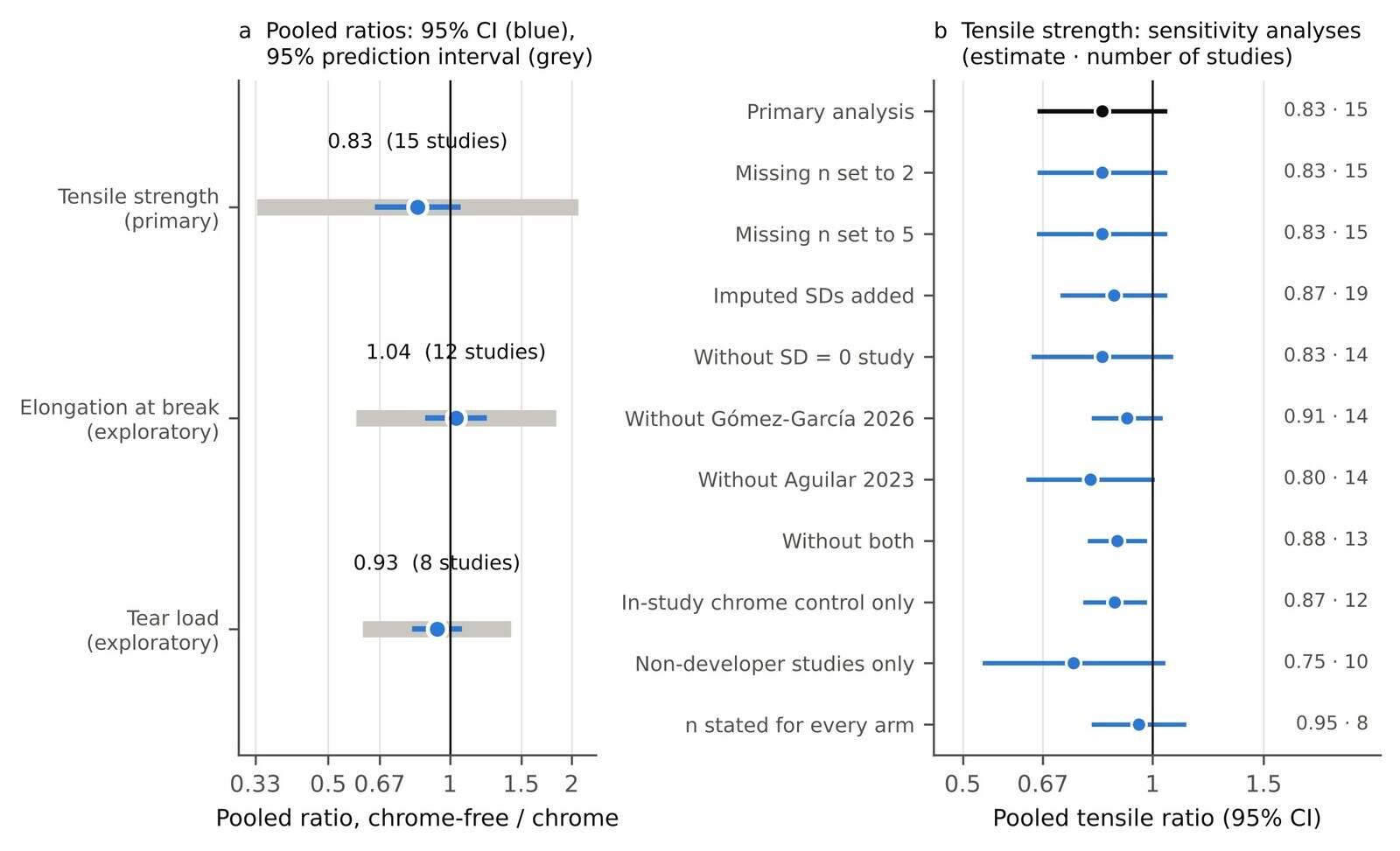
Fifteen studies gave 29 contrasts with SDs (Figure 1). The pooled ratio of chrome-free to chrome tensile strength was 0.83 (95% CI 0.66–1.05; p = 0.11; Table 3). Heterogeneity was large: τ between studies was 0.40 on the log scale, and the 95% prediction interval ran from 0.33 to 2.08. The two-stage check gave 0.83 (0.67–1.03). Tensile strength reached the pooling threshold of about 15 studies only with Gómez-García et al. (2026), which contributed one arm against an external chrome benchmark of unstated n; without it the ratio was 0.91 (0.81–1.03; 14 studies).
Two studies at the edges carried much of the heterogeneity, and both used a chrome comparator that was not tanned in the study. In tilapia leather, a mimosa-tanned arm had 0.22 times the tensile strength of a chrome-tanned industrial benchmark (5.8 vs 26.8 N/mm²; Gómez-García et al., 2026); the tara and quebracho arms of that study, reported in the text as about 9.1–9.2 N/mm², could not be extracted with their SDs. In a study whose chrome leather was supplied by a company, two silica-sol arms were 1.37 and 1.63 times as strong as the chrome leather (Aguilar et al., 2023); without this study the ratio was 0.80 (0.64–1.00; 14 studies), and without both studies 0.88 (0.80–0.97; 13 studies). Leaving out one study at a time gave ratios between 0.80 and 0.91. Restricting the analysis to the 12 studies that tanned their own chrome control gave 0.87 (0.78–0.97), with a much narrower prediction interval (0.59–1.28).
The result was insensitive to the assumed n (0.83 at both n = 2 and n = 5), to removing the study with an SD of 0.00 (0.83), and to adding four studies with imputed SDs (0.87, 0.72–1.05; 19 studies). In the eight studies that stated n for every arm it was 0.95 (0.81–1.12). Across all 38 tensile contrasts with means, including those without SDs, the chrome-free leather was weaker in 28.
By class, vegetable-tanned arms had a ratio of 0.75 (0.57–0.99; 8 studies), synthetic agents 0.77 (0.57–1.03; 5 studies) and aldehydes 0.98 (0.59–1.64; 3 studies); the remaining classes had one or two studies each (Table 3). Studies by developers of the tested agent reported ratios 1.36 times those of other studies (0.85–2.18), but this contrast rests on the two extreme studies above (a developer study with a commercial chrome comparator and a non-developer study with an external benchmark): with in-study chrome controls only it was 1.09 (0.86–1.37), and without those two studies 1.07 (0.86–1.33). The non-developer pooled ratio of 0.75 (0.54–1.04; 10 studies) likewise includes the tilapia study. There is no robust developer effect on tensile strength. The small-study test gave no clear signal (p = 0.70), with little power at this size.

Table 3. Pooled ratios of means (chrome-free / chrome) from the two-level random-effects model (REML; 95% CI with t on studies − 1 degrees of freedom; prediction interval with t on studies − 2). Tensile strength met the pre-set threshold for pooling (about 15 studies) only with Gómez-García (2026); elongation and tear did not, and pooling them is a deviation from the protocol (§2.8). Ratios below 1 mean the chrome-free leather scored lower.
| Analysis | Studies (contrasts) | Ratio | 95% CI | 95% prediction interval |
|---|---|---|---|---|
| Tensile strength, primary | 15 (29) | 0.83 | 0.66–1.05 | 0.33–2.08 |
| Elongation at break (exploratory) | 12 (26) | 1.04 | 0.88–1.22 | 0.59–1.83 |
| Tear load (exploratory) | 8 (19) | 0.93 | 0.82–1.05 | 0.61–1.42 |
| Tensile strength, sensitivity analyses | ||||
| Missing n set to 2 | 15 (29) | 0.83 | 0.66–1.05 | 0.33–2.07 |
| Missing n set to 5 | 15 (29) | 0.83 | 0.66–1.05 | 0.33–2.09 |
| Adding contrasts with imputed SDs (median CV) | 19 (38) | 0.87 | 0.72–1.05 | 0.38–2.00 |
| Without the study reporting an SD of 0.00 | 14 (27) | 0.83 | 0.65–1.07 | 0.32–2.19 |
| Without Gómez-García (2026; external chrome benchmark) | 14 (28) | 0.91 | 0.81–1.03 | 0.57–1.45 |
| Without Aguilar (2023; duplicate publication, commercial chrome) | 14 (27) | 0.80 | 0.64–1.00 | 0.33–1.92 |
| Without both of these studies | 13 (26) | 0.88 | 0.80–0.97 | 0.61–1.27 |
| Chrome control tanned in-study only | 12 (24) | 0.87 | 0.78–0.97 | 0.59–1.28 |
| Studies not by developers of the agent | 10 (17) | 0.75 | 0.54–1.04 | 0.25–2.23 |
| Studies stating n for every arm | 8 (18) | 0.95 | 0.81–1.12 | 0.58–1.56 |
| Leave one study out (range of ratios) | 14 each | 0.80–0.91 | ||
| Tensile strength by chrome-free class (meta-regression, cell means) | ||||
| Aldehyde | 3 (4) | 0.98 | 0.59–1.64 | |
| Combination | 2 (2) | 0.70 | 0.51–0.96 | |
| Non-chrome metal | 1 (1) | 0.95 | 0.54–1.66 | |
| Synthetic | 5 (8) | 0.77 | 0.57–1.03 | |
| Vegetable | 8 (12) | 0.75 | 0.57–0.99 | |
| Zeolite/silicate | 1 (2) | 1.54 | 0.62–3.81 | |
| Tensile strength, developer vs non-developer studies (ratio of ratios; exploratory) | ||||
| All studies | 5 vs 10 | 1.36 | 0.85–2.18 | |
| Chrome control tanned in-study only | 4 vs 8 | 1.09 | 0.86–1.37 | |
| Without Gómez-García and Aguilar | 4 vs 9 | 1.07 | 0.86–1.33 |
3.3 Elongation at break and tear load
Neither outcome reached the pooling threshold, so these estimates are exploratory (Table 3; Figure 2). For elongation at break, 12 studies gave 26 contrasts and a pooled ratio of 1.04 (0.88–1.22; prediction interval 0.59–1.83). The chrome-free leather stretched less in 14 of 30 contrasts with means. Developer studies reported higher elongation ratios than other studies (ratio of ratios 1.36, 1.04–1.79; 5 vs 7 studies), and this held with in-study controls only (1.41, 1.00–1.97); it is an exploratory finding from 12 studies. For tear load, 8 studies gave 19 contrasts and a pooled ratio of 0.93 (0.82–1.05; prediction interval 0.61–1.42); the chrome-free leather tore more easily in 13 of 23 contrasts. Adding the flagged study changed neither estimate materially (elongation 1.04; tear 0.91).
3.4 Shrinkage temperature
Eight studies reported Ts for 22 chrome-free arms and their chrome controls (Figure 3). Every chrome-free arm had a lower Ts than its control. The median difference was −23 °C (range −39 to −2.1 °C; median of study means −21.5 °C). Chrome-free Ts ranged from 62 to 95 °C. Chrome Ts ranged from 80 to 109.2 °C, and in 21 of the 22 arms the chrome value was either above 100 °C, beyond the scope of ISO 3380, or reported only as “> 95 °C”. The second case, all from one study of commercial leathers (Ferraris et al., 2025), understates the true gap. The arm median of −23 °C is used below; the median of study means, −21.5 °C, gives a similar picture. The only arm in which the chrome leather fell within the standard range was the tilapia study, where the chrome benchmark’s Ts was 80 °C against 77.9 °C for mimosa. The flagged study reported differences of −8 and −26 °C.

3.5 Chemical, effluent, life-cycle and end-of-life evidence
Thirteen studies compared chrome and chrome-free leathers or processes on these outcomes (Table 4).
Life-cycle assessment. Two LCAs compared routes using primary data from Italian tanneries. Daddi et al. (2025) found a metal-free synthetic-tannin route lower than chrome in particulate matter (−25%), non-carcinogenic and carcinogenic human toxicity (−31% and −56%) and acidification (−29%), and 18.4% lower on a single-score basis, with cattle breeding the largest contributor to several categories. Oliveira et al. (2024), according to the abstract, reported substantial reductions for the vegetable route, ranging from 20% in ozone depletion potential to 100% in human carcinogenic toxicity potential; tanning and retanning were the hotspot of the chrome route, and pickling, mainly liming, of the vegetable route. A pilot study of fish-skin tanning classed two chrome-free techniques as environmentally better than chrome on a set of indicators (Blas García et al., 2022). Three further LCA or physical-plus-environmental studies were identified but not retrieved (Reetz et al., 2026; Shi et al., 2016, 2024). The LCAs used different functional units, system boundaries and impact methods, and a review of the field found 39 LCA papers of four distinct types (Navarro et al., 2020), so their percentages cannot be combined.
Effluent. In one laboratory comparison the spent liquor of a triazine–vegetable system carried less chloride (about 3.2 vs 11.3 g/L), dissolved solids (8.5 vs 13.5 g/L) and COD (13.2 vs 19.7 g/L) than chrome, with a higher BOD5/COD ratio (0.35 vs 0.19) (Xiao et al., 2023); the chloride difference reflects in part the omission of the salt pickle, a process change rather than the tanning agent alone. An oxazolidine study reported the opposite for BOD/COD (Inbasekar et al., 2021). Soils around chrome tanneries in one Pakistani survey carried chromium well above background, those near vegetable tanneries did not (Tariq et al., 2009).
End of life. The direction depended on the test. Under anaerobic digestion, vegetable-tanned leather produced more gas than chrome-tanned leather (Dhayalan et al., 2007). Under intensive composting, wet-blue disintegrated in 31–35 days, while vegetable-tanned leather had only begun to degrade after 60 days and was not fully disintegrated at 90 (Pourrasoul Sardroudi et al., 2024). In the only respirometric test (ISO 20136), zeolite-tanned cow hide reached 91.0% of the biodegradation of pure collagen, a zeolite shoe-upper leather 74.4%, and chrome-tanned leather 0.5%; buried zeolite-tanned hide was also visibly more degraded than chrome- and aluminium-tanned hide (Esquerra-Resa et al., 2022). The zeolite leathers contained more than 12,000 mg/kg aluminium. In addition, a composting comparison of six tannages found all degraded at different rates (Constantinescu et al., 2015). Used as fertiliser after hydrolysis, wet-white and wet-blue residues released similar nitrogen, and the chromium from wet-blue was not bioavailable to tomato plants (Ciurli et al., 2025).
Chemical hazards in the leather. Chrome-free leathers are not chromium-free in a strict sense: commercial zeolite- and aluminium-tanned leathers were reported to contain 111.73 and 53.72 mg/kg total chromium (Ferraris et al., 2025). These figures should be read with caution, because the same table gives the chrome-tanned wet-blue only 2.965 mg/kg, which suggests a unit inconsistency in the source. In a pilot comet assay on HepG2 cells, leather pieces from all three tannages caused primary DNA damage, most after vegetable tanning, then synthetic, then chrome (Ercegović Ražić et al., 2022).
Table 4. Chemical, effluent, life-cycle and end-of-life evidence from studies that measured chrome and chrome-free leather or processes in the same study. Results are as reported by the authors; nothing was pooled. “Source read” states what the extraction rests on.
| Domain | Study | Comparison | Method | Reported result | Source read |
|---|---|---|---|---|---|
| LCA | Daddi et al. 2025 | metal-free synthetic-tannin tanning vs chrome tanning | 1 m2 finished leather; SimaPro 9.4; Ecoinvent; midpoint categories and single score | metal-free route lower: particulate matter -25%, human toxicity non-carcinogenic -31%, carcinogenic -56%, acidification -29%; single score -18.4%; cattle breeding the largest contributor to several categories | abstract |
| LCA | Oliveira et al. 2024 | vegetable vs chrome route | ReCiPe midpoint (hierarchist) | substantial reductions for the vegetable route, ranging from 20% (ozone depletion potential) to 100% (human carcinogenic toxicity potential); chrome hotspot tanning/retanning; vegetable hotspot pickling, mainly liming | abstract (institutional repository record) |
| Environmental indicators | Blas García et al. 2022 | two chrome-free techniques vs chrome | environmental performance indicators with grey clustering | both chrome-free techniques classed better than chrome; best (phenolic) technique per 1000 kg skin: 30.0 m3 water, 2022.7 kWh energy, 105.5 kg solid waste, chromium not detectable in wastewater | abstract |
| Effluent | Xiao et al. 2023 | triazine derivative + vegetable tannin vs chrome | spent tanning liquor analysis | approximate values (g/L), chrome-free vs chrome: chloride 3.2 vs 11.3; TDS 8.5 vs 13.5; COD 13.2 vs 19.7; BOD5 4.6 vs 3.8; BOD5/COD 0.35 vs 0.19; the chrome-free process also omitted the NaCl pickle | full text (Table 3) |
| Effluent | Inbasekar et al. 2021 | oxazolidine + polyallylamine vs chrome | spent liquor BOD/COD | BOD/COD ratio of the oxazolidine process reported as relatively lower than chrome tanning | abstract |
| Biodegradability | Esquerra-Resa et al. 2022 | zeolite-based tannage vs chrome and aluminium (burial) | burial in compost (photographs); ISO 20136 respirometry | zeolite-tanned cow hide visibly more degraded than chrome- and aluminium-tanned hide after burial; ISO 20136 relative biodegradability vs collagen: 91.0% zeolite-tanned cow hide, 74.4% shoe-upper retannage, 0.5% chrome-tanned leather; zeolite leathers contained >12000 mg/kg aluminium | full text |
| Biodegradability | Constantinescu et al. 2015 | vegetable; oxazolidine; resorcinol-oxazolidine; Cr(III); Ti-Al; Ti-Zr | EN ISO 20200; 90/120/220 days | all leathers biodegraded at different rates; oxazolidine- and vegetable-tanned more biodegradable than resorcinol-oxazolidine; abstract gives no single chrome vs chrome-free figure | full text and abstract |
| Biodegradability | Dhayalan et al. 2007 | vegetable vs chrome-tanned leather | biogas production | vegetable-tanned leather produced more gas than chrome-tanned leather | abstract |
| Biodegradability | Pourrasoul Sardroudi et al. 2024 | wet-blue vs vegetable-tanned bovine leather and alternatives | disintegration under composting | wet-blue fully degraded after 31-35 days; vegetable-tanned leather showed first degradation after 60 days and was not fully disintegrated at 90 days | abstract |
| Soil and fertiliser | Ciurli et al. 2025 | hydrolysates of wet-white vs wet-blue leather as fertiliser | N release; soil indicators; Cr bioavailability | both released 40-45% of total N in 42 days; DTPA-extractable Cr increased but stayed low in wet-blue-treated soil; Cr not bioavailable to tomato in either | abstract |
| Effluent and soil | Tariq et al. 2009 | chrome tanning cluster vs vegetable tanning cluster | metals in effluents and nearby soils | Cr in soils near chrome tanneries well above background; near vegetable tanneries close to background | abstract |
| Chemical (Cr in leather) | Ferraris et al. 2025 | chrome (wet blue) vs seven chrome-free leathers | ISO 17075-2 Cr(VI); ISO 17072-2 metals | Cr(VI) table entry <3.0 mg/kg; total Cr as reported in nominally chrome-free leathers up to 111.73 mg/kg (zeolite) and 53.72 mg/kg (aluminium); the same row gives the wet-blue leather 2.965 mg/kg, which looks internally inconsistent (possible unit error in the source) | full text (Table 1) |
| Chemical (genotoxicity) | Ercegović Ražić et al. 2022 | vegetable, synthetic and chrome-tanned bovine leather | alkaline comet assay after 24 h exposure | all tanned leathers caused primary DNA damage vs untreated cells; highest after vegetable tanning, then synthetic, then chrome | full text and abstract |
4. Discussion
4.1 What the evidence supports
Three findings are reasonably secure. Chrome-free leathers in this literature have a lower shrinkage temperature than their chrome controls, by a median of 23 °C, and the true gap is probably larger because many chrome values were capped by the test. In tensile strength, chrome-free leather was weaker on average; the pooled estimate was 17% lower, and 13% lower in the more trustworthy studies that tanned their own chrome control, where the confidence interval excluded parity. And the gap between agents and between studies is large enough that any single study could show the chrome-free leather stronger or much weaker.
What the evidence does not support is just as clear. It does not show that chrome-free leather “matches” chrome in strength, the common claim in developer papers: the pooled ratios for tensile strength and tear load were both below 1, and parity sat at the upper edge of their confidence intervals. Nor does it show a large, general strength penalty: elongation was at parity, tear load close to it, and aldehyde-tanned leathers close to chrome in tensile strength. For elongation and tear the data are too thin to say more.
The developer question, the main bias concern raised before the review began, is not settled by these data. An apparent tensile advantage in developer studies disappeared once the two studies with non-standard chrome comparators were set aside (ratio of ratios 1.07–1.09, with intervals spanning 1). For elongation, developer studies did report higher ratios, and this held with in-study controls, which is what one would expect if new agents are tuned until they look good against a chrome control; it could also reflect real differences, since developer papers test newer chemistries. With four or five developer studies per outcome, this is exploratory.
4.2 Why the evidence is thin
The literature is large, but very little of it answers this question. Of 65 full texts, 34 had no chrome-tanned control or no chrome-free arm. Most papers on new tanning agents compare them with mimosa, a commercial chrome-free agent, or a standard value, rather than with chrome. Of the 24 included studies, only 15 reported SDs for both arms on tensile strength. None stated that the leathers came from matched hides or sides, so hide-to-hide variation is mixed into every contrast. Only nine stated n for every arm. Ts was measured beyond the range of its standard in most chrome controls. And 118 of the 185 eligible-looking reports could not be retrieved, many from the Journal of the American Leather Chemists Association and the Journal of the Society of Leather Technologists and Chemists, which carry much of the field’s laboratory work. The included studies are therefore the open-access part of a literature whose closed part may differ.
For the environmental questions the problem is different: the studies exist but are not comparable. The two LCAs with primary data both favour chrome-free routes, by margins that depend on the impact category. Daddi et al. (2025) found cattle breeding the largest contributor to several categories, which limits what any tanning change can achieve in those categories; Oliveira et al. (2024) found the tanning stage the hotspot of the chrome route and liming the main contributor in the vegetable route, with reductions up to 100% in one category. Biodegradation results reverse with the method and the leather, from wet-blue disintegrating faster than vegetable-tanned leather under composting, to vegetable-tanned leather producing more biogas under anaerobic digestion, to zeolite-tanned leather far outperforming chrome in the one respirometric test. A trace of chromium can remain in chrome-free leather, and vegetable and synthetic tannages are not free of their own hazards; the comet-assay finding is a single in vitro pilot study, but it is a reminder that “chrome-free” is not a synonym for “non-toxic”.
4.3 What would help
Primary studies would be more useful if they tanned a chrome control from matched halves of the same hides, stated n and reported SDs, measured Ts in a medium that does not cap the chrome value (and said which), and reported the full set of standard physical tests rather than a selection. Independent replications of promising agents, by groups that did not develop them, would address the developer pattern directly. For environmental outcomes, an LCA that holds the functional unit, system boundary and hide supply constant and varies only the tanning stage would answer the question that the existing studies do not.
4.4 Limitations
One reviewer, an AI system under the author’s direction, screened and extracted, with no duplicate review, so some eligible studies may have been missed or misclassified. The rule-based pre-screen could have excluded eligible records whose abstracts lacked the search terms; one such study was found through the scoping brief. More than half of the reports sought were not retrieved, and the review covers only open-access full texts. Missing n was imputed, although the results did not depend on the choice. Tensile strength reached the pooling threshold only through one study with an external chrome comparator, from which only one of three arms could be extracted; without it the confidence interval still included parity. One retained study is a duplicate publication with an unregistered DOI. Several protocol items were not carried out (§2.8). Different directions of cut, processing stages and test standards were combined; the ratio measure removes units but not these differences. The chrome comparator in five studies was not tanned in the study, and in one it was described as an external benchmark. The study-level moderators, especially developer status, rest on few studies and are exploratory. The protocol was written before extraction but was not registered. Several rows of Table 4 rest on abstracts rather than full texts. Finally, the author has a commercial interest in leather (see Conflicts of interest).
5. Conclusion
In published laboratory comparisons, chrome-free leather was about 9–17% weaker in tension than chrome-tanned leather, depending on which comparisons are trusted, close to it in elongation and tear load, and a median of 23 °C less heat-stable. The comparisons are few and poorly controlled, and nearly half were written by the developers of the chrome-free agents. Life-cycle studies with primary data favour chrome-free routes, but no two are comparable. A claim that chrome-free leather performs like chrome leather, or that it is far weaker, goes beyond what this literature can support.
Related on x9m8
- Fewer Alerts, Same Allergy: Hexavalent Chromium in EU Leather Goods, 2005–2026
- Leather’s carbon bill follows the hide price, not the cow
- Where the cattle were raised: tracing the deforestation in EU leather use, 2005–2023
Acknowledgements
The author thanks the authors of the included studies, OpenAlex and Europe PMC. Claude (Anthropic; model claude-opus-5-5) assisted with searching, screening, data extraction, analysis code and drafting in October 2026, as described in §2.10. The author reviewed all outputs and is responsible for the content.
Author contributions
P.K. conceived the study, directed the review and analysis, and reviewed and approved the manuscript.
Financial support
This research received no specific grant from any funding agency, commercial or not-for-profit sector.
Conflicts of interest
The author owns Marcellino NY, which designs and makes leather briefcases and buys finished leather, and so has a commercial interest in how chrome-tanned and chrome-free leathers are perceived. The author also operates a restaurant (The Heritage Diner). The author declares no other competing interests. No supplier, tannery or brand was consulted or informed of the results before posting.
Research transparency and reproducibility
The extraction sheets (with the table or text location of every value), the full-text screening log, the analysis code and the result files are in the reproducibility package linked from the article page. The search exports and the full texts of included studies are not redistributed because they contain publishers’ abstracts and articles; the package lists the queries, DOIs and source URLs needed to rebuild them.
References
Aguilar, J. E., Chariguaman Maurisaca, N. E., & Mejia Peñafiel, E. F. (2023). Determination of the best treatment for the tannery industry using sodium silicate (Na2SiO3) with sulfuric acid (H2SO4). Journal of Pharmaceutical Negative Results, 14(Special Issue 2), 159–172. https://pnrjournal.com/index.php/home/article/view/6619 (The DOI printed on the article, 10.47750/pnr.2023.14.S02.23, was not registered as of October 2026; the same article also appears at pp. 269–282 of the same issue.)
Anggriyani, E., Rachmawati, L., & Adetya, N. P. (2020). Development of processes in the use of peroxide as an ingredient to reduce free formaldehyde levels in the skin. Leather and Footwear Journal, 20(2), 153–160. https://doi.org/10.24264/lfj.20.2.6
Atinafu, W. W., & Teferi, T. A. (2026). Bio-inspired dual crosslinking of collagen using ellagic acid–chitosan for sustainable chrome-free tanning. World Journal of Advance Multidisciplinary Research, 3(3), 13–20 [journal name as on the masthead; the footer gives “Advanced”]. Archived on Zenodo. https://doi.org/10.5281/zenodo.19131211
Bielak, E., & Zielińska, G. (2022). Comparison and assessment of selected parameters of chrome-free and chrome-tanned leather. Leather and Footwear Journal, 22(1), 3–16. https://doi.org/10.24264/lfj.22.1.1
Blas García, J., Marrufo Saldaña, L., & Barra Hinojosa, J. (2022). Evaluation of environmental performance of chrome-free tanning techniques of paiche skins (Arapaima gigas). Journal of Ecological Engineering, 23(10), 11–24. https://doi.org/10.12911/22998993/151783
Cavali, J., de Souza, M. L. R., Kanarski, P. S. de O., Coradini, M. F., & Dantas Filho, J. V. (2022). Tanned leather of the paiche Arapaima gigas Schinz, 1822 (Arapaimidae) with extracts of vegetable origin to replace chromium salts. PLOS ONE, 17(1), e0261781. https://doi.org/10.1371/journal.pone.0261781
Chakraborty, D., Quadery, A. H., & Azad, M. A. K. (2008). Studies on the tanning with glutaraldehyde as an alternative to traditional chrome tanning system for the production of chrome free leather. Bangladesh Journal of Scientific and Industrial Research, 43(4), 553–558. https://doi.org/10.3329/bjsir.v43i4.2246
Ciurli, A., Di Biase, G., Ciavatta, C., & Cavani, L. (2025). Organic fertilizers obtained from metal-free and chromium tanned leather: Evaluation of nitrogen release and the effects on the soil microbiome. Journal of Environmental Chemical Engineering, 13(5), 118990. https://doi.org/10.1016/j.jece.2025.118990
Constantinescu, R. R., Deselnicu, V., Crudu, M., Macovescu, G., & Albu, L. (2015). Comparative study regarding leather biodegradability. Leather and Footwear Journal, 15(2), 73–84. https://doi.org/10.24264/lfj.15.2.2
Daddi, T., Ahmad, S., & Albano, F. (2025). Fostering environmental sustainability of leather industry: Environmental impact assessment and improvement prospects for leather-tanning technologies. Environmental Science and Pollution Research, 32(54), 29995–30012. https://doi.org/10.1007/s11356-024-35625-4
Dhayalan, K., Fathima, N. N., Gnanamani, A., Rao, J. R., Nair, B. U., & Ramasami, T. (2007). Biodegradability of leathers through anaerobic pathway. Waste Management, 27(6), 760–767. https://doi.org/10.1016/j.wasman.2006.03.019
Ding, W., Remón, J., & Jiang, Z. (2025). Environmentally-friendly tanning for leather production: A review. Environmental Chemistry Letters, 23(3), 839–864. https://doi.org/10.1007/s10311-025-01827-6
Egger, M., Davey Smith, G., Schneider, M., & Minder, C. (1997). Bias in meta-analysis detected by a simple, graphical test. BMJ, 315(7109), 629–634. https://doi.org/10.1136/bmj.315.7109.629
Ercegović Ražić, S., Kopjar, N., Kašuba, V., Skenderi, Z., Akalović, J., & Hrenović, J. (2022). Evaluation of DNA-damaging effects induced by different tanning agents used in the processing of natural leather—Pilot study on HepG2 cell line. Molecules, 27(20), 7030. https://doi.org/10.3390/molecules27207030
Esquerra-Resa, S., Esquerra-Dot, S., Garcia, A., Moreno, À., Mir, T., & Bacardit, A. (2022). Study of the biodegradability of leather tanned with sodium aluminosilicate. Journal of the American Leather Chemists Association, 117(6), 251–261. https://doi.org/10.34314/jalca.v117i6.4966
Evans, W. D., & Critchfield, C. L. (1933). The effects of atmospheric moisture on the physical properties of vegetable and chrome tanned calf leathers. Bureau of Standards Journal of Research, 11(1), 147–162. https://doi.org/10.6028/jres.011.013
Fatama, K., Alam, M. N. E., Akter, N., Tamanna, A., Hossain, M. K., Chowdhury, F., Azad, M. A. K., Saha, M. S., & Chakma, S. (2025). Exotic leather from broiler chicken leg skin: Processing and characterization. Bangladesh Journal of Scientific and Industrial Research, 60(4), 287–296. https://doi.org/10.3329/bjsir.v60i4.83796
Ferraris, S., Gamna, F., Luxbacher, T., Maculotti, G., Giorio, L., Kholkhujaev, J., Genta, G., Galetto, M., Sarnataro, A., Nogarole, M., & Florio, C. (2025). Comparative characterization of leather from different tanning processes as a contribution for a sustainable development of the leather industry. Scientific Reports, 15, 10608. https://doi.org/10.1038/s41598-025-94531-y
Girmay, H., Mengistu, A., Assefa, B., Abewaa, M., Andualem, G., & Yeheyis, B. (2024). The development of chrome free chestnut and tetrakis hydroxymethyl phosphonium sulfate based eco-benign combination tanning system. Heliyon, 10(1), e23141. https://doi.org/10.1016/j.heliyon.2023.e23141
Gómez-García, H. C., Alonso-Romero, S., Quiroz-Ramírez, J. J., Aguilera-Navarrete, I., & Medina-Torres, L. (2026). Comparative evaluation of metal-free vegetable tanning for tilapia leather using a DOE–QFD–FMEA framework toward cleaner production. Journal of Natural Fibers, 23(1), 2724460. https://doi.org/10.1080/15440478.2026.2724460
Hassan, M. M., Harris, J., Busfield, J. J. C., & Bilotti, E. (2023). A review of the green chemistry approaches to leather tanning in imparting sustainable leather manufacturing. Green Chemistry, 25(19), 7441–7469. https://doi.org/10.1039/d3gc02948d
Hedberg, Y. S., Lidén, C., & Odnevall Wallinder, I. (2014). Correlation between bulk- and surface chemistry of Cr-tanned leather and the release of Cr(III) and Cr(VI). Journal of Hazardous Materials, 280, 654–661. https://doi.org/10.1016/j.jhazmat.2014.08.061
Hedges, L. V., Gurevitch, J., & Curtis, P. S. (1999). The meta-analysis of response ratios in experimental ecology. Ecology, 80(4), 1150–1156. https://doi.org/10.1890/0012-9658(1999)080[1150:TMAORR]2.0.CO;2
Hedges, L. V., Tipton, E., & Johnson, M. C. (2010). Robust variance estimation in meta-regression with dependent effect size estimates. Research Synthesis Methods, 1(1), 39–65. https://doi.org/10.1002/jrsm.5
Higgins, J. P. T., & Thompson, S. G. (2002). Quantifying heterogeneity in a meta-analysis. Statistics in Medicine, 21(11), 1539–1558. https://doi.org/10.1002/sim.1186
Hoch, A. L. V., do Prado, M., Franco, M. L. R. de S., Scapinello, C., Franco, N. do P., & Gasparino, E. (2009). Ação de diferentes agentes curtentes utilizados no curtimento de peles de coelhos: Testes físico-mecânicos dos couros [Action of different tanning agents used in tanning rabbit skins: Physical-mechanical tests of the leathers]. Acta Scientiarum. Animal Sciences, 31(4), 411–415. https://doi.org/10.4025/actascianimsci.v31i4.5592
Huang, Y., Xiao, H., Pu, H., Xue, N., Hao, B., Huang, X., & Shi, B. (2022). Self-driven directional dehydration enabled eco-friendly manufacture of chrome-free leather. Journal of Leather Science and Engineering, 4, 17. https://doi.org/10.1186/s42825-022-00089-0
Inbasekar, C., Rao, J. R., & Fathima, N. N. (2021). Strategizing the development of a metal- and formaldehyde-free tanning process using (3,5-dimethyl-1H,3H,5H-oxazolo[3,4-c]oxazol-7a(7H)-yl) methanol heterocyclic derivative oxazolidine and polyallylamine. ACS Sustainable Chemistry & Engineering, 9(44), 15053–15062. https://doi.org/10.1021/acssuschemeng.1c06091
International Organization for Standardization. (2015). Leather — Physical and mechanical tests — Determination of shrinkage temperature up to 100 °C (ISO Standard No. 3380:2015).
Jia, X., Tan, R., & Peng, B. (2022). Synthesis of multi-site polyether amine triazine derivative for sustainable leather manufacturing. Journal of the American Leather Chemists Association, 117(4), 141–152. https://doi.org/10.34314/jalca.v117i4.4897
Jiang, M., Xiao, Y., Sang, J., Wang, C., Zhou, J., & Lin, W. (2023). Biomass-based tanning agent for sustainable leather manufacture via cyanuric chloride modified chitooligosaccharide. Journal of the American Leather Chemists Association, 118(10), 417–427. https://doi.org/10.34314/jalca.v118i10.8230
Lajeunesse, M. J. (2011). On the meta-analysis of response ratios for studies with correlated and multi-group designs. Ecology, 92(11), 2049–2055. https://doi.org/10.1890/11-0423.1
Nasr, A. I., Azzam, A. H., & Abdelsalam, M. M. (2020). Evaluation Abu-Dleek sheep leathers properties. International Journal of Zoology and Animal Biology, 3(1), 1–3. https://doi.org/10.23880/izab-16000201
Navarro, D., Wu, J., Lin, W., Fullana-i-Palmer, P., & Puig, R. (2020). Life cycle assessment and leather production. Journal of Leather Science and Engineering, 2, 26. https://doi.org/10.1186/s42825-020-00035-y
Nugraha, A. W., Afifah, A., Satria, B. P., & Jayanegara, A. (2025). The mechanical and physical properties of leather tanned by vegetable tannin: A meta-analysis study. Jurnal Teknologi Industri Pertanian, 35(3), 271–285. https://doi.org/10.24961/j.tek.ind.pert.2025.35.3.271
Oliveira, M., Zucaro, A., Passaro, R., & Ulgiati, S. (2024). Life cycle assessment of leather treatment at various scales: Comparison between chrome and vegetable processes. The International Journal of Life Cycle Assessment, 29(2), 153–173. https://doi.org/10.1007/s11367-023-02232-3
Page, M. J., McKenzie, J. E., Bossuyt, P. M., Boutron, I., Hoffmann, T. C., Mulrow, C. D., Shamseer, L., Tetzlaff, J. M., Akl, E. A., Brennan, S. E., Chou, R., Glanville, J., Grimshaw, J. M., Hróbjartsson, A., Lalu, M. M., Li, T., Loder, E. W., Mayo-Wilson, E., McDonald, S., … Moher, D. (2021). The PRISMA 2020 statement: An updated guideline for reporting systematic reviews. BMJ, 372, n71. https://doi.org/10.1136/bmj.n71
Pourrasoul Sardroudi, N., Sorolla, S., Casas, C., & Bacardit, A. (2024). A study of the composting capacity of different kinds of leathers, leatherette and alternative materials. Sustainability, 16(6), 2324. https://doi.org/10.3390/su16062324
Qiao, P., Liu, J., Jin, L., Zhang, F., Feng, Z., & Wang, Y. (2025). Ecofriendly and sustainable metal-free leather tanning using novel poly(carbamoyl sulfonate) technology. Collagen and Leather, 7, 9. https://doi.org/10.1186/s42825-025-00190-0
Reetz, I., Izquierdo, F., Baquero, G., & Bacardit, A. (2026). Zeolite versus other tanning systems: A life cycle and end-of-life perspective. Cleaner Engineering and Technology, 30, 101124. https://doi.org/10.1016/j.clet.2025.101124
Riley, R. D., Higgins, J. P. T., & Deeks, J. J. (2011). Interpretation of random effects meta-analyses. BMJ, 342, d549. https://doi.org/10.1136/bmj.d549
Rosiati, N. M., Rachmawati, L., & Udkhiyati, M. (2024). Characteristic of chrome-tanned and vegetable-tanned goat garment leathers. Jurnal Peternakan, 21(2), 284–294. https://doi.org/10.24014/jupet.v21i2.28919
Shi, J., Puig, R., Sang, J., & Lin, W. (2016). A comprehensive evaluation of physical and environmental performances for wet-white leather manufacture. Journal of Cleaner Production, 139, 1512–1519. https://doi.org/10.1016/j.jclepro.2016.08.120
Shi, J., Sheng, L., Salmi, O., Masi, M., & Puig, R. (2024). Life cycle assessment insights into nanosilicates-based chrome-free tanning processing towards eco-friendly leather manufacture. Journal of Cleaner Production, 434, 139892. https://doi.org/10.1016/j.jclepro.2023.139892
Tariq, S. R., Shah, M. H., & Shaheen, N. (2009). Comparative statistical analysis of chrome and vegetable tanning effluents and their effects on related soil. Journal of Hazardous Materials, 169(1–3), 285–290. https://doi.org/10.1016/j.jhazmat.2009.03.093
Tian, G. (2025). Research on the acoustic properties and sustainable development path of plant tanned leather in musical instrument manufacturing. Textile & Leather Review, 8, 1060–1073. https://doi.org/10.31881/tlr.2025.1060
Uddin, M. M., Hasan, M. J., Mahmud, Y., Tuj-Zohra, F., & Ahmed, S. (2020). Evaluating suitability of glutaraldehyde tanning in conformity with physical properties of conventional chrome-tanned leather. Textile & Leather Review, 3(3), 135–145. https://doi.org/10.31881/tlr.2020.09
Valeika, V. (2020). Low-pickle processing of leather: Assessment of leather tanning quality by methods of thermal analysis. Materials Science (Medžiagotyra), 26(3), 333–336. https://doi.org/10.5755/j01.ms.26.3.22509
Valeika, V., Širvaitytė, J., & Beleška, K. (2010). Estimation of chrome-free tanning method suitability in conformity with physical and chemical properties of leather. Materials Science (Medžiagotyra), 16(4), 330–336. https://doi.org/10.5755/j02.ms.26095
Xiao, Y., Zhou, J., Wang, C., Zhang, J., Radnaeva, V. D., & Lin, W. (2023). Sustainable metal-free leather manufacture via synergistic effects of triazine derivative and vegetable tannins. Collagen and Leather, 5, 2. https://doi.org/10.1186/s42825-022-00108-0
Yorgancioglu, A., Onem, E., Yilmaz, O., & Karavana, H. A. (2022). Interactions between collagen and alternative leather tanning systems to chromium salts by comparative thermal analysis methods. Johnson Matthey Technology Review, 66(2), 215–226. https://doi.org/10.1595/205651322X16225583463559
Zhu, H., Liu, H., Tang, K., Liu, J., Zheng, X., Pei, Y., & Zhong, J. (2022). Optimization of dialdehyde soluble soybean polysaccharide: Preparation by response surface methodology for cleaner leather tanning. RSC Advances, 12(12), 7506–7515. https://doi.org/10.1039/d2ra00222a




[…] What chrome buys: a meta-analysis of paired chrome-free and chrome leather tests […]