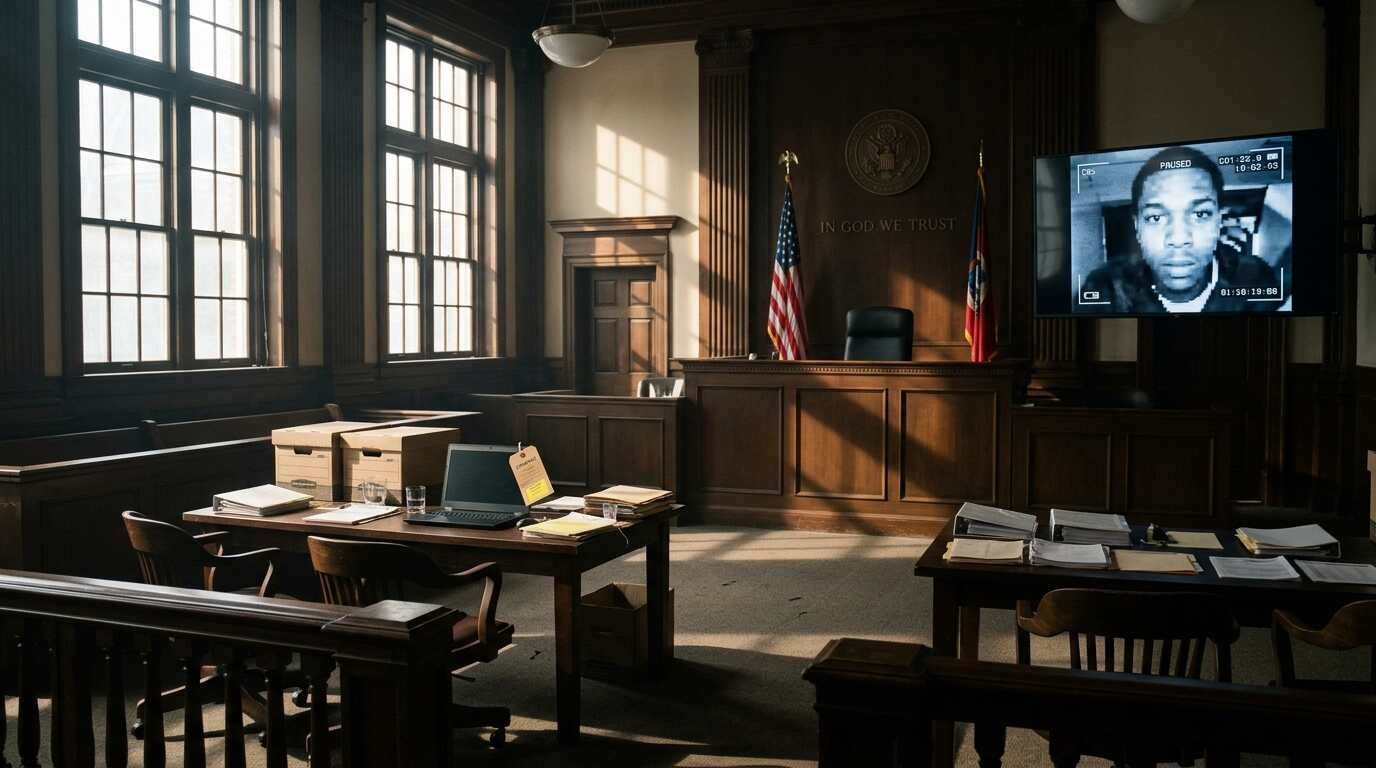
Federal Rule of Evidence 707 was supposed to be the federal courts’ first rule written for evidence produced by AI, and it has stalled. The draft would make a machine’s expert-like output clear the same reliability bar a human expert must clear. A companion idea aimed at deepfakes was never published. The open question is simple to state and hard to answer: when a party offers a video, an image or an analysis that software made or altered, do the existing rules on authentication and expert testimony already do the job, or does machine-generated evidence need gates of its own? Below: the current rules, the proposal, why it stalled, and two hypothetical exhibits run through each version. This is general information, not legal advice.
Andrea Roth opened her 2017 article in the Yale Law Journal with a sentence that reads like a forecast: “Machines play increasingly crucial roles in establishing facts in legal disputes.” (Roth 2017). Judges are now asking how far that should change the law. When the Federal Judicial Center surveyed federal judges for the rules committee, 931 responded and only 15 reported having faced a deepfake challenge in 2024 or 2025, according to a summary of the survey published with the committee’s May 2026 materials (Esquire Deposition Solutions 2026; Advisory Committee on Evidence Rules 2026). Rare, then, but no longer hypothetical.
What the rules already require
Two existing provisions carry most of the weight. The first is authentication. Under Rule 901(a), “the proponent must produce evidence sufficient to support a finding that the item is what the proponent claims it is.” The bar is low by design. Rule 901(b)(9) also allows proof through “Evidence describing a process or system and showing that it produces an accurate result.” Because authenticity is a question of conditional relevance under Rule 104(b), the judge asks only whether a reasonable jury could find the item genuine; the rest goes to the jury.
The second provision is Rule 702, which governs expert testimony. Since its 2023 amendment, the rule says outright that the proponent must show the court “more likely than not” that the testimony rests on sufficient facts or data, is the product of reliable principles and methods, and reflects a reliable application of those methods to the case. Rule 702 attaches to a witness. When a human expert relies on software, the software’s reliability is tested through that person on cross-examination. When no human expert takes the stand, the rule has nothing to grip.
That gap is the whole motivation for the proposal. A spreadsheet total or a thermometer reading poses little risk. An output that classifies, predicts or infers is different, because it embeds the kind of judgment that would trigger a reliability hearing if a person offered it. Roth argued that such outputs can mislead through flawed design, bad inputs or improper operation, and need safeguards of their own (Roth 2017).
Where proposed Rule 707 came from, and where it stands
The Advisory Committee on Evidence Rules voted 8 to 1 on May 2, 2025 to publish a new rule for comment, with the Justice Department’s representative dissenting (Proskauer 2026; UIC Law Library 2025). The operative sentence of the text the committee approved reads:
“Where machine-generated evidence is offered without an expert witness and would be subject to Rule 702 if testified to by a witness, the court must find that the evidence satisfies the requirements of Rule 702(a)-(d).”
Proposed Fed. R. Evid. 707, as approved for publication, May 2, 2025 (minutes in Advisory Committee on Evidence Rules agenda book, Nov. 2025)
A second sentence excludes “the output of basic scientific instruments.” Earlier sketches had also floated an exemption for routinely relied-upon commercial software, which the reporter and a consultant worried was too broad; the approved text kept only the instrument carve-out (Committee on Rules of Practice and Procedure 2025). The minutes record the Justice Department’s view, voiced by its representative, of “concerns that Rule 707 is overly broad and could require a Rule 702 showing for almost anything” (Advisory Committee on Evidence Rules 2025).
The Standing Committee approved publication in June 2025, and the preliminary draft went out on August 15, 2025, with comments open until February 16, 2026. More than 70 written comments arrived (Advisory Committee on Evidence Rules 2026). Plaintiffs’ lawyers argued the rule could sweep in routine data such as geolocation records or surveillance footage; others said it was too narrow because it reaches only evidence everyone agrees is machine-made, so it does nothing about a disputed fake (Proskauer 2026).
On May 7, 2026, the advisory committee declined to move the proposal forward. Members split on urgency, the Justice Department wanted more input on criminal cases, and the subject was set for the fall meeting with outside experts (Bloomberg Law 2026). The Standing Committee in June 2026 likewise did not recommend action, according to one law-firm account (Proskauer 2026). So the status is plain: Rule 707 is not law, it has not been withdrawn, and it is being reworked.
The deepfake half: an unpublished Rule 901(c)
Proposed Rule 707 says nothing about fabrication. That job belonged to a separate draft, usually called Rule 901(c), which the committee has prepared but not approved. As the committee materials describe it, the opponent would first have to offer evidence sufficient to support a finding that an item was fabricated by generative AI; only then would the burden shift, and the proponent would have to show it is more likely than not authentic (Advisory Committee on Evidence Rules 2026).
The design answers an asymmetry: under Rule 104(b), a convincing fake plus a cooperative witness can clear the bar. Bobby Chesney and Danielle Citron warned of the mirror-image risk as well, which they named the liar’s dividend: once the public knows fakes exist, a party can dismiss genuine recordings as fabricated (Chesney and Citron 2019). The threshold showing in the draft is meant to stop that move. A bare assertion that something is fake would not trigger the shift.
Courts are already meeting both problems without a new rule. In Mendones v. Cushman & Wakefield (Cal. Super. Ct., Alameda County, Sept. 9, 2025), the judge concluded that two video exhibits were generative-AI products rather than recordings of the witness they purported to show, pointing to differences in accent, cadence, gestures and expression, and imposed a terminating sanction (Volokh 2025). That was a California sanctions ruling, not a federal authentication ruling, but it shows what detection looked like in practice: careful comparison against a known genuine exhibit. For readers curious about the technical side of provenance checks, an earlier x9m8 piece covers how to check whether a viral video is AI-generated.
Three answers to the open question
Hypothesis 1: existing rules are enough
This is roughly the Justice Department’s position. Rule 901(b)(9) already demands proof that a process produces accurate results; Rule 403 lets a judge exclude confusing evidence; Rule 702 applies whenever a human expert relies on a tool. One judge on the committee was reported as saying he was not sure deepfakes are that unique (Bloomberg Law 2026). In State v. Puloka (Wash. Super. Ct., King County, 2024), a trial court excluded a defense video enhanced with machine-learning software after hearing that the tool created detail absent from the original and that the forensic video community had not accepted it (ABA Litigation News 2024; Greenberg Traurig 2024). No new rule was needed to reach that result.
Against it: Puloka involved a state Frye standard and a sponsoring witness. The harder case is an output offered with no expert at all.
Hypothesis 2: the gap is real, and Rule 707 fills it
Here the claim is narrower. Machine outputs that do expert-like work should not escape reliability screening merely because no person sponsors them. Matter of Weber (N.Y. Sur. Ct. 2024) is the cautionary example. A damages expert used Microsoft Copilot to cross-check figures; the court ran the same queries and got different numbers each time:
“While these resulting variations are not large, the fact there are variations at all calls into question the reliability and accuracy of Copilot to generate evidence to be relied upon in a court proceeding.”
Matter of Weber, 2024 NY Slip Op 24258, 85 Misc 3d 727 (Sur Ct, Saratoga County 2024)
The court required disclosure of AI use and a Frye hearing for such evidence. Weber had a human expert; proponents of Rule 707 ask what happens when the same output arrives without one.
Against it: if parties respond by simply calling an expert, the rule changes little. And the “if testified to by a witness” boundary is contestable for nearly any processed exhibit, inviting side litigation that poorer parties can ill afford.
Hypothesis 3: the real problem is authenticity, and it needs its own burden
On this view the urgent threat is the undetectable fake, not the opaque analysis, and Rule 707 is aimed at the wrong target. The draft 901(c) burden shift is the remedy. The case for urgency is thin, given the survey; the case for eventual need is stronger, since detection by eye, as in Mendones, depends on having a genuine sample to compare.
A structured test built for this article
To see where each proposal actually bites, I encoded the gates as a small decision function and ran it over every coherent combination of five facts about an exhibit: whether its output is expert-like, whether a human expert sponsors it, whether it comes from a basic scientific instrument, whether its authenticity is disputed, and whether the opponent has made the threshold showing the 901(c) draft requires. It compares three regimes: current federal rules (A), current rules plus Rule 707 (B), and B plus the 901(c) draft (C). This is a doctrinal model written for this article, not empirical data. The fact patterns are unweighted, so the counts measure coverage of logical cases, not frequency in real courtrooms.
# Which admissibility gates does an exhibit face under (A) current FRE,
# (B) A + proposed Rule 707 (text approved May 2025), (C) B + the unpublished
# Rule 901(c) deepfake draft as committee materials describe it?
from itertools import product

def gates(expert_like, sponsor, basic_instr, disputed, showing):
    g = {k: ["901(a) prima facie"] for k in "ABC"}
    if sponsor:                               # a human expert relies on output
        for k in g: g[k].append("702 via expert")
    elif expert_like and not basic_instr:     # machine conclusion, no expert
        g["A"].append("no 702 screen")
        for k in "BC": g[k].append("707 -> 702(a)-(d)")
    if disputed:                              # opponent says it is fabricated
        for k in "AB": g[k].append("104(b) jury question")
        g["C"].append("901(c): proponent >50%" if showing
                      else "104(b) jury question")
    return g

rows = []
for v in product([0, 1], repeat=5):
    e, s, b, d, o = v
    if (o and not d) or (b and e):            # drop incoherent combinations
        continue
    rows.append((v, gates(*v)))

def changed(g, x, y): return g[x] != g[y]
n = len(rows)
by707 = sum(changed(g, "A", "B") for _, g in rows)
by901 = sum(changed(g, "B", "C") for _, g in rows)
both = sum(changed(g, "A", "B") and changed(g, "B", "C") for _, g in rows)
none = sum(not changed(g, "A", "C") for _, g in rows)
deep = [g for v, g in rows if v[3] and not v[0]]   # disputed, not expert-like
print(f"fact patterns {n}; changed by 707 {by707}; by 901(c) {by901}; "
      f"by both {both}; by neither {none}")
print(f"classic deepfake patterns {len(deep)}; touched by 707 "
      f"{sum(changed(g,'A','B') for g in deep)}; by 901(c) "
f"{sum(changed(g,'B','C') for g in deep)}")| Result from this run | Count |
|---|---|
| Coherent fact patterns | 18 |
| Patterns where Rule 707 adds a gate | 3 |
| Patterns where the 901(c) draft adds a gate beyond 707 | 6 |
| Patterns changed by both proposals | 1 |
| Patterns changed by neither | 10 |
| Classic deepfake patterns (disputed, not expert-like) | 8 |
| Of those, changed by Rule 707 | 0 |
| Of those, changed by the 901(c) draft | 4 |
The two proposals turn out to be almost disjoint. Rule 707 touches only an expert-like, unsponsored, non-instrument output; the 901(c) draft touches only disputed items after a threshold showing. No disputed deepfake that lacks expert-like content is ever reached by Rule 707. In the 10 untouched patterns, existing gates govern alone.
Exhibit 1: an AI-enhanced bystander video
Suppose a defendant offers a ten-second phone clip that has been upscaled with a machine-learning tool, much like Puloka. Under current federal rules, a witness can authenticate the original. The enhanced version is a different item: the original as software reconstructed it. A court would likely look to 901(b)(9), Rule 403 and, if an analyst sponsors it, Rule 702.
Rule 707 is an awkward fit. Enhancement produces a picture, not a conclusion, and the committee’s stated aim was machine-generated, expert-like conclusions offered without an expert. The 901(c) draft fits even less well: the exhibit is admittedly altered, so the question is accuracy rather than fabrication. Coded as not expert-like, this exhibit gains no new gate from either proposal unless the opponent recasts the dispute as fabrication.
Exhibit 2: an AI analysis offered without an expert
Now suppose a plaintiff offers a report produced by a commercial AI tool that classifies thousands of trading records as “likely coordinated,” offered through a custodian who knows how it was generated but not how the model works. Today 901(b)(9) can be met with evidence that the tool generally works, and no human opinion triggers Rule 702. That is the gap in its purest form.
Rule 707 reaches it squarely. The proponent would have to show, more likely than not, sufficient input data, a reliable method and a reliable application to these records. In practice: validation studies, error rates on comparable data, and probably the prompts or settings used. The Weber problem (output that varies run to run) would sit under factor (d). If the tool’s output were disputed as fabricated, the 901(c) draft could add a second gate, which is the single pattern in the run touched by both proposals.
What the analysis does and does not show
It shows coverage, under the stated coding of each rule. It does not show how judges would rule, how often each pattern arises, or whether accuracy would improve. The coding also involves judgment calls that a reasonable lawyer could make differently: treating enhanced video as non-expert-like output, for instance, is my reading of the committee note’s focus, not a holding. The draft 901(c) text was not published, so the model follows the committee’s own description of it rather than final language.
One further limit: detection is outside the model. Every gate assumes someone can suspect an exhibit is machine-made. The same problem shows up with text, where AI-writing detectors fail in predictable ways, and with audio, where voice-cloning law is still catching up. A burden-shifting rule only helps once there is something to show.
The author’s reading, and what would settle it
What follows is my opinion, labeled as such. The committee’s hesitation looks justified on the deepfake side and less so on the analysis side. AI-fake authenticity disputes remain rare in federal court, and sanctions and Rule 403 have handled the visible cases. The unsponsored analytical output is different. It is the one situation where no current federal rule demands a preponderance showing of reliability, and it will grow as AI tools turn out routine records that read like conclusions.
Timing is not a matter of opinion. Under 28 U.S.C. § 2074, the Supreme Court must transmit a rule to Congress by May 1, and it takes effect no earlier than December 1 of that year. A revised Rule 707 that needed a fresh comment period starting in August 2027 could not, by my count of the usual annual cycle (advisory committee in spring, Standing Committee in June, Judicial Conference in September), take effect before December 1, 2029.
Specific developments that would settle the open question, or at least move it:
- A federal appellate opinion deciding whether an unsponsored machine analysis can be admitted under 901(b)(9) alone. A ruling either way would show whether the gap is real in practice.
- A repeat of the Federal Judicial Center judge survey. Prediction: if the share of judges reporting a deepfake challenge stays near the 2024-25 figure (15 of 931), the committee will keep 901(c) on the shelf; if it multiplies several-fold, it will publish.
- Validation data for the tools themselves. Published error rates for AI enhancement on forensic video, measured against ground truth, would answer the Puloka question directly.
- A narrowed Rule 707 draft that defines covered output by function (classification, prediction, inference) rather than by the counterfactual “if testified to by a witness.” Prediction: any version the committee republishes will narrow scope in that direction, because overbreadth was the most frequent objection.
A mock-jury study would also help: show the same clip with and without AI enhancement and measure how far findings shift. A small shift favors Hypothesis 1; a large one favors a dedicated gate.
Common questions
Is Federal Rule of Evidence 707 in effect?
No. It was published for comment in August 2025, but the advisory committee declined to advance it in May 2026. A revised version would still need committee votes, Judicial Conference approval, Supreme Court adoption and the congressional waiting period.
Does Rule 707 address deepfakes?
Not directly. It applies to machine output offered as something like expert analysis. Disputes over whether an image, audio clip or video was fabricated were assigned to a separate draft, often called Rule 901(c), which the committee has not published.
Can AI-enhanced video be used in court today?
Sometimes, but courts have been skeptical. In State v. Puloka, a Washington trial court excluded a machine-learning enhancement because the tool added detail and lacked acceptance among forensic video analysts. Results depend on the jurisdiction, the tool and the expert who sponsors it.
What happens if a party says genuine evidence is a deepfake?
Under current federal rules, the judge asks whether a reasonable jury could find the item authentic, and the jury decides the dispute. The 901(c) draft would require the challenger to produce real evidence of fabrication first, so a bare claim of fakery would not shift the burden.
References
- Advisory Committee on Evidence Rules. (2025). Agenda book, November 2025 (including minutes of the May 2, 2025 meeting and the text of proposed Rule 707 approved for publication). Administrative Office of the U.S. Courts. https://www.uscourts.gov/sites/default/files/document/2025-11_evidence_rules_commitee_agenda_book_final.pdf
- Advisory Committee on Evidence Rules. (2026). Agenda book, May 2026. Administrative Office of the U.S. Courts. https://www.uscourts.gov/sites/default/files/document/2026-05-evidence-rules-agenda-book.pdf
- Committee on Rules of Practice and Procedure. (2025). Preliminary Draft of Proposed Amendments, released August 15, 2025. https://www.uscourts.gov/forms-rules/records-rules-committees/preliminary-draft/preliminary-draft-proposed-amendments-2025
- Committee on Rules of Practice and Procedure. (2025). Agenda book, June 2025 (including January 2025 minutes). https://www.uscourts.gov/sites/default/files/document/2025-06-standing-agenda-book.pdf
- Federal Rules of Evidence, Rule 702 (as amended Dec. 1, 2023). Legal Information Institute. https://www.law.cornell.edu/rules/fre/rule_702
- Federal Rules of Evidence, Rule 901. Legal Information Institute. https://www.law.cornell.edu/rules/fre/rule_901
- 28 U.S.C. § 2074. Rules of procedure and evidence; submission to Congress; effective date. https://www.law.cornell.edu/uscode/text/28/2074
- Roth, A. (2017). Machine Testimony. Yale Law Journal, 126. https://www.yalelawjournal.org/article/machine-testimony
- Chesney, B., & Citron, D. (2019). Deep Fakes: A Looming Challenge for Privacy, Democracy, and National Security. California Law Review, 107, 1753. https://www.californialawreview.org/print/deep-fakes-a-looming-challenge-for-privacy-democracy-and-national-security
- Matter of Weber, 2024 NY Slip Op 24258, 85 Misc 3d 727 (Sur Ct, Saratoga County, Oct. 10, 2024). https://www.nycourts.gov/reporter/3dseries/2024/2024_24258.htm
- State of Washington v. Puloka (Wash. Super. Ct., King County, 2024), as reported in ABA Litigation News (2024), “Court Excludes AI-Enhanced Videos as Trial Evidence.” https://www.americanbar.org/groups/litigation/resources/litigation-news/2024/fall/court-excludes-aienhanced-videos-trial-evidence/
- Greenberg Traurig. (2024). Washington Court Rejects Novel Use of AI-Enhanced Video in Trial. https://www.gtlaw.com/en/insights/2024/5/washington-court-rejects-novel-use-of-ai-enhanced-video-in-trial
- Mendones v. Cushman & Wakefield, Inc. (Cal. Super. Ct., Alameda County, Sept. 9, 2025), as reported in Volokh, E. (2025), The Volokh Conspiracy. https://reason.com/volokh/2025/09/25/court-throws-out-case-after-finding-plaintiffs-submitted-deepfake-videos-and-altered-images/
- Bloomberg Law. (2026, May 7). Proposed AI Evidentiary Rules Punted Due to Lack of Consensus. https://news.bloomberglaw.com/us-law-week/proposed-ai-evidentiary-rules-punted-due-to-lack-of-consensus
- Proskauer Rose LLP. (2026). Machine-Generated Evidence Challenges the Federal Rules: Inside the Contested Proposed Federal Rule of Evidence 707. https://www.proskauer.com/blog/machine-generated-evidence-challenges-the-federal-rules-inside-the-contested-proposed-federal-rule-of-evidence-707
- Esquire Deposition Solutions. (2026). Federal Judges Set Bar for Deepfake Evidence Challenges. https://www.esquiresolutions.com/federal-judges-set-bar-for-deepfake-evidence-challenges/
- University of Illinois Chicago School of Law Library. (2025). Proposed New FRE 707. https://library.law.uic.edu/news-stories/proposed-new-fre-707