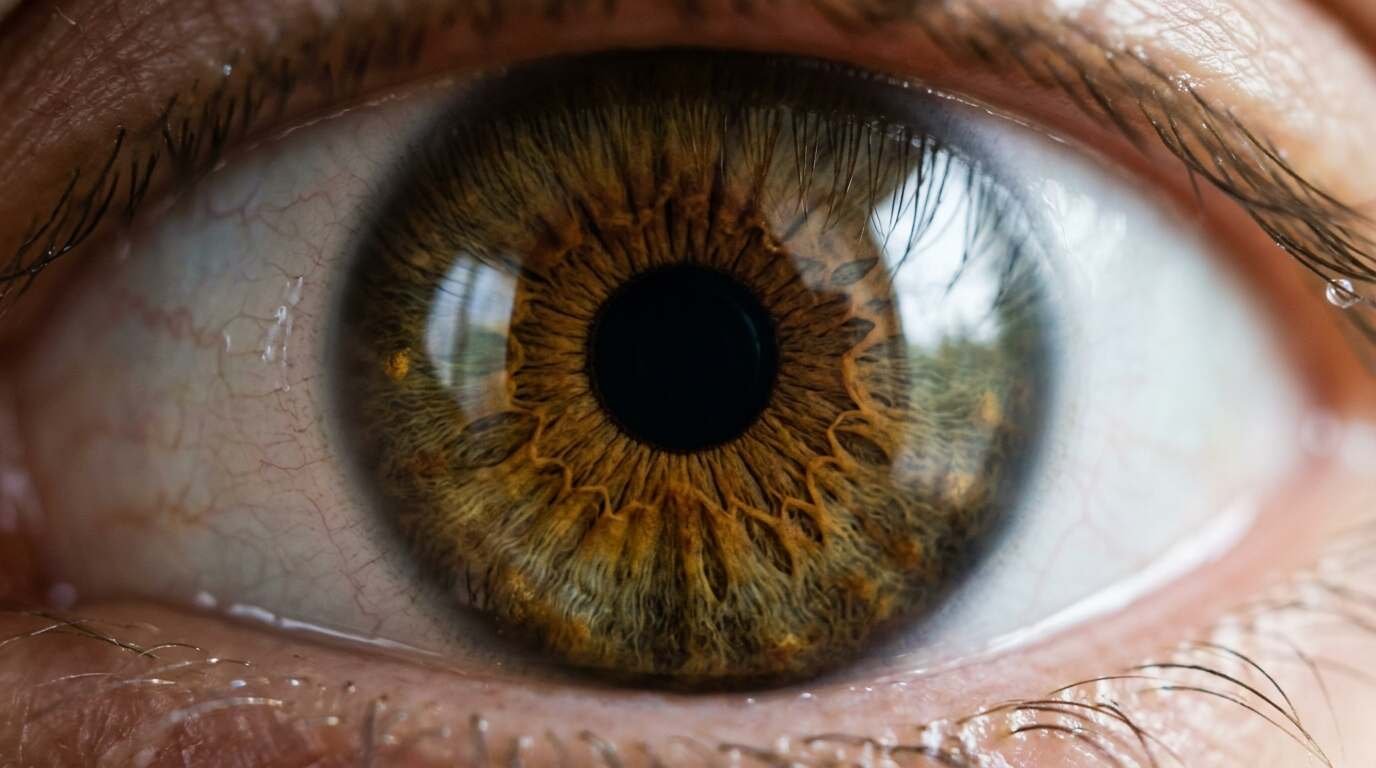
Darwin called the eye a difficulty for his theory, then explained why it was not. Here is what living animals, genes and fossils show about how eyes evolved.
How did the eye evolve? Charles Darwin thought the question was serious enough to confess, in On the Origin of Species in 1859, that the idea of an eye forming by natural selection seemed “absurd in the highest possible degree.” Then he spent the next few paragraphs explaining why it was not. A century and a half of comparative anatomy, genetics and fossils has since filled in much of the answer, and some of the details are better than Darwin could have hoped.
The short version: eyes did not appear as finished cameras. They grew out of light-sensing cells through a long series of small improvements, and many of the intermediate stages are still alive today. What follows covers the argument, the living examples, the numbers, the genes and the unresolved parts.
Why did Darwin call the eye a problem?
Because an eye looks like a machine whose parts depend on each other. A lens without a retina is useless, a retina without a lens gives only a blur, and the whole needs a nerve and a brain to make sense of the signal. If every part is required, how could natural selection build it one step at a time?
Darwin’s reply had two parts. First, if you can find a graded series of eyes, from simple to complex, in which each stage is useful to its owner, then the objection loses its force. Second, the variations have to be inherited, so each improvement can be passed on and built upon. He sketched a path from an optic nerve coated with pigment up to a moderately high level of perfection.
Note what he was and was not claiming. He did not claim to know the actual history. He claimed that a plausible chain of useful stages could exist, and that nature offers real examples to test the claim against.
What do the in-between stages look like?
You can line them up using living animals, and the result is surprisingly tidy. None of these is an ancestor of the next. They are different lineages that show what each stage can do.
- Eyespots are clusters of light-detecting cells that sense brightness but not direction or shape. Euglena, a single-celled organism, has a light-sensing spot that helps it swim toward light.
- Pit eyes are cup-shaped. The cup lets an animal tell roughly where the light is coming from, as in planarian flatworms.
- Pinhole eyes have a narrow opening that forms a real image, though a dim and fuzzy one. The nautilus has this kind, with no cornea and no lens.
- Camera eyes have a lens, cornea and iris, and they are found in vertebrates and in cephalopods such as octopuses.
- Compound eyes are made of many small units called ommatidia, as in insects and other arthropods.
Cubozoan jellyfish are a good surprise: they have eyes with camera-like structure despite having no brain as such. Every stage on this list works, and each one gives its owner some advantage over the stage before. A flatworm that can tell which way is shaded can find cover. A nautilus that sees an image can detect a moving shape.
How long would it take?
Quite a short time, according to a calculation made in 1994 by Dan-Eric Nilsson and Susanne Pelger. They modeled the change from a flat patch of light-sensitive cells to a vertebrate-style camera eye, with a lens, as a series of small steps. At each step, a small percentage change in some feature, such as the depth of the cup or the thickness of the lens, was allowed.
The authors deliberately used pessimistic assumptions. They overestimated the time each stage would need, and they set the generation time to one year. Even so, the estimate for the whole sequence came out to under 364,000 years. On geological timescales, that is brief.
A model is not a history, of course. It shows that the transition is not implausibly slow under reasonable assumptions about mutation and selection, which is the point Darwin needed. It does not tell us what actually happened in any one lineage.
Did the eye evolve once or many times?
The answer depends on what you count as an eye, and that is a real source of confusion.
If you mean any light-sensitive spot, then eyespots evolved independently many times, an estimated 40 to 65. If you mean an eye that can locate the direction of light within a few degrees, only six of the thirty-odd animal phyla have that, though those six include species that make up about 96 percent of living animal species. And complex image-forming eyes with lenses have arisen independently several times, in vertebrates, cephalopods, some snails, spiders, arthropods and certain jellyfish.
That convergent pattern is itself evidence. When separate lineages reach similar solutions to the same optical problem, the likely cause is that the problem has a limited number of good answers, and selection keeps finding them.
What about the genes?
The surprise came from genetics. A gene called Pax6 helps control where eyes develop in animals as different as fruit flies, mice and octopuses. Experiments have shown that a version from one species can trigger eye formation in another, even though the resulting eyes follow the host’s own design.
That finding seemed to suggest that all eyes share one origin. The more cautious reading is that Pax6 is very ancient and probably served other purposes first, then was recruited into eye development in different lineages. The genetic toolkit is shared even where the eyes themselves arose separately, a pattern biologists call co-option.
The light-sensing proteins tell a similar story. Opsins, the molecules that detect light, fall into nine groups, and all nine already existed in the last common ancestor of the bilaterian animals, the group that includes vertebrates, insects and molluscs. Vertebrates today have five visual opsin classes tuned to different light environments. So the chemistry of vision is older than most eyes.
There is a cellular split too. Molluscs, annelids and arthropods build their photoreceptors from tiny folds called microvilli, while chordates and echinoderms build theirs from cilia. That difference points to separate origins for the basic detector in the two great branches of animals.
Why is the vertebrate retina “backwards”?
In our eyes, light has to pass through layers of nerve fibers and blood vessels before reaching the photoreceptors, and the nerve fibers bundle together and leave through a spot with no receptors, which creates the blind spot. Octopus and squid eyes are built the other way round, with receptors facing the light and no blind spot.
This is often raised as a design question. From an evolutionary standpoint it is explained as a historical accident. Selection modifies what already exists. Once a lineage has a certain wiring plan, reversing it would require passing through stages that work worse, so the layout stays. Vertebrate vision works well despite the quirk, in part because the brain edits out the blind spot.
Another visible leftover of history is the flatfish, which begin life with an eye on each side and then have one eye migrate across the skull. The fossil Amphistium shows an intermediate stage of that process.
What does the fossil record show?
Eyes are soft tissue, and soft tissue rarely survives, so the record is thin. There are still some solid data points.
Possible eye fossils reach back to the Ediacaran, around 555 million years ago, but these are uncertain. The oldest fossilized eye accepted with confidence belongs to a trilobite, Schmidtiellus reetae, from Estonia and about 530 million years old. Its eyes resemble a compound eye with about 100 widely spaced ommatidia and no lens. That is a fairly simple design, appearing early in the Cambrian, which fits the idea that eyes were already becoming common by then.
One nice correction came from younger fossils. Eyes from 55-million-year-old crane flies suggested that the calcite once thought to be a feature of trilobite eyes may be a product of fossilization, not an original feature. Even the ancient record needs careful reading.
Many researchers think that the evolution of eyes may have helped drive the Cambrian burst of animal diversification, since vision changes how predators hunt and prey escape. That is a hypothesis, not a result, and it is covered in debates about the Cambrian explosion more generally.
What is still unknown?
Quite a lot, and it is better to say so. The exact sequence in any particular lineage is mostly lost, because the soft tissue did not fossilize. The count of independent origins depends on the definition of “eye,” so the numbers quoted vary. How much of the shared genetic machinery reflects a common ancestral light-sensing system and how much reflects later borrowing is under active research.
Also, models such as the 1994 calculation use simplified geometry. Real evolution involves developmental constraints, trade-offs with other organs and environmental differences that are hard to model. So the calculation supports plausibility; it does not replace evidence from fossils and genomes.
Common questions
What good is half an eye?
Quite a lot. A half-formed eye is not half-blind, it is a simpler eye, and simpler eyes work. A patch that detects light tells a flatworm about shade, and a cup that gives direction helps an animal flee or find food.
Did the eye evolve only once?
Not in the sense of complex eyes. Simple light-sensing spots arose many times, and lens eyes arose several times independently. Some genes and light-sensitive proteins are shared because they were inherited from a distant common ancestor.
What was the first eye?
Nobody knows. The oldest fossil eye accepted with confidence is about 530 million years old, but light-sensing cells almost certainly existed earlier, and soft tissue seldom fossilizes.
Why do octopuses see without a blind spot?
Their retinas are oriented with the photoreceptors facing the light, so the nerve fibers sit behind them and do not interrupt the image. Vertebrates ended up with the reverse arrangement through a different evolutionary history.
Is there any experiment showing eyes can evolve?
Direct experiments on whole eyes are not possible on human timescales. The evidence is comparative: living stages of eye complexity, shared genes, fossil data and mathematical models such as the 1994 estimate. Together they are consistent with gradual evolution.
Does Pax6 prove eyes have one origin?
No. It shows a shared developmental switch that is very old, probably predating eyes themselves. Eyes of different designs were built under its control in different lineages.
What to remember
Darwin’s difficulty was real, and his answer has held up well. A working eye does not require all its parts at once, because simpler eyes work, and animals alive today illustrate nearly every step.
The solid findings are the graded series of living eyes, the 1994 estimate that the transition could take less than about 364,000 years under pessimistic assumptions, and the shared gene and opsin toolkit. The unsettled parts are the exact histories of individual eye types, the number of independent origins, and what role vision played in the early diversification of animals.
Further reading
Includes a well-known chapter on how eyes can evolve through intermediate stages. See it on Amazon (affiliate link)
As an Amazon Associate I earn from qualifying purchases. A commission may be earned if you buy through this link, at no extra cost to you.
Sources