





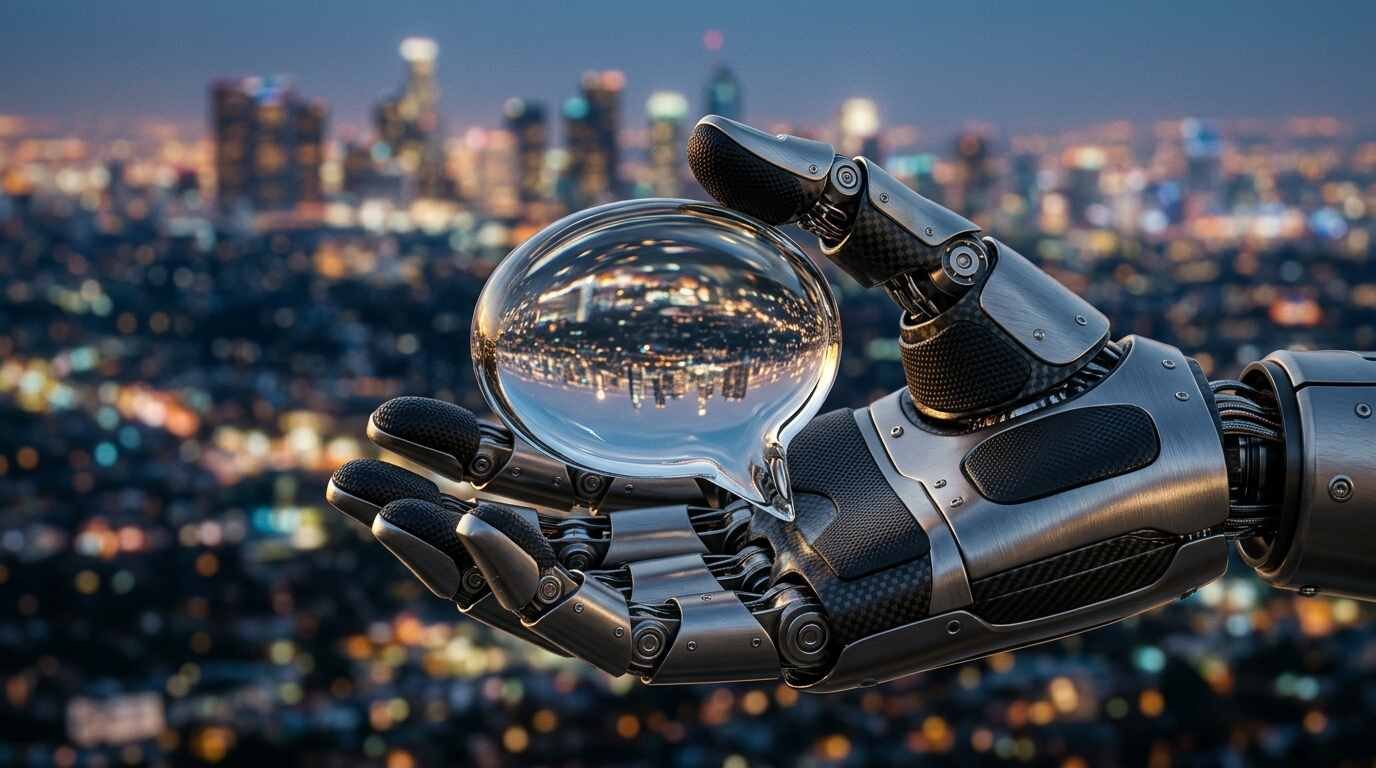
Chatbots invent facts because of how they are trained and graded. The causes, notable cases and the fixes being tried.
Why AI chatbots hallucinate is one of the most practical questions about the technology, because the answer explains both why the errors happen and why they are so hard to remove. A hallucination, in this sense, is a confident, fluent statement that is false or unsupported: an invented court case, a book that does not exist, a policy nobody wrote. It is not a random glitch. It follows from how these systems are trained and how they are graded. This article covers the causes, the documented cases, the fixes being tried and what a user can do today.
What counts as an AI hallucination?
The word borrows from psychology, and several researchers dislike it. It describes output that sounds plausible but is not grounded in fact or in the material the system was given. A chatbot might cite a paper that was never written, attribute a quote to the wrong person, or describe a feature a product does not have.
Critics point out that “hallucination” implies perception and a mind. Alternatives proposed in recent years include “bullshit” in philosopher Harry Frankfurt’s sense, meaning speech indifferent to truth (argued by Hicks, Humphries and Slater in June 2024), “mirage” (Mills and Angell, 2025) and the plainer “undesirable output” (Bender and Inie, January 2026). The naming dispute is more than pedantry. It reflects a real disagreement about whether these systems are trying and failing to tell the truth, or simply producing likely text.
How does next-word training lead to false statements?
A language model is first pretrained to predict the next token in huge quantities of text. The text carries no true or false labels. The model learns patterns, and where patterns are strong and consistent, it gets very good. Spelling, grammar and parenthesis matching improve reliably with scale.
Arbitrary facts are different. A person’s birthday, the title of an obscure dissertation or the exact wording of a regulation cannot be deduced from patterns. If a fact appeared rarely or never in training, the model has nothing to retrieve, yet the training objective still rewards producing a plausible continuation. A plausible birthday looks like a birthday, so the model writes one.
OpenAI researchers described this in a post dated September 5, 2025, using a chatbot that gave three different wrong birthdays and three different wrong dissertation titles for one of the paper’s authors. They argued that errors on rare facts are an expected consequence of the training setup, not a mystery.
Why do evaluation scores reward guessing?
The same OpenAI work makes a point about incentives that is easy to grasp from school. On a multiple-choice test with no penalty for wrong answers, a blank answer scores zero while a guess has some chance of scoring. A student who always guesses beats one who admits uncertainty.
Most AI benchmarks grade accuracy alone. A model that says “I don’t know” gets zero, exactly like a wrong answer, so a model that always guesses looks better on the leaderboard. The post gave a comparison on a factual-question benchmark called SimpleQA: one smaller model abstained 52 percent of the time and had a 26 percent error rate, while an older model abstained 1 percent of the time and was wrong 75 percent of the time, with only slightly higher accuracy. The extra guessing mostly added errors.
The authors concluded that hallucinations are neither inevitable in every form nor a puzzling glitch, and that post-training, which is meant to reduce them, is shaped by those same scoring incentives. This is one research group’s analysis, though it fits with other work. Reinforcement learning from human feedback has a related weakness: human raters often cannot spot mistakes in complex answers, so a model can learn to sound correct rather than be correct.
What is happening inside the model when it makes something up?
Interpretability research offers a partial picture. In March 2025 Anthropic published findings on its Claude models, reporting that declining to answer is the default behavior, and that a “known entity” feature can switch that default off when the model recognizes a name. Problems arise when that feature misfires, for example when the name is familiar but little else is known. The model then answers instead of declining, and the answer is a plausible invention.
The study also found that a model’s description of its own reasoning may not match what it did. In one case a model claimed to have performed a calculation that the researchers’ tools found no evidence of, and when given a hint it sometimes worked backward from the suggested answer. That matters for users: asking a chatbot to explain how it knows something does not reliably reveal its real process.
These are results from one lab on specific models, and the techniques see only part of what is going on. They are best read as early evidence for a mechanism, not a complete account.
What real-world damage has hallucination caused?
The documented cases are mostly legal and corporate. Meta’s science model Galactica was withdrawn on November 17, 2022, after generating text including citations to fictitious papers. In Mata v. Avianca, a New York case, a lawyer filed a brief containing six invented precedents, and on June 23, 2023, the judge fined the lawyers $5,000. In February 2024, a Canadian tribunal ordered Air Canada to honor a bereavement fare policy that its own support chatbot had made up.
Citation errors recur in research settings as well. One 2023 study in the journal Cureus found that 69 of 178 references produced by GPT-3 had incorrect or nonexistent identifiers, and another analysis of 115 references from ChatGPT-3.5 found 47 percent fabricated. Consulting reports published by Deloitte in Australia and Canada in late 2025 reportedly included false citations. A public database of legal decisions involving AI hallucinations, begun in April 2025, had logged more than 1,300 cases within a year.
Many of these figures were gathered from one encyclopedia compilation of reported cases, so treat the exact counts as indicative.
Can hallucinations be fixed?
Reduced, yes. Eliminated, almost certainly not completely. Several approaches are in use:
- Retrieval-augmented generation fetches documents and has the model answer from them, which gives the answer something to be grounded in, although the model can still misread or ignore the source.
- Better benchmarks would penalize confident errors more than honest uncertainty and give partial credit for abstaining, a change OpenAI researchers argued should be made to the main scoreboards, not tacked on as extras.
- Confidence scoring generates several candidate answers and checks agreement, which can catch some errors but multiplies computing cost.
- Guardrails and detection tools hard-code certain responses or flag suspect output, and some systems have models debate one another before answering.
- Neuro-symbolic designs pair language models with formal knowledge bases and logic engines, a research direction still maturing.
- Human review remains the most dependable check, which is why some courts, beginning with Judge Brantley Starr in 2023, required that AI-assisted filings be verified by a person.
The OpenAI analysis adds a notable caveat: perfect accuracy is unattainable because some questions have no answerable basis, and a calibrated model that says “I don’t know” can be more reliable than a larger model that always answers. The goal is therefore not a model that never errs but one that errs less often and tells you when it is unsure.
Is every invented answer a pure defect?
Not everyone treats it that way. Some researchers frame hallucination as the flip side of originality: a system tuned to produce novel combinations will sometimes produce ones that are novel and wrong, a tension between novelty and usefulness described by Mukherjee and Chang in 2023. For brainstorming or fiction, an invented detail is the point. For a legal brief, it is a disaster. The same behavior is a feature or a failure depending on the task.
The term itself is older than chatbots. Eric Mjolsness used it in a 1986 doctoral thesis about computer vision, and it was later applied to image systems that see objects that are not there. Some researchers also found in 2022 that language models can amplify hallucinations, including ones that other methods were designed to suppress, which is one reason the problem has stayed stubborn.
How can users protect themselves?
Practical habits help, none of them foolproof. Ask for sources and open them; a link or title the model supplies may not exist. Be most skeptical about names, numbers, dates, quotations, legal and medical details, and anything obscure. Provide the text you want analyzed, rather than asking the model to recall it. Ask it to say when it is unsure, though models do not always comply. For anything with consequences, check against a primary source.
Using a chatbot well resembles using a knowledgeable but overconfident colleague: good for drafts, ideas and orientation, and not the final word.
Common questions
Do all AI chatbots hallucinate?
Every large language model system documented so far can produce false statements, though rates differ by model, topic and setup. Systems that retrieve documents tend to do better on factual questions than those relying on memory alone.
Are newer models better?
Often, on average, but not uniformly, and gains are uneven across question types. The OpenAI comparison showed that a newer small model’s main advantage was abstaining more, not knowing more.
Why does the chatbot sound so sure?
Fluent, confident prose is what the training data and human feedback reward. Tone is a property of the writing style it learned, not a measurement of how reliable the claim is.
Is hallucination the same as lying?
Lying implies intent to deceive. Current evidence points to a statistical process that fills gaps with likely text, though how to describe that is debated, as the naming disputes above show.
Will hallucinations ever go away completely?
Researchers expect they can be reduced substantially but not removed entirely, since some questions are unanswerable and models work from incomplete information. Predictions beyond that are speculation.
What to remember
Chatbots hallucinate because they are trained to produce plausible text, learn from data that cannot settle rare facts, and are graded in ways that favor guessing. Documented consequences include fake legal citations and invented company policies. Grounding in sources, better scoring and human checking help, and none removes the problem. Verify what matters.
Further reading
A skeptical, accessible look at what AI does and does not do reliably. See it on Amazon (affiliate link)
As an Amazon Associate I earn from qualifying purchases. A commission may be earned if you buy through this link, at no extra cost to you.
Sources