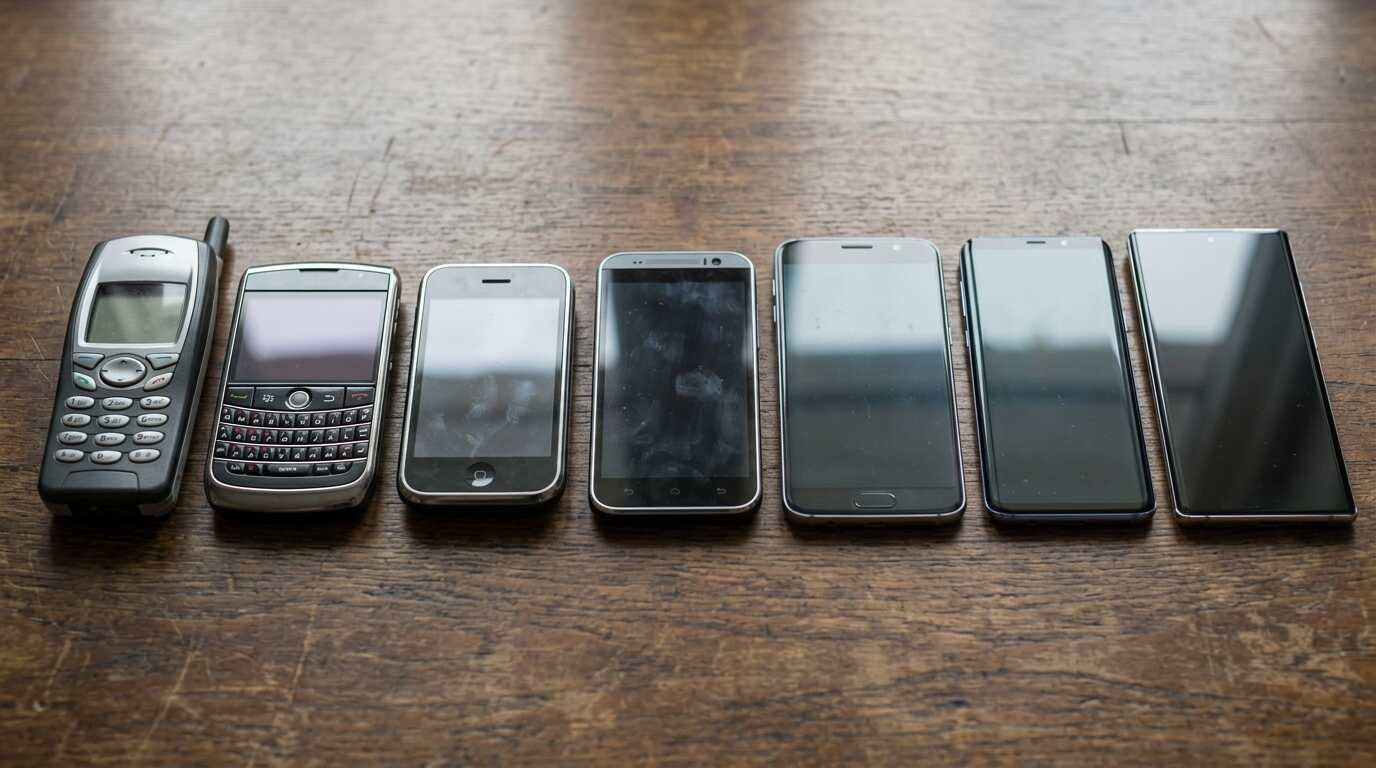
From an 80-pound car phone to a pocket computer: the networks, devices and software that built the smartphone, with the dates sources agree on.
A device that began as a heavy radio handset now holds a camera, a map, a wallet, and a browser, and the story of how smartphones evolved runs through more than one technology at once. Radio networks, batteries, touchscreens, chips, and software stores all had to mature, and they did not mature on the same schedule. Here is how the pieces came together, with the dates that sources agree on and a few places where they do not.
What came before the cell phone?
Mobile telephony is older than most people assume. AT&T’s Mobile Telephone Service began in St. Louis, Missouri, on June 17, 1946, and was commercialised in 1949. The subscriber equipment weighed about 80 pounds (36 kilograms), so it lived in a car trunk, not a pocket. An improved service in 1965 added more channels, customer dialling, and smaller equipment.
These systems shared a handful of radio channels across a whole city. Only a small number of calls could run at once, which is why they stayed a niche for wealthy or professional users. The leap needed a different network design, in which a region is divided into small cells and frequencies are reused in non-neighbouring ones.
Who made the first handheld phone call?
Martin Cooper of Motorola made the first handheld mobile call on April 3, 1973, to Joel Engel of Bell Labs. The prototype weighed about 2 kilograms, or 4.4 pounds, gave roughly 30 minutes of talk time, and needed about 10 hours to recharge. It was a demonstration, not a product.
The commercial version took another decade. The Motorola DynaTAC 8000X launched on Ameritech’s first US 1G network on March 6, 1983, after a development effort that reportedly cost $100 million. Its talk time and charging time were about the same as the prototype’s. The same year, in October, the DynaTAC was commercially launched, and the AMPS cellular standard went on sale across the Americas on October 13.
Other countries had been moving too. Japan’s NTT launched a first-generation system in 1979, Sweden’s Comvik in September 1981, and the Nordic NMT network the following month. The UK’s first two commercial networks, Vodafone UK and Cellnet, appeared in 1985.
When did phones become “smart”?
Sources disagree on the first smartphone, and the disagreement is partly about definitions. IBM’s Simon, widely cited as the first, is dated 1992 by one reference and 1993 by another; I am treating both as early-1990s. It combined a phone with a touchscreen, a calendar, and email-like functions, which made it a pocket organiser that could place calls.
In 1994, General Magic’s Magic Cap devices, built by Sony and Motorola, arrived with similar ambitions. They did not take off. The ingredients were missing: networks were slow, batteries were limited, and few services existed to use.
The second generation helped. GSM, a digital standard, launched on the first network (Radiolinja in Finland) in 1991, and in 1998 the same operator sold the first downloadable content for phones, a ringtone. In 1999 NTT DoCoMo started a full internet service on mobile phones in Japan. Phones were learning to be connected before they were learning to be clever.
What changed with the iPhone?
Apple announced the first iPhone on January 9, 2007 and released it in the US on June 29. At launch the 4 GB model cost $499 and the 8 GB model $599, both with a two-year contract. It had a 3.5-inch multi-touch display, a 2-megapixel camera, a Safari browser, and Wi-Fi.
By modern standards it was limited. It used GSM with GPRS and EDGE and had no 3G, so browsing over cellular was slow. Copy-and-paste and picture messaging were absent at release. Third-party apps could not be installed at first; some observers argued that, for this reason, it was not yet a true smartphone. Walt Mossberg of The Wall Street Journal called it “a beautiful and breakthrough handheld computer” while criticising those gaps, and Time named it the invention of the year.
What the iPhone changed was the interface. A large touchscreen replaced the physical keypad, and software could redraw the screen for every task. Sales were modest at first: Apple reported four million sold by January 2008, and the original model reached about 6.1 million units before it was discontinued in July 2008.
Was the first iPhone an instant success?
Not in the way the legend suggests. About 270,000 units sold in the US during the first week, a respectable figure for a premium phone but not a revolution by itself. Critics found plenty to dislike. Steve Ballmer, then Microsoft’s chief executive, criticised the high price and the lack of a physical keyboard, a complaint that sounds quaint now but reflected the BlackBerry-era expectation that serious phones had buttons.
Apple adjusted quickly. On September 5, 2007, the price of the 8 GB model dropped to $399 and the 4 GB model was discontinued. A 16 GB version arrived in February 2008 at $499. European sales were weaker than American ones, and the phone never launched in Canada. The product that made the category mainstream was, in its first form, an expensive device with obvious gaps.
This matters for the larger story. The evolution of smartphones was not a single stroke of genius. It was a sequence of improvements: 3G in the iPhone 3G, the App Store, better cameras, faster processors, and each generation of cellular networks. The 2007 launch is best seen as the point where those threads started to pull in the same direction.
Why did the App Store matter so much?
A phone is a fixed piece of hardware; apps make it many different tools. Apple released a software development kit on March 6, 2008, and the App Store opened in July 2008 alongside the iPhone 3G. That arrangement, in which the manufacturer hosts and distributes apps, spread quickly. Google’s Android Market, later renamed Google Play, and BlackBerry’s App World followed.
Third-party software turned phones into platforms. Navigation, ride hailing, banking, photography, and mobile games all became things you installed, not things you bought separately. The model also concentrated power in a small number of store owners, which remains a subject of regulation and legal dispute in several countries.
How did mobile networks keep up?
First-generation systems such as AMPS carried voice as analogue signals. The second generation, which began with GSM in 1991, went digital, and that shift made room for text messages, better privacy, and more calls on each radio channel. Everything since has been a story of more data per second. Phones needed to be fast before apps could be rich, and apps needed to be rich before people would pay for data plans, so the network and the software pulled each other along.
Each cellular generation roughly matches a leap in what phones could do. NTT DoCoMo ran the first commercial 3G network, launching on October 1, 2001, after a trial in May of that year. By the end of 2007, 295 million people subscribed to 3G, about 9 percent of the worldwide base. The first public LTE service, from TeliaSonera in Scandinavia, started in 2009 and brought faster mobile data; the same reference also mentions 4G native-IP networks in South Korea in 2006, so the “first” depends on how you define 4G.
5G deployment began in 2019. By 2025 the International Telecommunication Union estimated that about 3 billion 5G subscriptions existed, close to a third of all mobile broadband subscriptions, and that 5G covered about 55 percent of the world’s population. Coverage is very uneven: about 84 percent in high-income countries, and 4 percent in low-income ones. Commercial 6G deployment is expected around 2030, which is a forecast and not a certainty.
How many people use smartphones, and has the market peaked?
Shipments passed 1 billion units for the first time in 2013, up 38 percent from 725 million in 2012, and smartphones held 55 percent of the mobile phone market that year. Shipments reached 1.54 billion in 2019, then fell 3.2 percent that year, described as the largest drop in smartphone history. One estimate puts smartphone users at about 75 percent of the world population in 2020, though definitions of “user” vary.
The competition at the top has tightened. In the first quarter of 2024 shipments rose 7.8 percent to 289.4 million units, and Samsung overtook Apple at 20.8 percent. In the first quarter of 2026, Samsung held 21.2 percent and Apple 21.0 percent, a margin small enough that rankings flip from one quarter to the next.
What are phones adding now?
Satellite links are one recent direction. The iPhone 14 in 2022 supported emergency text messages through Globalstar satellites, and the iPhone 15 in 2023 added satellite roadside assistance in the US. T-Mobile also announced a partnership with Starlink in 2022. The iPhone 15 also switched to USB-C. These are incremental additions in a mature product, closer to refinement than reinvention.
Inside the device, the storage is flash memory, the type used in most smartphones. What comes next is mostly speculation: tighter integration of on-device AI, new form factors, and a gradual shift toward wearables. Treat forecasts as opinion.
Common questions
What was the first smartphone?
IBM’s Simon is the most commonly cited, dated 1992 or 1993 depending on the reference. Whether it counts depends on your definition of “smart”.
Did the iPhone invent the smartphone?
No. Smartphones existed before 2007, including the Simon and several later designs. The iPhone reshaped the touchscreen interface and, a year later, the app model.
How much did the first mobile phone weigh?
Cooper’s 1973 prototype weighed about 2 kilograms (4.4 pounds). The 1949 car-installed equipment weighed about 80 pounds.
What does the “G” in 5G stand for?
Generation. Each one marks a major change in the radio technology and capabilities of mobile networks, from analogue 1G through digital 2G, then 3G, 4G, and 5G.
When might 6G arrive?
Commercial deployment is expected around 2030, according to the reference I used. That date is a projection and may move.
What to remember
The smartphone is the product of three decades of overlapping progress. Radio networks went from a few shared channels to cellular systems; handsets shrank from the 80-pound car installation to Cooper’s 2-kilogram prototype and then to pocketable devices; and the 2007 iPhone and 2008 App Store changed how people interact with software. The most reliable dates are the 1973 handheld call, the 1983 commercial DynaTAC, the 2001 launch of 3G, and the 2007 and 2008 Apple milestones. Treat anything about the future, including 6G and device forms, as a forecast.
Further reading
A popular, well-regarded history of the iPhone's development. See it on Amazon (affiliate link)
As an Amazon Associate I earn from qualifying purchases. A commission may be earned if you buy through this link, at no extra cost to you.
Sources