
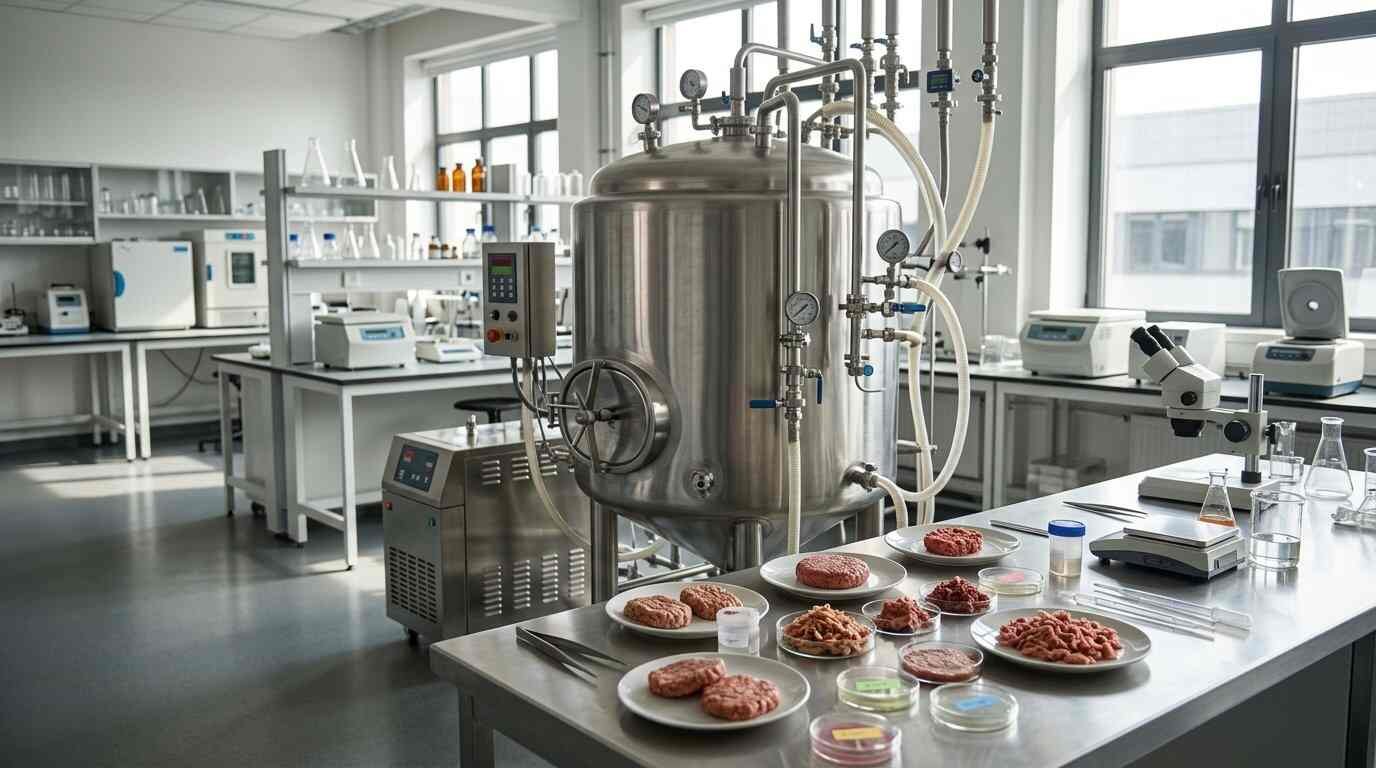
Precision fermentation and cultivated meat are both ways of making food ingredients with cells instead of animals, but in October 2026 they are at very different stages. Precision fermentation uses microbes to produce specific molecules and sits close to commercial sales. Cultivated meat grows animal cells into tissue, has cleared several US regulatory reviews, and is still struggling with plant economics, as the recent collapse of a once well-funded builder shows.
Two technologies that get lumped together
The Good Food Institute describes precision fermentation as using microbial hosts as cell factories for a chosen molecule, such as a protein, lipid, flavor compound, enzyme or pigment. The host carries genetic instructions for that molecule, the culture grows in a tank, and the product is separated and purified. The measures that decide whether it pays are titer (how much product per volume of liquid) and yield (how much purified product you recover).
Cultivated meat is different in kind. Here the cells are the product. They come from an animal, multiply in a bioreactor, and are shaped into food. That makes the biology slower and the media and equipment more demanding, which is why the economics remain the central argument.
| Precision fermentation | Cultivated meat | |
|---|---|---|
| What grows | Microbes (yeast, fungi, bacteria) | Animal cells |
| What you sell | A purified ingredient | The cell mass itself |
| Older precedent | Fermentation-made chymosin replaced calf rennet in most cheesemaking, per GFI | First sale in Singapore in 2020, per GFI |
| Main hurdle | Purification and cost at scale | Reactor size, media cost, financing |

Precision fermentation: a prove-it phase
Fermentation-derived products are already routine in food. GFI notes that vitamins such as B12 and riboflavin, many flavor components and enzymes come from fermentation. The newer part is using it for functional proteins such as whey or egg proteins.
A concrete current case is Verley, which makes beta-lactoglobulin (BLG), a whey protein. In an interview reported by AgFunderNews, the company said it is working toward 200,000-liter fermentation at a co-manufacturer, plans commercial sales next year, and received a US GRAS “no questions” letter in September 2025. It said titer, yield and productivity are already at target, and that the hard parts now are purification and repeatability at scale. Canada is next on its list, and it hopes for European approval in two to three years.
The same article gives a useful price anchor. The CEO said Arla sells milk-extracted BLG above $40 per kilogram and that Verley is at parity, expecting prices to fall with volume. These are company statements from an interview. The funding figure also differs inside the page (€32 million in the text, a $38 million Series A in a linked headline), so I leave the amount out.
Cultivated meat: what regulators have cleared
The US route is a pre-market consultation with the FDA, followed by USDA oversight for meat and poultry. The FDA’s inventory page lists five recent completed consultations, with FDA letter dates as follows.
- Cultured chicken cell material, first letter November 16, 2022, with later letters in 2023 and 2024.
- Cultured chicken cell material from GOOD Meat (per the attachment title), March 20, 2023.
- Cultured pork fat cell material, March 7, 2025.
- Cultured salmon cell material, May 28, 2025.
- Cultured chicken cell material, July 24, 2025, with a supplement on September 24, 2025.
The page notes that the full inventory sits in a separate database, so the count may be higher, and the page does not name most sponsors. It also does not say whether any product is on sale. A completed consultation means FDA had no further questions about the safety conclusion; it is not a grant of permission to sell, and a USDA step still applies to meat and poultry.
For context, GFI’s overview dates the first cultivated burger to August 2013 at Maastricht University, the first wave of dedicated companies to 2016 in the US, the Netherlands and Israel, and the first commercial sale to 2020 in Singapore. Its database lists 142 companies working on cultivated meat and seafood products or inputs, though the page gives no date for that count. The same page notes that some European countries, Italy among them, have moved to ban the product.
Where the money went wrong: Believer Meats
Regulatory clearance has not guaranteed survival. AgFunderNews, in a report dated around September 29, 2026, said Believer Meats, which had raised almost $400 million, stopped operating in December and entered receivership in early February. Its Wilson, North Carolina plant is valued at $150 million. UPSIDE Foods had made a $50 million stalking horse bid, then terminated it in August when conditions were not met, though it says it remains interested.
Two secured creditors, Gray Construction (which sued for $36.4 million in unpaid construction work) and Ameris Bank (a $25 million loan), may buy the assets through a combination of credit bid and cash. Any deal needs court approval and could face competing bids. This is a trade-press account of court filings, not a ruling, and the situation can change quickly.
A different bet on scale: Meatly
At the other end of ambition, UK pet-food company Meatly told AgFunderNews it plans to prove unit economics at a 20,000-liter vessel within about two years, rather than building a vast plant first. The September 28, 2026 report cites a £10.4 million Series A closed in April 2026, capital spending of roughly £3 to 4 million, and a cost target below £10 per kilogram. The CEO also said the company would prefer debt, project financing or a joint venture over equity for bigger facilities.
Those figures are the company’s own claims. Nothing in the article offers independent confirmation of the cost target, and the report does not describe a Meatly-specific UK approval, so I make no claim on that point.

Another ingredient on the same path: human lactoferrin
Australian startup Eclipse Ingredients illustrates the sequencing precision-fermentation firms tend to use. According to AgFunderNews (September 27, 2026), the company makes human lactoferrin by precision fermentation and is not yet on the market. It plans a global launch next year, targeting Asia-Pacific and the US before the EU, which its CEO expects to take longer. Cosmetics come first, adult nutrition second, and infant formula, which needs a more focused dossier and a longer approval, last. Equipment from four research partners covers everything from microliter plates to 2,000-liter pilot scale, and tech transfer to a commercial manufacturer is being prepared.
The pattern is worth noticing. A company with a high-value ingredient enters the least regulated market first, earns revenue, and moves toward the strictest category as its safety file grows. All the milestones above are plans stated in an interview, not completed events.
Why scale-up is harder than the lab suggests
GFI lists several structural barriers for fermentation-derived alternative proteins: improving production economics, a limited number of commercialized host species, regulatory hurdles for new strains, and a lack of open-access technoeconomic models for bioprocess design. Each of those shows up in the cases above. Verley says the remaining work is downstream purification. Eclipse is planning its transfer to a commercial manufacturer. Meatly is choosing a modest vessel size to test the numbers before committing capital.
The scale gap is large. A pilot at 2,000 liters and a commercial run at 200,000 liters differ by a factor of 100, and every process variable, from oxygen transfer to heat removal, behaves differently in a larger tank. Strain performance that looks excellent in a small reactor is a promise, not proof. That is why the phrase “prove-it phase” in the AgFunderNews headline fits.
How to read an announcement in this field
- Regulatory letter or sale? A completed FDA consultation or GRAS “no questions” letter is a safety review outcome. It does not mean a product is in stores.
- Pilot or commercial scale? Ask what tank volume the headline number refers to.
- Company claim or measured result? Cost targets such as less than £10 per kilogram are goals until independent data appear.
- Who is quoted? A founder, an investor and a regulator each have a different incentive.

The money picture
An interview with investor Erich Sieber of Peakbridge, also on AgFunderNews, gives one fund manager’s reading. He expects more down rounds, restructuring and some liquidations, sees capital-efficient companies raising on better terms, and says alternative protein “just takes so much time” for a fund. He points investors toward clinically validated functional ingredients and nutrition products aimed at people on GLP-1 drugs. That is one opinion, not an industry statistic, but it matches the pattern above: lean pilots attract money, giant plants struggle.
What to watch next
- How the Believer Meats sale resolves, and who ends up running the North Carolina plant.
- Whether Verley or a peer sells precision-fermented protein at commercial volume in 2027, and at what price.
- Whether small-scale models like Meatly’s show real unit economics at 20,000 liters.
- Any further FDA consultation completions beyond the five listed above.
This is general science and industry information, not investment advice.
Sources
- Good Food Institute, The science of fermentation
- Good Food Institute, Cultivated meat
- FDA, Inventory of completed pre-market consultations for human food made with cultured animal cells
- AgFunderNews, Verley progresses towards 200,000-L tanks
- AgFunderNews, Believer Meats creditors weigh bid for US plant after UPSIDE Foods exit
- AgFunderNews, Meatly bets on 20,000-liter scale
- AgFunderNews, Eclipse Ingredients scales human lactoferrin platform
- AgFunderNews, Where are foodtech investors looking next after the boom and bust?