






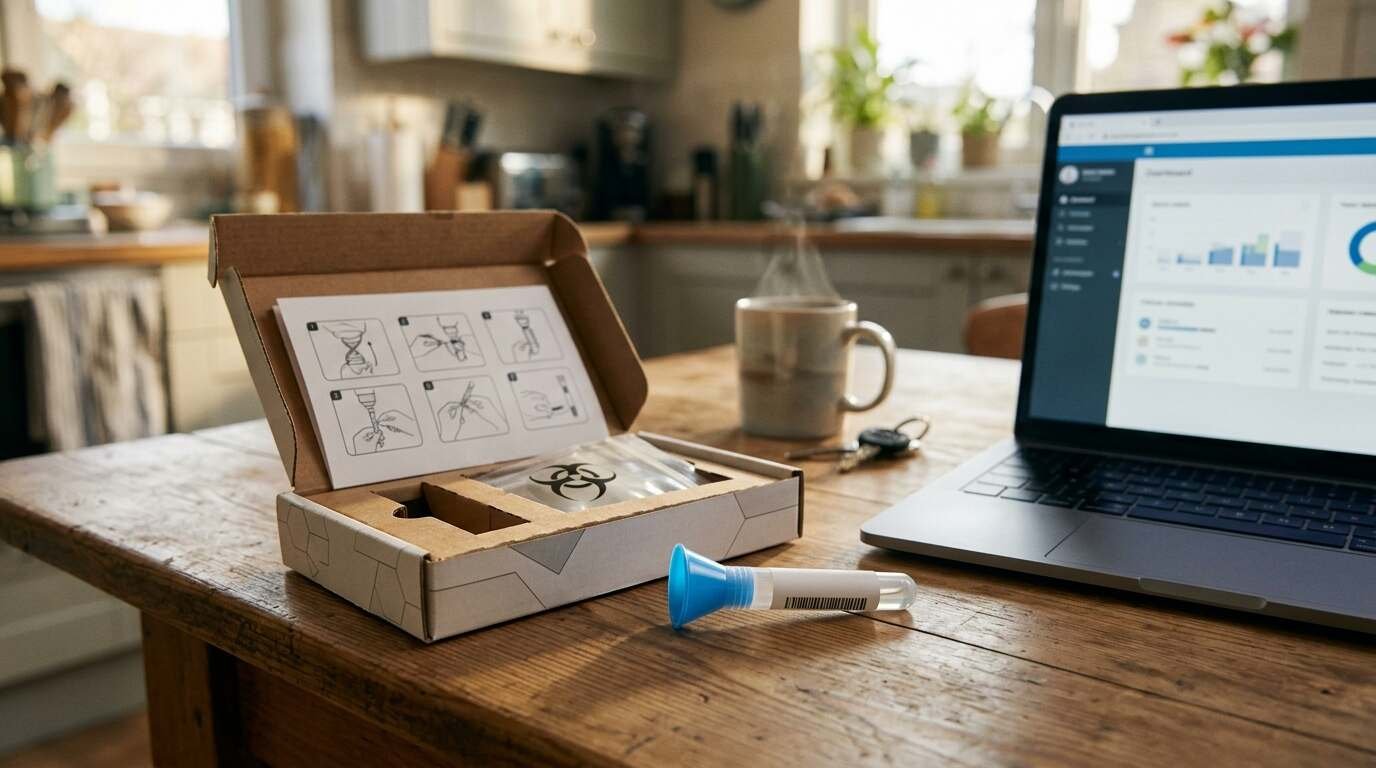
Consumer DNA kits read your genetic letters well but interpret them with varying care. Here is what holds up, what does not, and what to do with a result.
Consumer DNA tests are better at some jobs than others, and the gap between the two is where most disappointment comes from. A spit-in-a-tube kit can read the letters of your DNA with high technical reliability. What it does with those letters afterward, whether that means sorting you into regions of the world or flagging a health risk, involves much more judgment, and judgment is where errors creep in.
This guide separates the parts that are solid from the parts that are soft. It covers how the tests work, why two companies can give you different ancestry results, what researchers found when they checked health-related raw data against clinical labs, and what happened to customer data when 23andMe went bankrupt in 2025. Nothing here is medical advice; it is an explanation of what the tests can and cannot do.
How do consumer DNA tests actually work?
Most kits use a chip, often called a SNP array, that checks a few hundred thousand to a few million specific spots in your genome where people are known to differ. One source describes such chips as covering roughly 0.02 percent of the genome. Sequencing, by contrast, reads far more of the letters, around 3,000 times as many bases according to the same description.
That design has consequences. A chip can only report on the variants it was built to look for. If a variant that matters to you is not on the chip, the test is silent about it, and silence is easy to mistake for a clean bill of health.
Your saliva sample is the starting material. The lab extracts DNA, runs it across the chip, and produces a raw file of genotypes. Everything else, the ancestry pie chart, the cousin list, the trait reports, is software working on top of that file.
Is the raw data itself accurate?
Mostly, yes, for the spots the chip covers. Technical accuracy is usually the strongest part of the pipeline. The weak points sit elsewhere: a mix-up with a sample, a variant that the chip reads poorly, or a rare variant sitting in a region where chips are known to struggle.
Rare variants deserve special care. Chips are designed around variants common enough to be worth printing on the chip, and rare ones are harder to call correctly. That matters because many of the health findings people worry about, such as variants in cancer-risk genes, are rare.
One often-cited check came from a clinical lab, Ambry Genetics, which looked at 49 patients who had been referred for confirmatory testing after a consumer test flagged a variant. Published in Genetics in Medicine, the report found that as many as 40 percent of the variants in the consumer raw data were false positives, meaning the clinical lab could not confirm them. The sample was small, and the authors themselves noted that it may not represent everyone who tests, since it only included people who sought confirmation. Still, the direction of the finding is why confirmation testing is standard advice.
Why do health reports cause so much confusion?
Reading a variant is one task. Knowing what it means for you is another.
Researchers who study test quality usually split the question into three parts. Analytic validity asks whether the lab measures the variant correctly. Clinical validity asks whether the variant is linked to the disease. Clinical utility asks whether knowing the result helps anyone make a better decision. A test can pass the first and fail the other two.
The Ambry report adds a concrete example: eight variants in five genes had been labeled “increased risk” in third-party interpretation, yet clinical labs classify them as benign. In other words, the lab behind the chip read them correctly, and the interpretation was the part that went wrong.
There is also the matter of how common scary-looking variants are. A study published in Nature in 2016, drawing on the Exome Aggregation Consortium, found the average person carries about 54 variants that had been assumed to be harmful but show no obvious ill effect. Finding a variant with an alarming name in your file is therefore less informative than it sounds.
What does the FDA actually review?
The FDA looks at consumer tests according to risk. Ancestry and general wellness tests are not reviewed by the agency. Tests that make moderate- or high-risk health claims generally are, and companies must show that results are accurate and that ordinary consumers can understand them.
The agency’s own guidance is blunt: no test is 100 percent accurate, a negative result does not rule out risk because not every relevant variant is tested, and a positive result does not mean a condition will develop. Environment and lifestyle contribute to most health conditions. The FDA also advises talking with a health care provider, ideally a genetic counselor or medical geneticist, before changing diet or medical care based on a result.
Some history helps here. In 2013 the FDA stopped 23andMe from marketing its health analysis, partly over worry that people would misread the results. The company later won authorization for specific reports, including a limited BRCA1/BRCA2 report covering selected variants. That limited scope is the point: a report covering a few chosen variants is not a full screen of those genes, and the agency’s page on these tests says so.
Why do ancestry results differ between companies?
Ancestry estimates are statistical guesses, and different companies make them differently. The basic method compares your DNA with reference groups of people whose ancestors are believed to come from particular places, then reports which groups you resemble most. A typical test uses at least 20 populations.
Change the reference panel, the number of regions, or the algorithm, and your percentages shift. That is the main reason one person can get two different results from two companies without anything being wrong with either sample. Genetic genealogists have long warned that these breakdowns may be inaccurate and, at best, approximate.
The estimates also lean on what the panel knows. Regions that are poorly represented in reference data get blurrier results. And the borders on the chart are tidy, while real populations have mixed and moved for thousands of years.
If you want a gut check on how seriously to take your percentages, treat them as a rough sketch for large regions, and the finer slices (a specific country, a small percentage) as the least certain part.
How good are the relative matches?
This is the part of ancestry testing that tends to hold up best, though it has its own limits. Autosomal DNA, the kind these tests read, is inherited from all your ancestors in recent generations, so a long shared segment between two testers is good evidence of a recent common ancestor.
Short segments are another story. They can match by coincidence rather than by descent. Segment length gives more confidence in a real shared ancestor, which is why serious genealogists pay attention to it.
Distant cousins also vanish. One summary estimates that about 10 percent of third cousins, 55 percent of fourth cousins, and 85 percent of fifth cousins share no detectable DNA at all. A missing match therefore does not disprove a family link, and comparing results with known relatives remains the most reliable check.
What happens to your data and who else can see it?
A DNA file is unlike a password, because you cannot change it, and relatives share parts of it. That makes privacy a bigger question than for most consumer products.
Three episodes show the range of risk. In 2018, the arrest of a suspect in the Golden State Killer case popularized investigative genetic genealogy, in which police search consumer databases for relatives of an unknown person. GEDmatch tightened its privacy rules in May 2019 after criticism. In October 2023, 23andMe suffered a breach in which hackers used reused passwords to reach data tied to about 6.9 million users.
Then came the bankruptcy. 23andMe filed for Chapter 11 on March 23, 2025. A court-supervised auction followed, and the sale to TTAM Research Institute, a nonprofit led by co-founder Anne Wojcicki, closed on July 14, 2025, at a reported $305 million. During the proceedings, California’s attorney general reminded residents of their right to ask for deletion of their data. Customers who tried to delete reported that the company kept some information for a period to meet legal obligations.
Under federal law known as GINA, health insurers cannot use genetic information in coverage decisions, and employers with 15 or more workers cannot use it in hiring or firing. Life, disability, and long-term care insurance are not covered by that law, according to the FDA.
Common questions
Can a DNA test tell me my exact ethnicity?
No. It estimates which reference populations your DNA most resembles. The numbers depend on the company’s reference panel and method, so they can change when the company updates its software.
Should I act on a health result from a consumer test?
Treat it as a prompt for a conversation, not a diagnosis. The FDA recommends talking with a health care provider or genetic counselor, and confirmatory testing in a clinical lab may be appropriate before anyone changes treatment.
Does a negative result mean I am in the clear?
No. A consumer test checks a limited set of variants, and a negative result does not rule out risk. The FDA says so directly.
Why do siblings get different ancestry percentages?
Each child receives a different random half of each parent’s DNA, so full siblings can show different percentages from the same two parents. The estimate is tied to the particular pieces you inherited.
Can I delete my data if I change my mind?
Most companies offer a deletion process, though the details vary, and some data may be kept for legal reasons. Read the privacy terms before testing, and check the deletion options of any company that holds your sample.
What to remember
Consumer DNA tests read your letters well and interpret them with varying care. Ancestry breakdowns are estimates that depend on the company’s reference data. Health findings can include false positives and variants that clinical labs consider harmless, so anything that matters deserves confirmation through a clinical channel.
Privacy deserves as much thought as accuracy. Once your genotype exists in a company’s database, it can be breached, subpoenaed, or sold along with the business. That is no reason to avoid testing, only a reason to decide with open eyes.
Further reading
Popular, readable account of what DNA can and cannot say about ancestry. See it on Amazon (affiliate link)
As an Amazon Associate I earn from qualifying purchases. A commission may be earned if you buy through this link, at no extra cost to you.
Sources




One thought on “How Accurate Are Consumer DNA Tests? Ancestry and Health”