






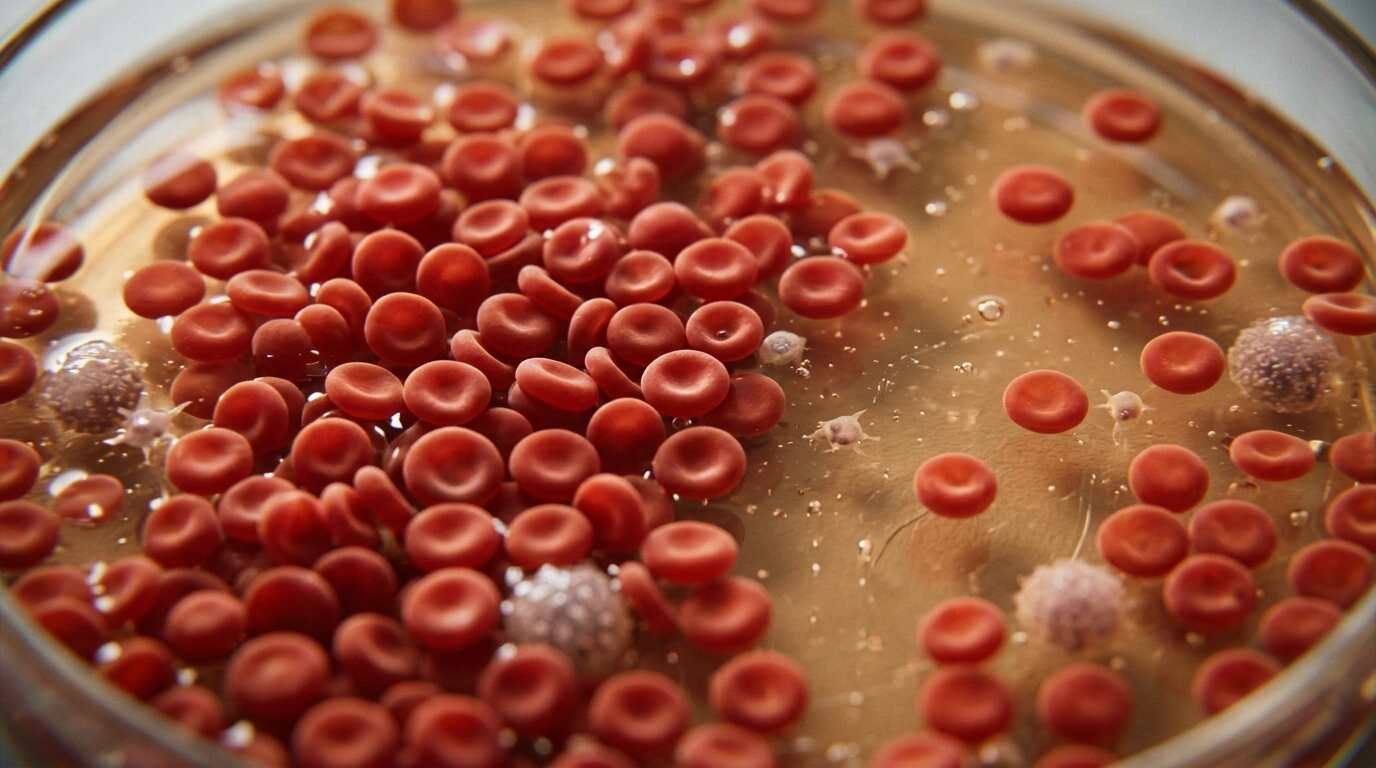
Two one-time gene therapies were approved for sickle cell disease in December 2023. Here is how each works and what the evidence and limits are.
Gene therapy for sickle cell disease went from a research hope to an approved treatment in December 2023, when the US Food and Drug Administration cleared two one-time therapies on the same day. They are among the first medicines to change a patient’s own genetic instructions in this condition, and they work by a clever workaround rather than a straight repair. This post explains the disease, how the two therapies differ, what the trials showed and what stands between most patients and treatment.
What is sickle cell disease?
Sickle cell disease is a group of inherited conditions that affect hemoglobin, the protein in red blood cells that carries oxygen. The cause is a single-letter change in the HBB gene, which codes for part of hemoglobin. The change swaps one amino acid, glutamic acid, for another, valine, at position 6 of the beta-globin chain, producing an abnormal form called hemoglobin S.
In low-oxygen conditions, hemoglobin S sticks together in rigid strands that distort red cells into a crescent shape. Sickled cells do not squeeze through small vessels easily, and they can block blood flow. The results include sudden pain episodes called vaso-occlusive crises, anemia, stroke, infections and damage to organs such as the kidneys, lungs and eyes.
How is it inherited, and who has it?
It is autosomal recessive. A child gets the disease by inheriting a sickle gene from each parent. If both parents are carriers, each pregnancy has a 25 percent chance of a child with the disease, 50 percent of a carrier, and 25 percent of neither. Carriers have sickle cell trait and usually have no symptoms.
The numbers are large. The US National Heart, Lung, and Blood Institute estimates more than 100,000 people in the United States and 8 million worldwide are affected. In the US, over 90 percent of those with the disease are non-Hispanic Black or African American, and about 1 in 365 Black babies is born with it. A 2021 global estimate put the figure at about 7.7 million people, with around 80 percent of cases in sub-Saharan Africa.
That gene is common in places where malaria has been common, and the likely reason is protective: carriers are less likely to suffer severe malaria, because the parasite grows poorly in their red cells. That is the standard explanation, supported by decades of evidence.
Two facts help explain why the disease is so common. About 1 in 13 Black babies has sickle cell trait, meaning one copy of the gene. Because it is a lifelong illness, the burden accumulates: pain crises often need hospital care, and recurring episodes can lead to disability or early death.
What treatments existed before gene therapy?
Supportive care has long been the foundation: vaccinations, daily penicillin in young children, hydration, pain control and transfusions when needed. Hydroxyurea, the first approved drug, reduces crises and may extend survival, partly by raising fetal hemoglobin, though it is underused. A drug called voxelotor (Oxbryta) was withdrawn by Pfizer in September 2024.
The only established cure has been a blood and bone marrow transplant from a well-matched donor. That can work, but it requires a suitable donor, and the procedure carries serious risks. Many patients have no such donor. Gene therapy was designed to sidestep that problem by using the patient’s own cells.
How does the gene therapy work in general?
Treating sickle cell disease by gene therapy is not a new idea. The first attempt in a single patient was in 2014, followed by clinical trials that treated several people. Both approved therapies follow the same outline. Doctors collect blood-forming stem cells from the patient. In a laboratory, the cells are modified. The patient then receives high-dose chemotherapy, called myeloablative conditioning, to clear out the existing marrow stem cells, and the modified cells are infused back as a single dose. They settle in the bone marrow and begin producing red blood cells with the change.
So the two therapies take opposite strategies. Casgevy removes the brake on a gene the body already has. Lyfgenia adds a new gene the body did not have. Because the cells are the patient’s own, there is no donor and no risk of the body rejecting a graft in the usual sense. The cost is the conditioning step, which is harsh. It involves a long hospital stay while the new cells engraft and begin to function.
What does Casgevy do?
Casgevy (exagamglogene autotemcel) uses CRISPR gene editing, and it does not fix the sickle mutation. Instead, it goes after a switch. Before birth, babies make fetal hemoglobin, which does not sickle. After birth, a gene called BCL11A turns fetal hemoglobin production off and adult hemoglobin takes over. Casgevy edits the BCL11A control region in the patient’s stem cells so the off switch no longer works in red cell precursors, and the cells produce fetal hemoglobin again.
The extra fetal hemoglobin dilutes the sickling hemoglobin and prevents red cells from sickling. The FDA describes it as the first approved therapy using CRISPR/Cas9. The UK approved it in November 2023, and the FDA followed on 8 December 2023 for patients 12 and older with recurrent vaso-occlusive crises. Vertex Pharmaceuticals and CRISPR Therapeutics developed it.
What does Lyfgenia do?
Lyfgenia (lovotibeglogene autotemcel) takes a different route. It uses a modified virus, a lentiviral vector, to insert a working gene for a changed hemoglobin called HbAT87Q. That form works like normal adult hemoglobin and is less prone to sickling, and it sits alongside the patient’s own hemoglobin rather than replacing it.
The label carries a boxed warning: blood cancer has occurred in treated patients, and lifelong monitoring is advised. The FDA announcement describes that warning for Lyfgenia only, and long-term follow-up for both therapies is ongoing.
What did the trials show?
For Casgevy in sickle cell disease, 44 participants were treated. Of 31 with enough follow-up to be evaluated, 29 (93.5 percent) had no severe vaso-occlusive crises for at least 12 consecutive months during 24 months of follow-up. All treated participants engrafted, with no graft failure or rejection.
Lyfgenia’s 24-month study of patients aged 12 to 50 found 28 of 32 (88 percent) with complete resolution of vaso-occlusive events between 6 and 18 months after infusion.
Two cautions apply. These were small, single-arm studies without a comparison group, and the follow-up is short compared with the decades a person lives with the disease. The trials are strong evidence that the therapies reduce crises; how long the benefit lasts and what late effects emerge is still being learned.
What are the risks?
Many of the side effects come from the chemotherapy conditioning. For Casgevy, the most common reported were low platelet and white blood cell counts, mouth sores, nausea, musculoskeletal and abdominal pain, vomiting, febrile neutropenia, headache and itching. Lyfgenia’s common effects were similar, with the addition of low red blood cell counts, and it carries the cancer warning.
Patients and families weigh this against living with the disease, which has its own risk of severe pain, organ damage and early death. The decision is individual and belongs with a hematology team.
Why can’t most patients get it?
Price and infrastructure. The US list price of Casgevy is $2.2 million per patient. Estimates of the cost at which it would be cost-effective fell between $1.35 million and $2.05 million, depending on perspective. Treatment also requires a specialized center able to collect stem cells, give chemotherapy and manage a long hospital stay.
Poverty is not the only obstacle in the countries hardest hit. Nigeria is estimated to have about 150,000 affected births a year. In Uganda, one source reports that the country’s only dedicated sickle cell clinic sees about 200 patients daily, and that national data have not been updated since the early 1970s. Stigma, misinformation and limited research funding add to the problem.
The access gap is starker globally. About 80 percent of people with the disease live in sub-Saharan Africa, where, in settings without good health care infrastructure, an estimated 50 to 90 percent of affected children die before age five. These therapies, as designed, are not within reach of most of the people who need them.
Approvals spread in steps. Bahrain approved Casgevy on 2 December 2023, the FDA followed on 8 December for sickle cell disease and in January 2024 for transfusion-dependent beta thalassemia, and the European Union gave conditional authorization in February 2024. The first commercial case in the US, a patient named Kendric Cromer, was discharged from Children’s National Hospital in October 2024, which shows how recent real-world use is.
Progress continues in wealthier settings. England’s NHS planned to offer Casgevy from 2025, and in July 2026 the FDA expanded its approval to patients aged 2 and older with sickle cell disease and recurrent crises, or transfusion-dependent beta thalassemia.
Common questions
Is gene therapy a cure for sickle cell disease?
It is described as potentially curative by many clinicians, but the long-term data are still being collected. The trials show most treated patients free of severe crises for at least a year. A cure is a stronger claim than the evidence yet supports.
Does CRISPR fix the faulty gene?
Not in Casgevy. It leaves the sickle mutation in place and instead reactivates fetal hemoglobin by editing BCL11A.
Who can receive these therapies?
In the US, patients 12 and older with recurrent vaso-occlusive crises were approved for Casgevy and Lyfgenia in 2023, and Casgevy was extended to ages 2 and up in 2026. Eligibility is decided by a specialist team.
How long does treatment take?
It is a single infusion, but the whole process includes collecting cells, laboratory manufacturing, chemotherapy and a prolonged hospital stay. The sources reviewed here do not give an exact total duration.
What are the alternatives?
Supportive care, hydroxyurea and, for some people with a matched donor, a bone marrow transplant. A hematologist can explain which options apply.
What to remember
Sickle cell disease comes from a single-letter change in the HBB gene. Two gene therapies approved in December 2023 use a patient’s own stem cells: Casgevy edits a switch to bring back fetal hemoglobin, and Lyfgenia adds a gene for a less sickle-prone hemoglobin.
Early results are strong, and risks are real, including harsh chemotherapy and, for Lyfgenia, a boxed warning for blood cancer. The main limits are long-term follow-up, price and access. For most of the world’s patients, these treatments remain out of reach.
Further reading
Popular account of the development of CRISPR, the editing tool used in Casgevy. See it on Amazon (affiliate link)
As an Amazon Associate I earn from qualifying purchases. A commission may be earned if you buy through this link, at no extra cost to you.
Sources
- FDA approves first gene therapies to treat patients with sickle cell disease
- Sickle cell disease (NHLBI, NIH)
- Sickle cell disease (Wikipedia)
- Gene therapy for sickle cell disease (Wikipedia)
- Exagamglogene autotemcel (Wikipedia)
- FDA expands use of first sickle cell disease gene therapy for children as young as 2 years (HealthDay, July 2026)



