DJI’s Osmo 360 II is the company’s second-generation 360-degree camera, and European buyers can order it this week. It records 360-degree video at up to 8K and 60 frames per second, uses hand-swappable lenses, and stores footage on 105GB of built-in memory. Pricing in Europe starts at €589 or £509. In the United States, no […]
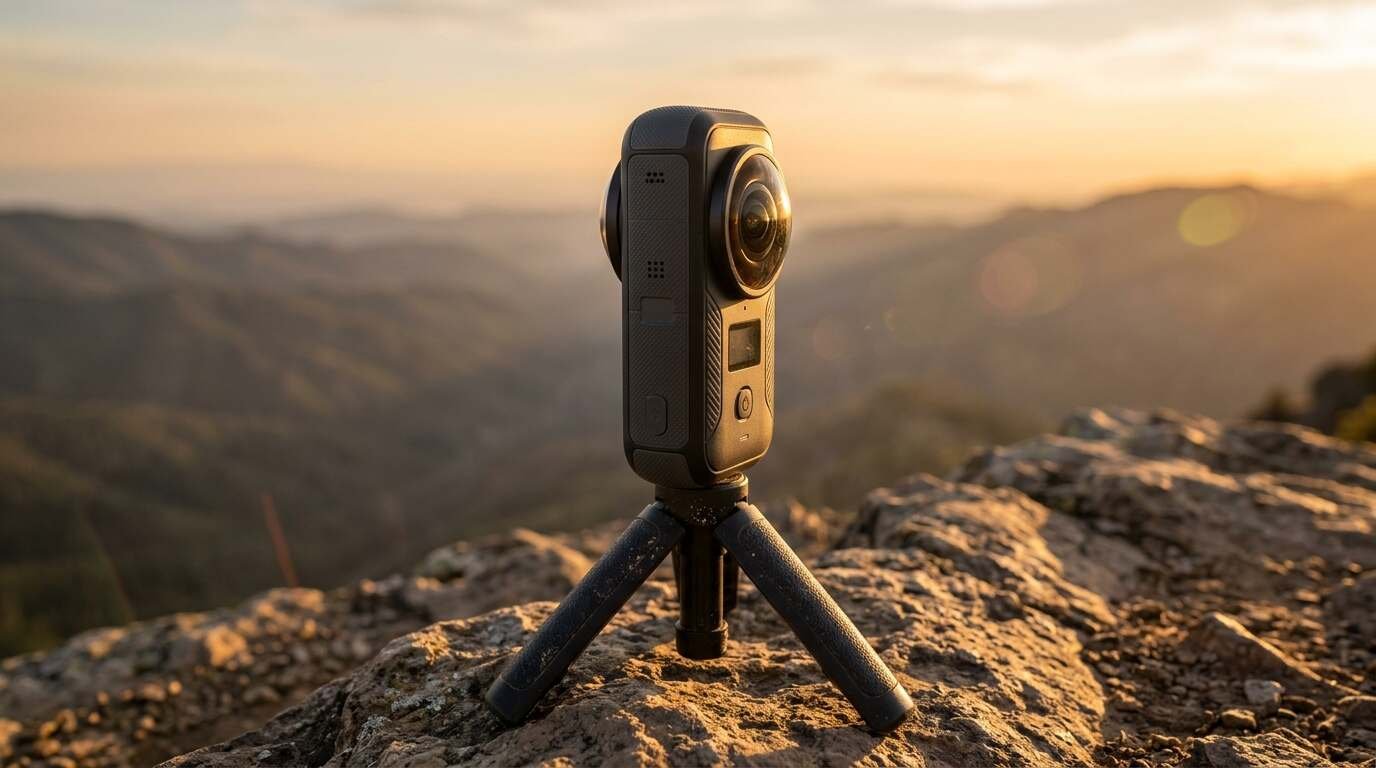
DJI’s Osmo 360 II is the company’s second-generation 360-degree camera, and European buyers can order it this week. It records 360-degree video at up to 8K and 60 frames per second, uses hand-swappable lenses, and stores footage on 105GB of built-in memory. Pricing in Europe starts at €589 or £509. In the United States, no price or store listing exists.
DJI announced the camera globally on September 3 and showed it to the public at IFA in Berlin, September 4 to 8. A China launch preceded both, in August. The specifications below are manufacturer claims gathered from DJI’s launch materials and trade coverage; none have been confirmed by independent testing at the time of writing.
Where It Sells and What It Costs
Europe gets the camera in two bundles. The Standard Combo is €589 or £509, and the Adventure Combo is €739 or £639. DroneXL’s tracker says European shipping starts September 15, and Digital Camera World listed the Adventure Combo as available to order on the same date. China priced the camera at ¥3,299 when it launched on August 13.
The U.S. situation is unusual. DroneXL reports no price, no date and no listing on DJI’s American store, even though the camera received FCC equipment authorization on December 21, 2025. DroneXL reads that as a sign regulators are not the barrier and that the decision rests with DJI. No Film School estimates the price at about $685 by converting from other markets, which is a guess, not a quote. For reference, DroneXL puts the original Osmo 360 at $549.99 when it launched in July 2025.
How a 360 Camera Turns Two Fisheyes Into One Picture
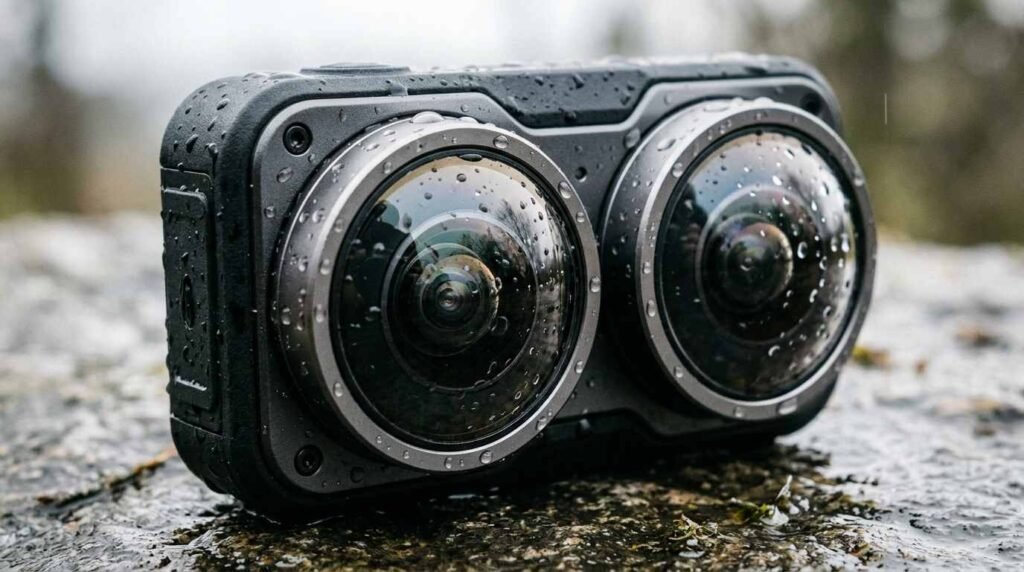
A 360 camera does not capture a sphere in a single exposure. It carries two ultra-wide fisheye lenses back to back, each seeing slightly more than 180 degrees, and software stitches the overlapping edges into one spherical image. The seam is where problems show: objects close to the camera, fast motion near the stitch line, or differing exposure between the two lenses can all produce visible joins.
Stitching quality is largely a software matter, though capture quality still sets the ceiling. Camerajabber describes the 360 II’s sensor as square, a shape that suits the job because each fisheye lens projects a circular image and a square wastes less area than a widescreen rectangle would. DJI also advertises AI-assisted stitching for its 120MP 360-degree photos.
What 8K 360 Really Delivers
Eight-K sounds like a television, but the number describes the flattened frame that holds the entire sphere. A typical 8K 360 video is 7,680 pixels wide, and DJI’s sources do not list exact frame dimensions. Spread over 360 degrees, that is about 21 pixels per degree. A viewer watching a 90-degree window sees roughly 1,920 of those pixels across, close to full HD.
That calculation is simple arithmetic rather than a DJI figure, but it explains why 360 cameras chase resolution so aggressively: the viewer crops a small slice of the sphere, so a headline resolution that sounds enormous becomes ordinary once reframed into a normal 16:9 clip. Moving to 8K at 60 frames per second, up from 8K at 50 on the original Osmo 360, helps motion look smoother in that reframed view.
Sensor Size and Dynamic Range
Descriptions of the sensor differ. DiveMagazine and DroneXL call it a 1-inch sensor, while Camerajabber lists a 1/1.1-inch square CMOS with 2.4-micron pixels and an ƒ/1.9 aperture, described as a 1-inch-equivalent image field. The naming convention is loose, since “1-inch” is a legacy label rather than a literal measurement, so the sources are likely describing the same chip in different terms. DiveMagazine adds that DJI claims 25 percent greater sensor utilization.
Dynamic range is quoted at up to 14.5 stops, versus 13.5 on the original camera. A stop is a doubling of light, so that extra stop lets the camera hold detail across a brightness range twice as wide, at least under DJI’s lab conditions. For a 360 camera, which sees sun and shadow in the same frame by design, that headroom is more important than it would be on a conventional action camera.
Video Modes, Slow Motion and Photos
According to Camerajabber, the mode list reaches well beyond the headline resolution:
- 8K at 60 fps HDR 360-degree video
- 8K at 120 fps in Vortex mode, up from 6K at 120 fps on the original, per DiveMagazine
- 4K at 240 fps slow motion, with AI frame interpolation in DJI Studio producing up to 64x panoramic slow motion in post
- 16K 360-degree timelapse
- 120MP HDR 360-degree stills
All video formats support 10-bit color and D-Log M, a flat profile that preserves highlight and shadow detail for grading. AI SuperNight 2.0 handles low light, according to DiveMagazine and No Film School.
Lenses, Waterproofing and Durability
Protruding fisheye glass is the most vulnerable part of any 360 camera, so DJI made both lenses replaceable and gave them a harder optical coating. A dual lens replacement kit costs £35 or from €39. The camera is waterproof to 10 meters without a case, and a new Invisible Waterproof Case, compatible with the first Osmo 360 as well, extends that to 50 meters. Its price and date are still pending. Operating temperature is rated down to minus 20 degrees Celsius.
The body measures 61 x 81 x 36.3 mm and weighs 183 grams. Magnetic quick-release points sit on both sides, and a quarter-inch thread allows standard mounting.
Why Shoot 360 at All: The Reframing Idea
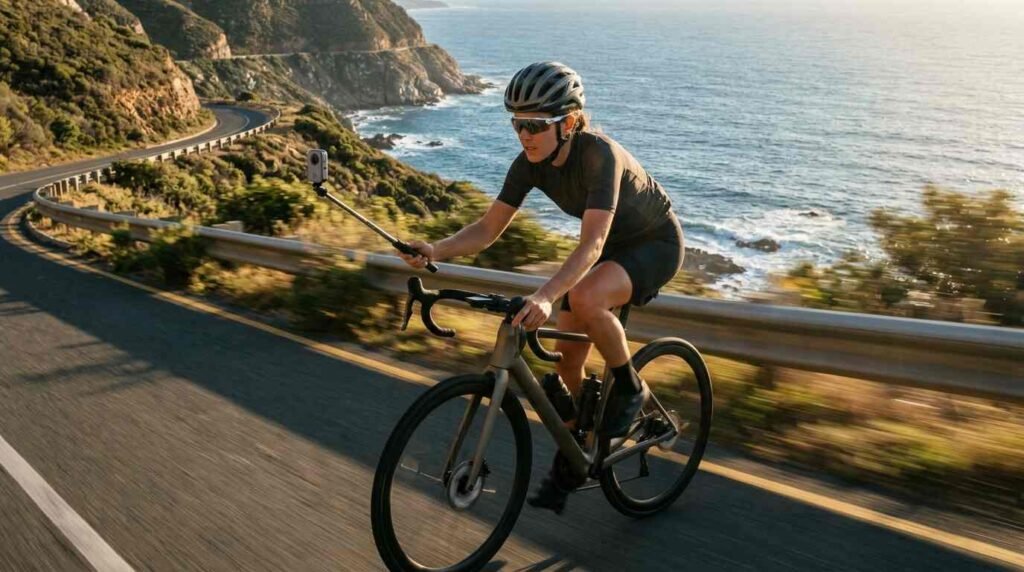
Most people use a 360 camera for what comes after the shoot. Because the camera records everything around it, the editor picks the framing later, panning and zooming through the sphere to produce a conventional flat clip. One mount point on a bike helmet can yield a forward view, a rear view and a follow-shot of the rider, all from a single take.
It also changes how the camera disappears. Mounted on a pole, the two lenses see around the stick and software erases it, which gives the impression of a drone-like third-person shot with no drone. Those workflows depend heavily on resolution and dynamic range, the two areas where this generation claims gains.
Vortex, Slow Motion and Timelapse in Plain Terms
Vortex is the name DJI uses for a bullet-time style mode, where the camera appears to orbit a subject frozen or slowed in time. Raising it to 8K at 120 frames per second, per DiveMagazine, gives the effect more resolution to survive reframing. Slow motion at 4K and 240 frames per second works the usual way: each second of real action stretches across ten seconds of playback at 24 frames per second.
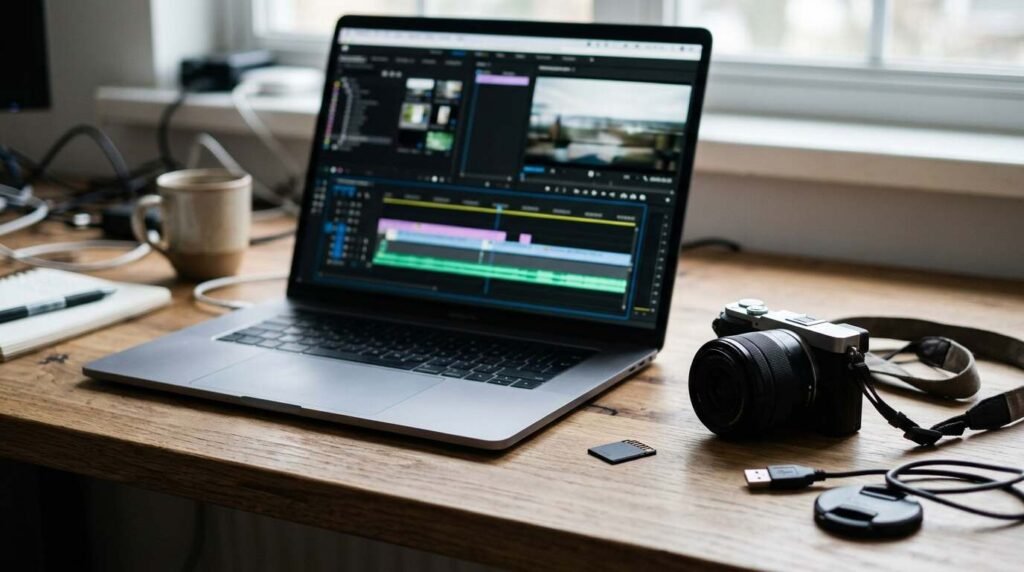
Timelapse at 16K goes the other direction. Capturing a still every few seconds and stitching them into a short clip yields a far larger frame than any video mode, which leaves room to crop into the scene, though it also produces large files that most laptops will struggle to edit smoothly.
Battery, Storage and Audio
DJI claims up to 100 minutes of continuous 8K recording at 30 frames per second, with a charge to 80 percent in 22 minutes. A Battery Extension Rod, priced at £89 or from €99, is said to add 180 minutes. Storage is 105GB of usable internal memory, which means no memory card is required, though it also means capacity cannot be expanded.
A four-microphone array with wind-noise reduction handles sound, and the camera connects directly to DJI wireless microphones, including the Mic 3 and Mic 2.
Where It Sits Among Rivals
Price comparisons give the camera context. DroneXL lists the Insta360 X6 at $699.99 in the United States, a useful benchmark for what a flagship 360 camera costs there. Because DJI has not set a U.S. price, American shoppers cannot do a like-for-like comparison today. No Film School suggests those buyers look at other action cameras, older models or secondhand units in the meantime.
For buyers in Europe, the decision turns on the specification gaps already described: the move from 8K at 50 to 8K at 60 frames per second, an extra stop of dynamic range, and lenses that can be swapped when scratched. Whether those upgrades justify the premium over the original is a question that independent testing will answer better than any launch sheet.
What to Verify Before Buying
- U.S. availability. No price or listing exists as of mid-September.
- Sensor specification. Sources disagree on how to describe the sensor size.
- European delivery dates. Camerajabber’s September 3 report said UK and EU availability would be announced later in the month; DroneXL says shipping starts September 15.
- Independent results. Battery life, stitching quality and the claimed 14.5 stops are all manufacturer figures.
Sources