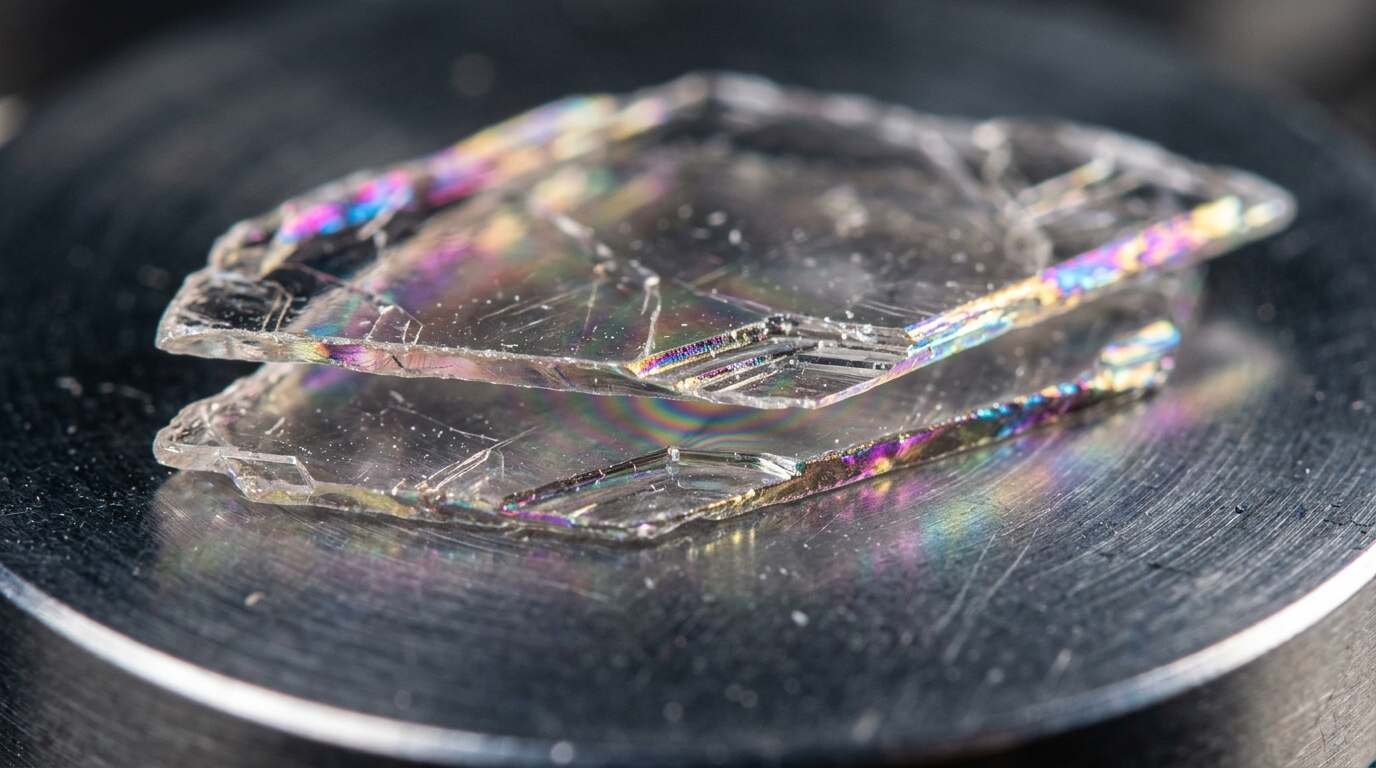
A preprint posted September 11 reports chiral edge modes in twisted BSCCO cuprates, imaged by single-spin quantum sensing. Here is what it builds on, what it claims and what is still unproven.
Chiral edge modes are one-way channels that run along the boundary of a material, and finding them in a high-temperature superconductor would be a notable step toward a long-sought goal in topological matter. On September 11, 2026, a collaboration that includes Philip Kim and Chunhui Rita Du posted a preprint (arXiv:2609.13070) claiming to have visualized such edge modes in twisted layers of the cuprate Bi2Sr2CaCu2O8+x, usually shortened to BSCCO.
The method is unusual. Instead of passing current through the sample, the team scanned a single-spin quantum sensor over it and watched how quickly the sensor’s spin relaxed. Edges that carry their own electromagnetic noise should speed that relaxation up, and the temperature dependence should reveal when a gap opens.
This post reads the claim against the theory and the experiments that came before it. The work is a preprint, posted the same day this article is dated, and everything below about its contents comes from the abstract and the listed metadata. The full figures were not available to me.
Why Twisting a d-Wave Superconductor Matters
In a cuprate, the superconducting gap has d-wave symmetry: it changes sign as you move around the Fermi surface and drops to zero along four nodal directions. Those nodes leave a population of gapless quasiparticles, which is one reason cuprates are hard to turn into clean topological devices.
A 2021 theory paper in Nature Physics by Oguzhan Can, Marcel Franz and colleagues at the University of British Columbia proposed a workaround. Stack two single-layer d-wave superconductors with a relative twist, and the combination can become a stable, fully gapped topological superconductor. The phase breaks time-reversal symmetry on its own, without a magnetic field, and hosts chiral Majorana edge modes. The calculation points to twist angles near 45°, with the effect appearing at a temperature close to the bulk critical temperature of about 90 K. The authors suggested that such structures could be assembled by peeling layers from bismuth-based cuprate crystals.
What the 2023 Experiments Established
A major experimental test came in Science in December 2023, from a team of eighteen authors whose list begins with S. Y. Frank Zhao and ends with Philip Kim. The main obstacle was fabrication. The group stacked twisted BSCCO layers into Josephson junctions using a cryogenic, solvent-free transfer in argon, with the stage held below −90 °C, which kept the buried interface nearly as clean as the inside of a single crystal.
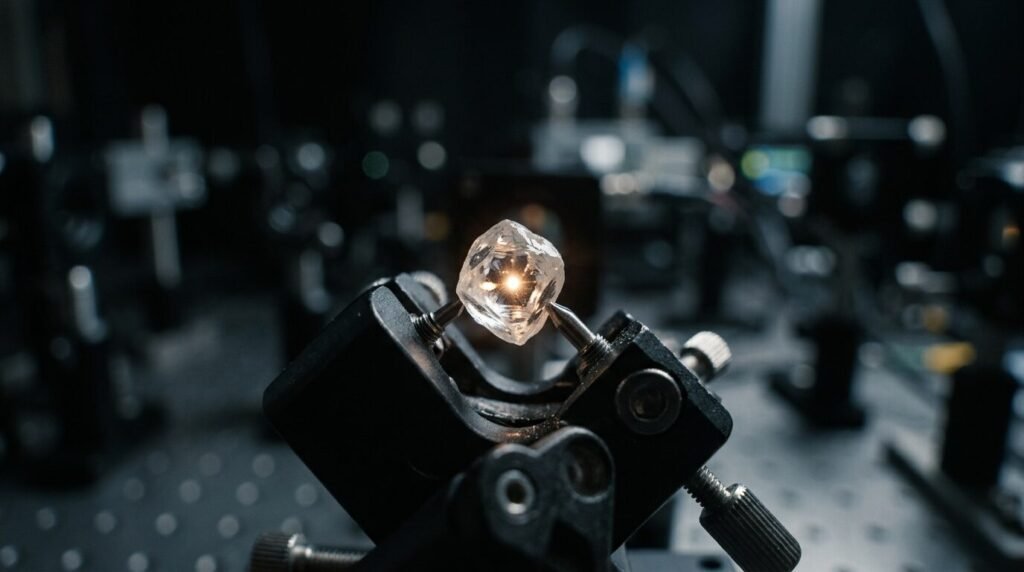
The results across 26 devices, with twist angles from 0° to 180°, were encouraging. Critical temperatures exceeded 79 K, averaging 84 K, and twist-angle disorder stayed below 0.2°. Near 45°, the critical current dropped by about two orders of magnitude relative to the untwisted case, and a junction at 44.9° remained superconducting up to 79 K. Fractional Shapiro steps and Fraunhofer interference patterns pointed to two degenerate ground states related by time-reversal symmetry. By choosing the sequence of current bias, the authors switched a junction between those states without any magnetic field, which made it a reversible Josephson diode. That diode effect faded as the temperature rose and vanished near 50 K.
Those are transport signatures. They indicate that time-reversal symmetry is broken at the interface, but they do not image an edge. A 2025 theory paper by Jefferson Tang and Pavel Volkov added more fingerprints to look for, including a soft collective Josephson plasmon mode and a second-harmonic voltage under alternating-current drive, which the authors describe as both required for and proof of broken time-reversal symmetry.
What the September 11 Preprint Adds
The new paper, “Visualizing Chiral Edge Modes in Twisted Cuprate Superconductors via Scanning-Probe Quantum Sensing,” has a long author list that includes Senlei Li as first author, Kenji Watanabe and Takashi Taniguchi, Genda Gu, Kartiek Agarwal, Philip Kim and Chunhui Rita Du. According to the abstract, the team reports three things.
- Edge modes form spontaneously in twisted BSCCO, and single-spin relaxometry images them directly.
- Tracking how the edge-driven spin relaxation changes with temperature lets the authors estimate the size of the topological gap opened at the nodal points, and how it behaves near the critical temperature for different twist angles.
- Alternating chiral domains appear, defined by the edge modes, along with signs of topology induced by an in-plane magnetic field in 45° twisted BSCCO.
The abstract gives no numerical values for the gap or the temperatures. Those will be in the figures and the text, which I did not read.
How Single-Spin Relaxometry Can See an Edge
The abstract does not name the sensor. Scanning-probe quantum sensing of this kind is commonly built around a nitrogen-vacancy defect in diamond, so that is my working assumption, and it should be checked against the paper.
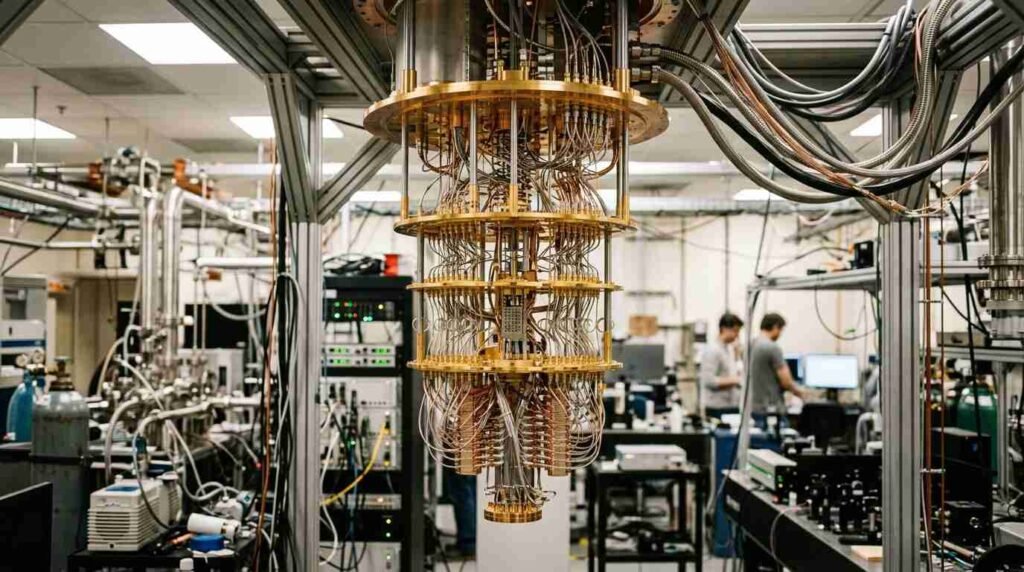
The principle, as general background, runs like this. A single spin prepared in a known state relaxes back toward equilibrium at a rate that depends on how much magnetic noise sits at its transition frequency. Bring it close to a sample and any fluctuating currents nearby add noise, shortening the relaxation time. A chiral edge mode carries current along the boundary, so the relaxation rate should change in a pattern that follows the edge. Warming the sample through the transition, where the gap closes, should change the pattern in a recognisable way. That is how a relaxation measurement could be converted into a map of edge states and an estimate of a gap.
Four Rungs of Evidence
| Step | What it shows | Type | Status as of September 11, 2026 |
|---|---|---|---|
| Prediction | Twisted d-wave layers near 45° can form a gapped, chiral topological phase | Theory (2021) | Established as a proposal |
| Interface symmetry breaking | Two degenerate states, a switchable Josephson diode | Transport (Science, 2023) | Published |
| Dynamical fingerprints | Josephson plasmon and second-harmonic voltage | Theory (2025) | Predictions in the literature I retrieved |
| Edge-resolved imaging | Spatially resolved edge noise, gap estimate, chiral domains | Quantum sensing (preprint, September 11, 2026) | Unreviewed claim |
Where the Claim Is Fragile
The distance between “edge noise” and “chiral edge mode” is where scrutiny should land.
- It is a preprint. Peer review may change the conclusions, the error bars or the interpretation.
- Relaxometry reads magnetic noise, not chirality. My caution, not the authors’ words: noise at an edge can have other sources, such as vortices, disorder or conventional edge states, and chirality has to be inferred from the pattern of domains and its response to field.
- The abstract speaks of chiral edge modes and topology but does not mention Majorana modes. Any step from this result to topological quantum computing would be a step the abstract does not take.
- Twist-angle control matters enormously. The 2023 work needed disorder below 0.2°, and edge physics near 45° could shift quickly with small deviations.
- The gap estimates rest on a temperature-dependent signal and a model. How they compare with the transport critical temperatures (79 K and above in the earlier devices) is something the full paper has to show.
What Would Strengthen It
These are my suggestions, not statements from the paper. Measuring the sensor signal and the Josephson diode behaviour on the same device would tie the two lines of evidence together. Reversing the chiral domains with a field of the opposite sign, and showing the edge signal responds as predicted, would strengthen the chirality reading. A second probe, such as scanning magnetometry with a different sensor, would guard against an artifact of one technique. And an independent group reproducing the twist-angle dependence would turn a striking preprint into an established result.
Frequently Asked Questions
What does “chiral” mean here?
A chiral edge mode propagates in one direction only along a boundary. Its direction is set by the broken time-reversal symmetry, so domains with opposite sign carry modes that run the opposite way.
Why 45 degrees?
The 2021 theory identifies twists near 45° as the regime where a fully gapped, time-reversal-breaking topological state is expected. As general background, at that angle the nodal directions of one layer line up with the gap maxima of the other, so the combined structure can open a gap where each layer alone has none.
Does this bring topological quantum computers closer?
Not directly. The abstract describes a high-temperature topological superconducting platform and does not report Majorana modes or any device operation. It is a materials result, not a computing one.
Sources and Verification Notes
- Li et al., “Visualizing Chiral Edge Modes in Twisted Cuprate Superconductors via Scanning-Probe Quantum Sensing,” arXiv:2609.13070, submitted September 11, 2026
- Can et al., “High-temperature topological superconductivity in twisted double-layer copper oxides,” Nature Physics 17, 519–524 (2021)
- Zhao et al., “Time-reversal symmetry breaking superconductivity between twisted cuprate superconductors,” Science 382, 1422–1427 (2023), accepted-manuscript copy
- Tang and Volkov, “Dynamical signatures and control of time-reversal breaking in twisted nodal superconductors,” arXiv:2507.22495
Verification notes: details of the new preprint come from its abstract and metadata only, so none of its figures, error bars or methods were checked. I could not open the journal page for the 2023 Science paper and used an accepted-manuscript copy for its numbers. The explanation of relaxometry, the account of why 45° works and the assumption that the sensor is a nitrogen-vacancy centre are my own background reading, not statements from the preprint. Journal and publication status refer to what was retrievable on the dated day.