






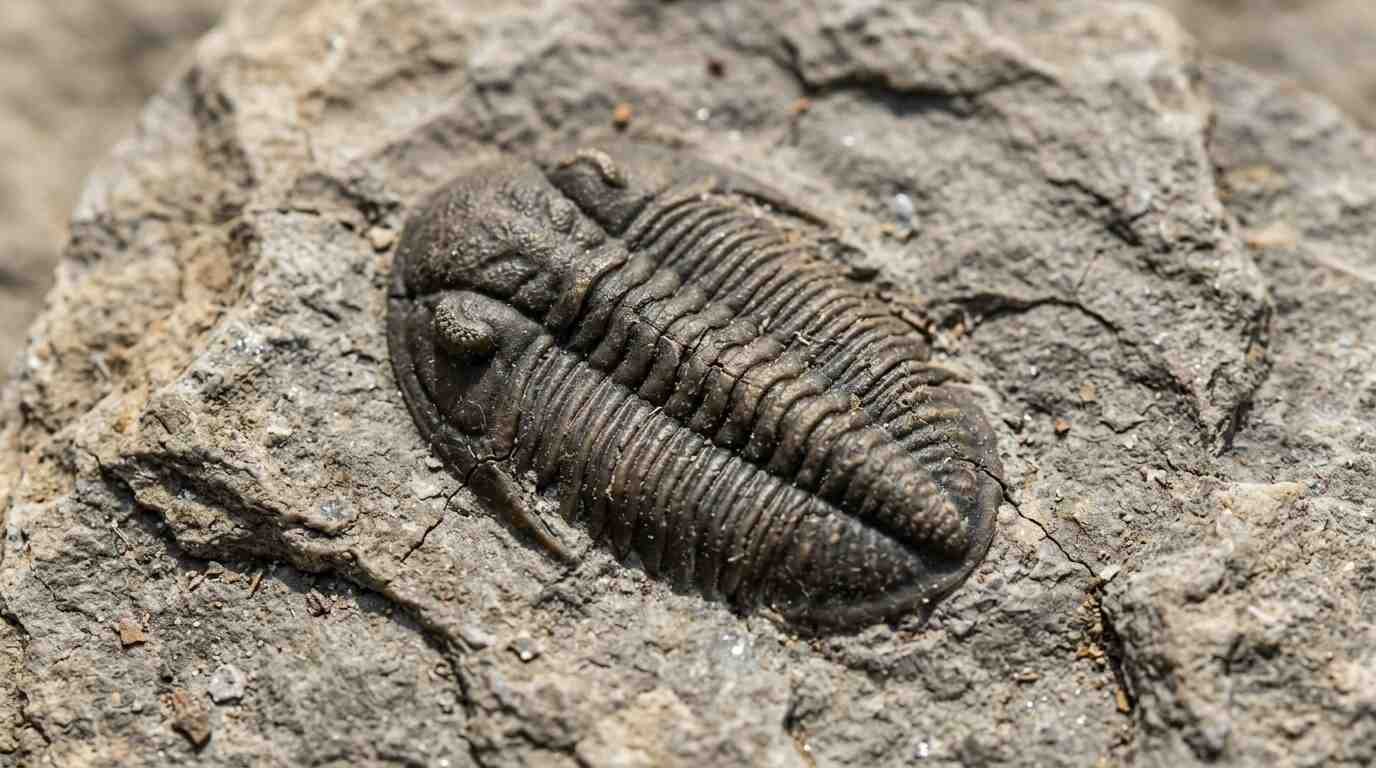
Around 539 million years ago, most major animal groups appear in the fossil record. Here is what was found, what came before, and which explanations are still being argued over.
The Cambrian explosion is the name given to a stretch of Earth history, beginning a little under 540 million years ago, in which most of the major groups of animals appear in the fossil record within a geologically short window. Before it, the fossil record offers soft-bodied oddities and little else. After it, the seas hold arthropods, molluscs, early chordates and predators with spines and claws. That contrast has fascinated paleontologists since Darwin, who counted the apparent suddenness among the difficulties facing his theory.
The picture today is more nuanced than “life appeared overnight.” This article covers what the fossils show, what came before, what might have triggered the change, and which parts of the story are still argued over.
What was the Cambrian explosion?
It is a burst of animal diversification at the start of the Cambrian period. The most widely used dating puts its beginning at about 538.8 million years ago and its duration at roughly 13 to 25 million years. For perspective, that is long compared with a human lifetime and brief compared with the roughly 3.5 billion years that life had already existed.
The dates have not been fixed. Estimates for the start of the Cambrian itself moved from 542 million years ago in 2004 to 541 million in 2012 and to 538.8 million in 2022, as better rock dating came in. The period of unusually fast change appears to have wound down around 521 million years ago, when trilobites first show up in the fossil record.
“Explosion” is a label of convenience. It describes the pace relative to what came before, not a literal blast, and some researchers prefer the term “Cambrian radiation.”
Which animals appeared?
Nearly all the animal phyla that exist today have a representative in Cambrian rocks, including the earliest chordates, the group that contains vertebrates. A phylum is a broad body plan: arthropods, molluscs, annelid worms and so on.
The fossils include forms that look strange even now. Marrella, the most common animal in the Burgess Shale, was a small arthropod that does not fit neatly into any known arthropod class. Opabinia had five eyes and a flexible frontal appendage; it looked odd enough that it was once treated as belonging to a phylum of its own. Wiwaxia was a spiny, slug-like grazer.
This was also when many animals acquired hard parts: shells, plates, spines and mineralized skeletons. Hard parts fossilize far better than soft tissue, which partly explains why the Cambrian looks so rich. We will return to that point, because it affects how the evidence should be read.
How do we know what lived then?
Mostly from a handful of exceptional deposits that preserved soft tissue, which paleontologists call lagerstätten. Four are worth knowing.
- Chengjiang, in Yunnan, China, is early Cambrian and preserves soft anatomy in unusual detail.
- Sirius Passet in Greenland is another early Cambrian site.
- The Burgess Shale in British Columbia is middle Cambrian, around 505 million years old. Charles Walcott found it on 30 August 1909 and worked the quarry nearly every year until 1924, collecting more than 65,000 specimens.
- The Qingjiang biota in Hubei, China, reported in 2019, is about 518 million years old. It has yielded over 20,000 specimens, and about half were species new to science.
The pattern is useful because the sites span millions of years and several continents, so they cross-check each other. It also has a limitation. Exceptional preservation is rare, and each site records a particular environment at a particular moment, not the whole planet.
What came before it?
Something, as it turns out. The Ediacaran period, from about 580 to 543 million years ago, holds the Ediacara biota: large, soft-bodied organisms with frond-like, quilted or disc-shaped forms. Some may be early relatives of later groups; Kimberella, for instance, resembles a mollusc.
Trace fossils, which record movement and burrowing instead of bodies, appear from about 565 million years ago and suggest worm-like animals with a front and back end. By the late Ediacaran there are small mineralized tubes such as Cloudina, and possible sponge spicules.
These precursors weaken the idea of a sudden bang from nothing. What the Cambrian adds is variety, abundance and the combination of eyes, limbs, shells and predation in the same ecosystems. The line between “before” and “after” is sharper in textbooks than in the rocks.
Was it really that fast?
Here the experts disagree. Arguments that it was a genuine, unusually rapid event sit alongside arguments that the speed is partly an illusion. Several issues feed the uncertainty:
- Molecular clocks, which estimate branching times from DNA differences, are unreliable for this interval. Estimates made with different techniques can differ by a factor of two.
- Statistical analysis has suggested the explosion was no faster than some other radiations of animals.
- Most early animals were soft-bodied, and about two-thirds of living phyla have never been found as fossils at all. A missing fossil does not mean a missing animal.
- A bias called the push of the past can make early diversification look faster than it was, because we only see the lineages that survived to the present.
There is another wrinkle on body plans. Disparity, the spread of different body designs, appears relatively modest during the Cambrian and reaches modern levels only after the Early Ordovician radiation, which followed. So the common phrase “all body plans appeared at once” is an overstatement.
Why did it happen?
Nobody knows for certain. Several hypotheses have supporters, and they are not mutually exclusive.
*Oxygen.* Rising oxygen levels may have allowed larger, more active animals. Molybdenum isotope records link biodiversity to expanding oxygenated bottom waters. The objection is that similar oxygen conditions at other times did not produce a comparable burst.
*Predation.* An arms race between predators and prey could have driven the evolution of eyes, armor and spines. But predation existed before the Cambrian, so it likely shaped body forms more than it started the process.
*Developmental genes.* Small changes in regulatory genes such as Hox genes can have large effects on body shape. The difficulty is that much of this genetic toolkit seems to have been in place already.
*Ocean chemistry.* Boron isotope analysis published in 2014 showed rising ocean alkalinity in the early Cambrian, which would have made it easier to build calcium carbonate shells. Supplies of calcium and phosphorus have also been proposed as limiting factors.
*Snowball Earth.* Glaciations in the late Neoproterozoic might have caused a genetic bottleneck, but they happened long before the Cambrian, which makes a direct link hard to demonstrate.
If you want a summary of the state of play, it is this: a combination of environmental change, ecological feedback and evolutionary innovation is the favored class of explanation, and none of the single-cause stories is complete. That is a statement of the current research position, not a settled result.
Were the Burgess Shale animals really so strange?
For a while, the answer seemed to be yes. Walcott, working in the early 20th century, sorted the fossils into living groups, and many were treated as curiosities. Later, Harry Whittington, Derek Briggs and Simon Conway Morris re-examined the material and found a fauna more diverse and unusual than Walcott had allowed. Animals such as Opabinia and Hallucigenia seemed to resemble nothing alive.
Stephen Jay Gould’s 1989 book Wonderful Life made this a public story. He argued that Cambrian life was more varied in body plan than life today and that many lineages were evolutionary experiments that went extinct, with survival partly a matter of luck. Conway Morris, whose reinterpretations Gould relied on, disagreed with the conclusion, holding that nearly all the animals could be placed within modern phyla.
The current view sits closer to Conway Morris’s. Many Burgess Shale animals are considered stem-group members of modern phyla, branches that split off before the living groups were fully assembled, while some are crown-group members. They are early relatives, not aliens. Whether Gould was right about the role of contingency is a separate question, and one that is still discussed.
Does the Cambrian explosion challenge evolution?
No. The claim sometimes made is that the sudden appearance of animals contradicts gradual evolution. Three observations undercut it.
First, there are animal fossils and trace fossils from before the Cambrian, as described above. Second, the preservation bias is real: the Cambrian benefits from hard parts and from some extraordinary fossil beds, while the late Precambrian world mostly preserved soft tissue poorly. Third, “fast” in geological terms means millions of years, which is ample time for many generations of animals with short life cycles.
Hypotheses about its causes remain unsettled, and that is normal in science. A puzzle about timing and triggers is not a refutation of the underlying theory. It is a reason to look for more fossils and better dates, which is what researchers have been doing, and the Qingjiang discovery in 2019 is an example of how a single new site can add thousands of specimens.
Why does it matter?
For a few reasons, none of which require exaggeration. It marks the point at which complex animal ecosystems, with predators, grazers, burrowers and filter feeders, become visible in the record. It is the first interval for which paleontologists can reconstruct food webs. And the animals that appear include the ancestors of the major groups alive today, which makes the period a baseline for understanding how body plans arose.
It also illustrates how scientific knowledge changes. The start date shifted by several million years in under two decades. Animals once thought bizarre were reassigned. A site reported in 2019 added thousands of specimens, about half of them new species. Anyone reading a confident single-sentence summary should expect it to be revised.
Common questions
When did the Cambrian explosion happen?
The most widely used estimate starts it about 538.8 million years ago, with the fastest change lasting for about 13 to 25 million years. The exact figures have been revised more than once.
Did all animal phyla appear during it?
Almost all the phyla that exist today have a representative in Cambrian rocks, but not every phylum shows up in the fossil record, and about two-thirds of living phyla have no known fossils. Absence from the record is not proof of absence from the ocean.
What caused the Cambrian explosion?
The cause is unresolved. Rising oxygen, predator-prey arms races, developmental genes and changes in ocean chemistry are all proposed, and probably interacted. No single factor has been shown to account for the whole pattern.
Was there life before the Cambrian?
Yes. Single-celled life goes back billions of years, and the Ediacaran period holds large soft-bodied organisms and early animal traces. The Cambrian is the start of the abundant animal fossil record, not the start of life.
Were Cambrian animals more diverse than modern ones?
That was Gould’s claim, and it has not held up well. Later work treats many of those animals as stem-group relatives of modern groups, and measures of body-plan disparity suggest modern levels were reached after the Cambrian.
Why are so many famous Cambrian fossils from Canada and China?
Those regions contain rocks that preserved soft tissue under unusual conditions. Burgess Shale in British Columbia and the Chengjiang and Qingjiang deposits in China are exceptional preservation sites, not necessarily the only places where such animals lived.
What to remember
The Cambrian explosion is real as a pattern in the fossil record: a rapid appearance, on geological timescales, of many animal groups beginning around 539 million years ago. It is also less abrupt than the name implies, because Ediacaran organisms and trace fossils came first and because soft-bodied animals leave poor records.
The established facts are the timing, the major fossil sites and the existence of precursors. The open questions are the cause, the true speed and the accuracy of molecular dating. Anyone offering a single tidy explanation is going beyond the evidence.
Further reading
The book that brought the Burgess Shale fossils to a general audience, though some of its conclusions have been disputed. See it on Amazon (affiliate link)
As an Amazon Associate I earn from qualifying purchases. A commission may be earned if you buy through this link, at no extra cost to you.
Sources



