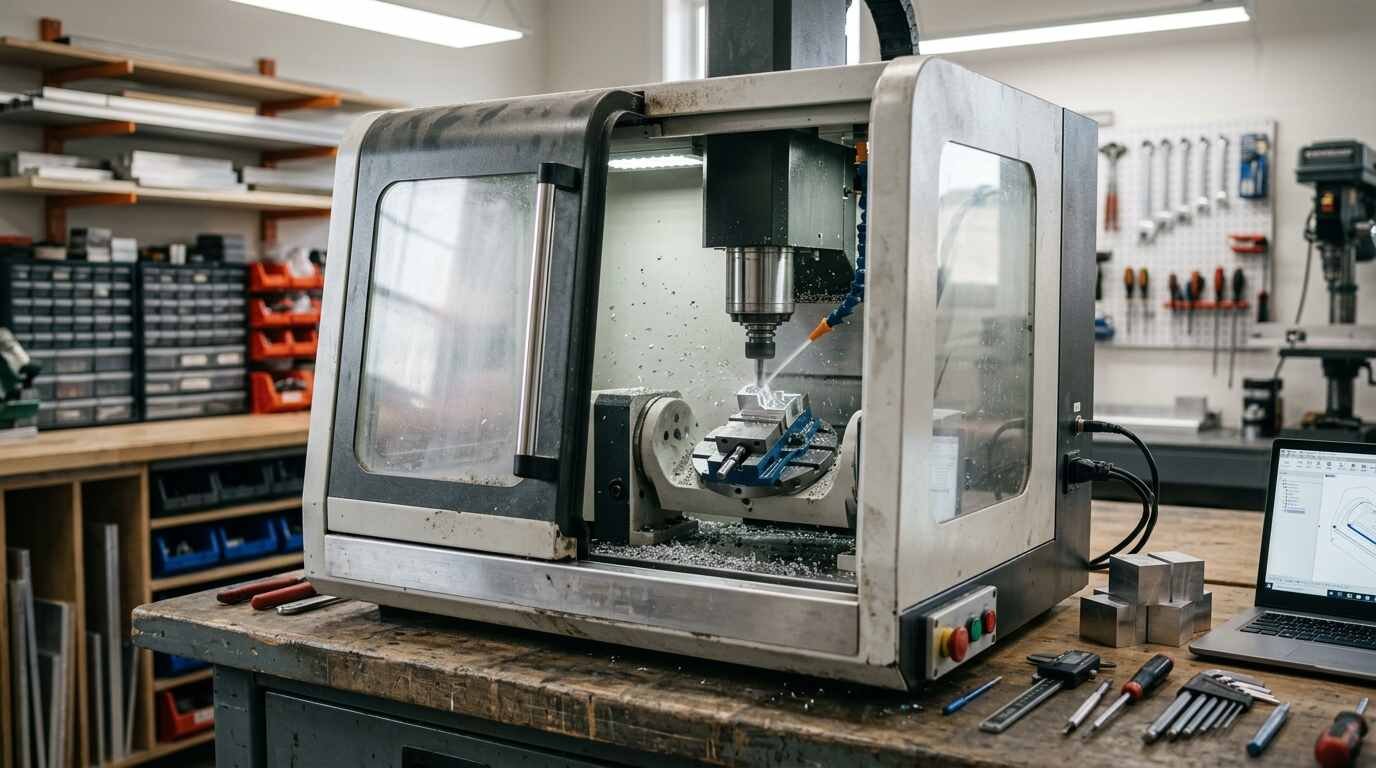
InfiMaker's K1 lists simultaneous five-axis motion, a 1.5 kW spindle and 0.01 mm repeatability for $5,199. Here is what the spec sheet says, where its pages disagree and what is still unverified.
A desktop 5-axis CNC that weighs 110 kg and starts at $5,199 is the sort of claim that sends machinists straight to the spec table. InfiMaker’s K1, open for pledges on Kickstarter as of Monday, August 24, 2026, lists simultaneous motion on five axes, a 1.5 kW spindle, a six-station tool changer and 0.01 mm repeatability.
Machines in this class usually live in shops with climate control and a service contract. Rigidity, thermal stability and controller software account for most of the cost, and none of them show up in a headline. This post sorts what InfiMaker has published by source, runs the arithmetic the listing skips and marks what nobody outside the company has verified. The Crafty Catsman’s August 24 report says it has not tested the machine, and I found no independent test either.
- Price: $5,199 starting pledge, or $4,999 with a refundable $50 VIP deposit. Android Authority reported a planned retail price of $8,599.
- Motion: Three linear axes (220 × 160 × 180 mm) plus a tilting B axis (−30° to 110°) and a rotating C axis (360°).
- Spindle and tools: 1.5 kW at up to 20,000 rpm, with five tool slots and one probe slot.
- Unverified: Every figure is InfiMaker’s own. Spindle torque, structural stiffness, warranty and landed cost are unpublished.
What “five-axis” means on a bench-top machine
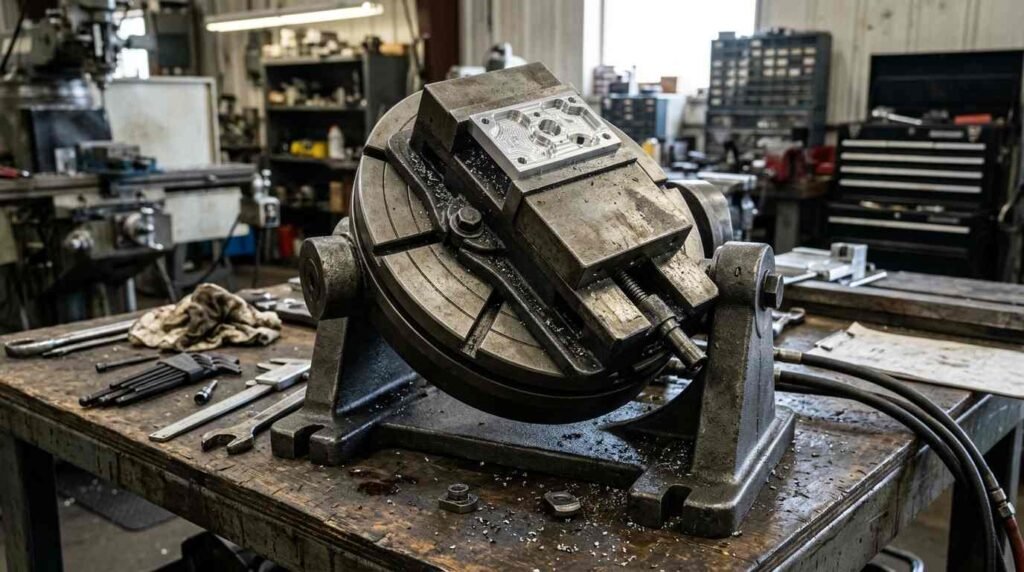
A three-axis mill moves the cutter along X, Y and Z. Add two rotary axes and the workpiece can tilt and spin as well, which lets the tool reach faces that would otherwise need a second setup. Those extra axes get used in two ways. In 3+2 machining the part is rotated to an angle and locked, then cut as an ordinary three-axis job. In simultaneous five-axis machining all five axes move together, so the cutter can follow a curved surface while holding a steady angle to it. The K1 lists both modes.
On this machine the B axis tilts from −30° to +110°, a 140° span, and the C axis turns through a full 360°. InfiMaker argues that eliminating re-clamping reduces cumulative alignment error. That is the standard case for five-axis work: each time a part is released and refixtured, a little position information is lost.
One line on the spec page deserves a closer look. RTCP, short for rotation tool center point, keeps the cutter tip on the programmed path while the rotary axes move. Without it, tilting the part would swing the tip sideways, so the controller has to add compensating motion in X, Y and Z. The K1 lists RTCP as supported. How fast that compensation can run is not listed. The rotary axes top out at 15 rpm (B) and 30 rpm (C), which works out to 90° and 180° per second.
The specs, sorted by source
InfiMaker publishes two pages with overlapping numbers, and they do not always agree. The table keeps them apart.
| Item | Listed value | Source and note |
|---|---|---|
| XYZ travel | 220 × 160 × 180 mm | Product page |
| Rotary axes | B: −30° to 110°; C: 360° | Product page |
| Rapid / cutting feed | 4,500 mm/min / 2,500 mm/min | Product page |
| Spindle | 1.5 kW, 20,000 rpm (2.2 kW rated machine power) | Product page |
| Tool changer | Six stations: five tools plus a probe | Product page |
| Repeatability | 0.01 mm (XYZ); B and C listed as 40″ | Product page |
| Positioning accuracy | ±0.015 mm (XYZ) | Announcement page table; its headline says ±0.01 mm |
| Table load | 15 kg | Product page |
| Footprint | 560 × 700 × 800 mm, or about 600 × 640 × 830 mm | Product page versus announcement page (23.62 × 25.20 × 32.68 in) |
| Mains power | 110–240 V AC, or 90–240 V AC | Product page versus announcement page |
| Noise | Under 70 dB | Company figure, measured under conditions the page does not detail |
A 1.5 kW spindle at 20,000 rpm: what it can realistically cut
Power equals torque times angular speed, so a spindle rating says little until it is paired with a speed. If the full 1.5 kW were available at 20,000 rpm, the shaft would deliver about 0.72 N·m. At 5,000 rpm the same arithmetic gives 2.9 N·m, but whether the K1’s spindle holds full power that low is precisely what the listing leaves out.
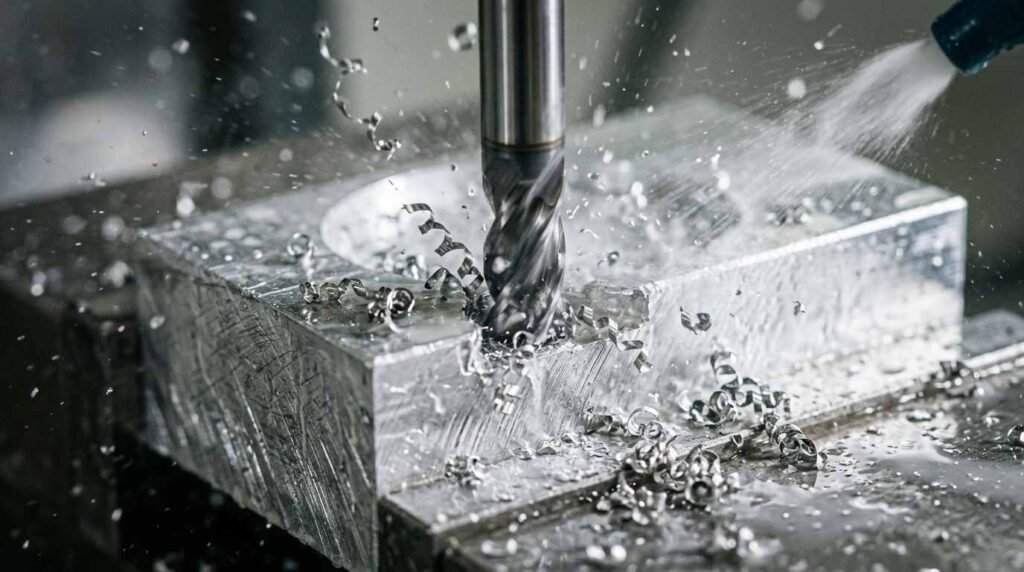
1,500 W ÷ (5,000 rpm × 2π ÷ 60) = 2.9 N·m
Max cutting feed: 2,500 mm/min ≈ 98 in/min (rapids: 4,500 mm/min ≈ 177 in/min)
Chip load at 20,000 rpm, 2 flutes, 2,500 mm/min: 0.0625 mm per tooth
The materials list is where this matters. Aluminum, brass, copper, wood, acrylic, wax, resin and composites all sit comfortably within reach of a small, fast spindle. Steel and titanium are different: they get cut slowly, under heavy force, with little tolerance for chatter. The product page names both as supported materials, while the announcement page restricts them to light-duty work. In my reading, that qualifier is the more informative of the two.
Feed rate looks like the smaller worry. Lowering rpm raises the chip load that a 2,500 mm/min ceiling allows, so feed is unlikely to be the first limit on a 110 kg machine. That is my reading, not a published result, and InfiMaker has not released a stiffness figure to test it against.
Repeatability, accuracy and the 40-arcsecond figure
Repeatability describes how closely a machine returns to the same commanded point. Accuracy describes how close that point is to where it was supposed to be. A machine can be repeatable and still wrong, which is why the two numbers should never be swapped. InfiMaker’s product page gives 0.01 mm for repeatability. The announcement page’s table gives ±0.015 mm for positioning accuracy, even though its headline says ±0.01 mm. Neither page explains how the figures were measured.
The rotary axes are listed at 40″, which I read as 40 arcseconds. Rotary error scales with radius, so what it does at the part depends on how far the surface sits from the axis.
At 60 mm radius (the edge of the 120 mm five-axis cube): 0.000194 × 60 mm = 0.012 mm
That lands in the same neighborhood as the 0.01 mm linear figure, so the two claims are at least consistent with each other. Consistent is not measured, though, and no one has published a cutting test of a finished part.
The work envelope shrinks when all five axes move
The 220 × 160 × 180 mm travel figure describes the cutter’s reach, not the size of part the K1 can make. InfiMaker lists three workpiece limits by mode, and the five-axis one is the smallest by a wide margin. Fixturing eats into it further, because the page notes that five-axis size assumes the part is centered and mounted flush.
| Mode | Max workpiece (mm) | Volume | Share of travel volume |
|---|---|---|---|
| Travel envelope (X × Y × Z) | 220 × 160 × 180 | 6.34 L | 100% |
| Three-axis | 220 × 150 × 150 | 4.95 L | 78% |
| 3+2 | 170 × 150 × 150 | 3.83 L | 60% |
| Simultaneous five-axis | 120 × 120 × 120 | 1.73 L | 27% |
Volumes are my arithmetic from the listed dimensions. A 120 mm cube holds small parts and prototypes, not larger components. If that scale matches the work, the machine’s sweet spot is clear; if it does not, the other numbers on the page matter less.
Software, coolant and what needs an internet connection
The K1 runs InfiMaker’s InfiStudio CAM, available on Windows, macOS, Android and iOS, and it accepts STL, STEP and OBJ models as well as standard G-code. A camera reads a tag on the stock to load a matching material profile, and an AI feature turns text or a 2D image into a millable 3D model. Core machining works offline, while the AI generation needs a connection. Kickstarter backers get free usage rights to the software version included at delivery, which says nothing about later versions.
Coolant deserves a check before anyone pledges. The product page describes a high-pressure system, InfiFlow, that recirculates distilled water through a filter, with minimum-quantity lubrication as an option. Android Authority reported that higher pledge tiers add a water coolant system, plus vise jaws and a wireless jog handwheel, so the base tier may not include it. The pages do not say whether a lubricating additive is expected when cutting steel.
Kickstarter terms: price, delivery and what is missing
A pledge is not a store purchase, and rewards can slip or fail to arrive. Kickstarter’s page for the K1 shows a campaign that began on August 11 and runs to September 26. InfiMaker’s own announcement page carries a different date, so the timeline here follows Kickstarter’s.
- Price: $5,199 super-early-bird pledge. A $50 refundable VIP deposit brings it to $4,999. Android Authority reported a planned retail price of $8,599, which makes the early-bird price about 40% lower.
- Delivery: The Crafty Catsman reports a target of within three months after the campaign ends. InfiMaker’s announcement page says worldwide shipping should begin in Q3 2026. Q3 ends on September 30, four days after the campaign closes, so the two statements cannot both hold on a plain reading.
- Not published: freight, duties, taxes and remote-area surcharges; warranty terms; spare-parts and service commitments.
- Capacity claim: InfiMaker says its Shenzhen plant can build 3,000 units a month. That is a statement, not an audited figure.
Independent cutting tests are the information that would matter most, and none exist yet. The beta-user testimonials on InfiMaker’s page are anecdotal.
My take: The K1’s most interesting numbers are the ones it has not released: a spindle torque curve, a stiffness figure and a landed price. A pledge makes sense for someone who wants to learn five-axis work on aluminum, wax and wood, can absorb a delay and treats steel as a stretch goal. Anyone who needs a working machine by a particular date should wait for independent cutting tests. That is an opinion, not a finding.
Frequently asked questions
What is the difference between 3+2 and simultaneous five-axis machining?
In 3+2 machining the rotary axes position the part and lock, and the cut runs as a three-axis program. In simultaneous five-axis machining all five axes move during the cut, which allows continuous contouring of curved surfaces. The K1 lists both modes plus plain three-axis operation.
How heavy a part can the K1 hold?
InfiMaker lists a 15 kg worktable load. Usable workpiece size depends on the mode, from a 120 mm cube in five-axis mode to 220 × 150 × 150 mm in three-axis mode.
Does the K1 work without an internet connection?
According to the product page, core machining works offline. The AI model-generation feature needs an internet connection.
Is $5,199 the final cost?
No. It is the starting Kickstarter pledge. Freight, duties and taxes have not been published, and InfiMaker’s planned retail price is $8,599, as reported by Android Authority.
Sources