






A Science Advances experiment measured the quantum phase of a freely falling atom wave and found it consistent with Einstein's equivalence principle. How the interferometer works, and what it leaves open.
A cloud of about 20,000 rubidium atoms, chilled to a sliver above absolute zero, spent a few milliseconds doing something that argument alone could never settle: it fell and stood still at the same time. The result, published in Science Advances on 2 September 2026, is the first direct measurement of the quantum phase that a freely falling matter wave is predicted to pick up, and it matches what the quantum equivalence principle says it should be.
The work comes from Ron Folman’s group at Ben-Gurion University of the Negev in Israel, with co-authors that include Vlatko Vedral and Roger Penrose of Oxford and Wolfgang Schleich. Press coverage on 3 September framed it as proof that quantum physics and gravity are not in conflict at this scale. That is a bigger claim than the paper itself makes, and the gap between the two is worth understanding.
This article walks through what the equivalence principle asserts, why testing it on a quantum object is hard, how the interferometer was built, and what the numbers do and do not establish. One caution up front: the figures below come from published reporting on the paper and from the authors’ preprint page, not from the journal article, which I could not open. Check the paper before quoting any of them.
The numbers at a glance
| Quantity | Reported value |
|---|---|
| Atomic species | Rubidium |
| Atoms per run | About 20,000, cooled into a Bose-Einstein condensate |
| Distance below the atom chip | About 113 micrometers |
| Chip wire material and thickness | Gold, 2 micrometers thick |
| Separation of the two paths at the top of the arc | About 7.5 micrometers |
| Longest free-fall time | About 2.4 milliseconds |
| Measurement runs | 633 runs over 5.3 hours |
| Oscillations recorded | 13 full oscillations |
| Agreement with the theoretical model | Within about 2.5% |
| Fringe contrast | Fell from 80% for short runs to 20% for the longest |
What the equivalence principle actually claims
Einstein called it his happiest thought: a person in free fall does not feel their own weight. Put someone in a sealed elevator and cut the cable, and every loose object floats alongside them. Nothing inside the box can tell the difference between falling in a gravitational field and drifting through empty space.
Stated more carefully, the principle says that gravity and acceleration are locally indistinguishable, and that bodies fall the same way regardless of what they are made of. General relativity is built on it. Experiments on large, classical objects have tested it precisely, as the authors note in their abstract. Atoms, with their wave nature, are a different matter.
Why a quantum wave complicates the picture
A quantum particle has no single trajectory to follow. It is described by a wave, and a wave can occupy two paths at once, a condition called superposition. Gravity enters that description as a phase, a kind of internal clock reading attached to each piece of the wave. Ask what the equivalence principle means for such an object and you are really asking what happens to that clock.

The effect at the heart of this paper was predicted in 1927 by Charles Galton Darwin and Earle Kennard, and had not been observed until now. The authors describe a gauge phase, equal to the quantum phase of a freely falling object, that the equivalence principle requires in the quantum domain. Detecting it means comparing a wave that falls with an identical wave that does not.
Two derivations, one answer
There are two ways to compute the expected phase. The first treats gravity as an ordinary force acting on a quantum wave and solves the resulting dynamics. The second hops into the falling frame, where gravity vanishes by the equivalence principle, computes the phase there, and transforms back to the laboratory.
Both routes give the same answer on paper. The experiment asks whether real atoms follow that number. The reported finding is that they do, to within about 2.5% of the model.
The apparatus: a condensate under a chip
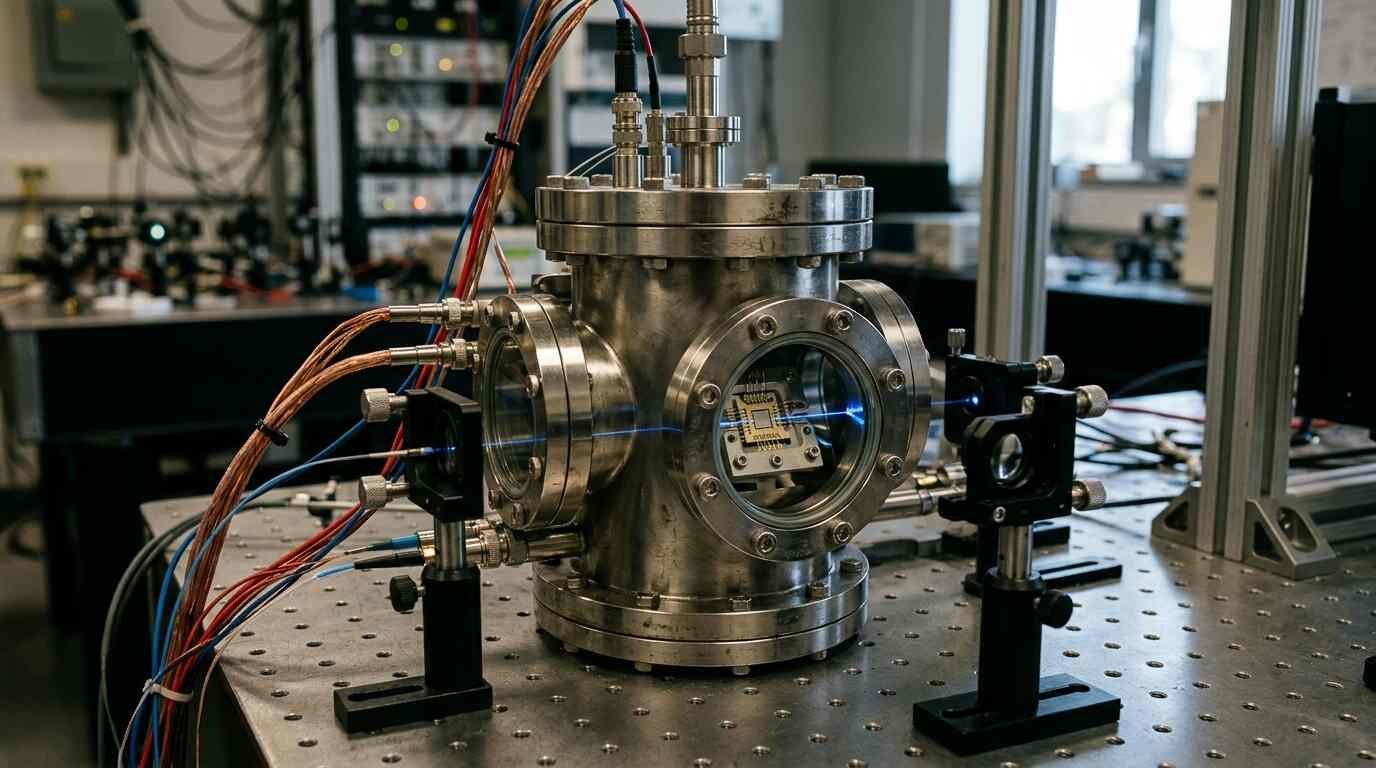
The team started with about 20,000 rubidium atoms cooled into a Bose-Einstein condensate, a state in which the atoms share a single quantum wave. The cloud was released from a magnetic trap and positioned roughly 113 micrometers beneath an atom chip, a small device whose gold wires, each 2 micrometers thick, carry currents that sculpt the magnetic fields around the atoms.
Everything that follows takes place within a couple of milliseconds. The device is called the quantum Galileo interferometer, a nod to the old story of dropping two weights to see which lands first. Here, one half of the atom drops and the other half refuses to.
How the interferometer works, step by step
- Split. Radio and microwave pulses place each atom in a superposition of two magnetic states. Both halves start together.
- Separate. A magnetic kick sends one half upward. It rises, slows, and then falls under gravity alone.
- Hold. A magnetic force cancels gravity for the other half, so it sits still in the laboratory frame. At the top of the arc the two halves are about 7.5 micrometers apart.
- Recombine. The halves are brought back together and made to interfere.
- Read out. The interference pattern reveals how far the two internal clocks have drifted apart, and that drift is the quantum phase of free fall.
Recombining the halves is the hard part. Because the two pieces move at very different speeds, bringing them back into a clean overlap is difficult, a problem Scully, Englert and Schwinger nicknamed the Humpty-Dumpty effect.
Why the phase grows with the cube of the fall time
The predicted phase does not grow in step with the fall time. It grows with the cube of it, so doubling the fall time multiplies the effect eightfold. A dimensional argument shows why that is plausible: the natural dimensionless combination of mass, gravitational acceleration, time and the reduced Planck constant is mass times g squared times time cubed, divided by that constant. Treat this as a scaling argument rather than the paper’s exact expression, since the interferometer’s geometry sets the numerical factor.
The cube law is a gift and a trap. Waiting longer makes the signal swell, which is what an experimenter wants. But the same waiting lets the two halves drift apart and lose their relationship, so the fringes wash out. Here the contrast fell from 80% for short runs to 20% for the longest, and that decay limited how long the experiment could run, to about 2.4 milliseconds of free fall.
What the data show
Across 633 runs spread over 5.3 hours, the team recorded 13 full oscillations of the interference signal. The measured phase and the model agree to roughly 2.5%. For a first observation of an effect predicted almost a century ago, agreement at that level is a strong first check.
The expected phase comes straight from applying the equivalence principle to a quantum wave, so a match supports the idea that the principle carries over. A mismatch would have been the more dramatic headline, and it did not appear.
What the result does not show
Headlines saying there is no conflict between quantum physics and gravity run ahead of the evidence. The Oxford announcement is explicit that the result neither unifies quantum mechanics with gravity nor shows that gravity itself is quantum. It shows consistency with the equivalence principle in the regime that was tested.
Live Science adds a second caveat: the measurement does not rule out every theory in which the principle breaks down. A theory that departs from the principle only at higher energies, for heavier objects, or over longer times would not be touched by an experiment limited to rubidium and a couple of milliseconds. The test is a clean data point, not a closed case.
Penrose’s own conjecture, that gravity may destroy quantum superpositions of massive objects, is also out of reach here. The masses and timescales are too small, as the Oxford release notes.
Where the experiment goes next
- Testing the principle under more general conditions, such as in a rotating frame.
- Placing two quantum systems in superposition and checking whether they influence each other gravitationally.
- Scaling up to heavier objects. A follow-up with nanodiamonds is underway at Ben-Gurion University, which could probe whether gravity obeys quantum rules and test Penrose’s conjecture.
Each step trades the cleanliness of a single cold atom for more mass and more fragility. That trade is the central engineering problem of the field.
A short glossary
- Equivalence principle: the statement that gravity and acceleration cannot be told apart locally, and that bodies fall alike.
- Superposition: a quantum state in which an object occupies two paths or conditions at once.
- Bose-Einstein condensate: a cloud of ultracold atoms that behaves as a single quantum wave.
- Atom chip: a microfabricated surface with current-carrying wires that shape magnetic fields near trapped atoms.
- Fringe contrast: how sharp the light-and-dark pattern of interference is. Low contrast means the two halves have lost their phase relationship.
- Quantum phase: the clock-like quantity attached to a wave, which shifts when the wave experiences gravity.
Frequently asked questions
What did the experiment actually measure?
The relative quantum phase between an atom wave that fell freely and an identical one held stationary, using an atom interferometer.
Does it prove gravity is quantum?
No. The Oxford announcement says it does not unify the theories or show that gravity is quantum. It checks that the equivalence principle holds for a quantum wave in the regime tested.
What is new here?
Reporters describe it as the first direct measurement of the predicted quantum phase of a freely falling object, an effect first predicted in 1927.
Why did the signal fade for longer falls?
As the two paths separate they become harder to recombine into a clean overlap, so the interference contrast dropped from 80% to 20%. That limited the longest free fall to about 2.4 milliseconds.
Where can I read the paper?
It appeared in Science Advances, volume 12, issue 36. The authors’ preprint is linked in the sources below.
Sources
- Live Science (Andrey Feldman, 3 September 2026): physicists test Einstein’s happiest thought at quantum scales
- University of Oxford Department of Physics: Scientists observe Einstein’s gravity in the quantum world
- arXiv preprint 2502.14535: Observation of quantum free fall and the consistency with the equivalence principle
- Paper as cited by Live Science: Dobkowski et al., “Observation of the quantum phase of free fall and the consistency with the equivalence principle,” Science Advances 12(36), published 2 September 2026, DOI 10.1126/sciadv.aec8045.



