






Are memes faithful enough to be replicators? An error-threshold model, fitted to 12,096 transmissions from open transmission-chain experiments, says human memory keeps only a few words exact. The rest survives as reconstructed gist.
Preprint, version 1 (October 2026). Not peer reviewed. This is the author’s manuscript, prepared for submission to a peer-reviewed journal. Code and derived results: download the reproducibility package (zip, 32 KB).
Cite as: Kalafatis, P. (2026). Too leaky to replicate: An error threshold for memes in human memory [Preprint]. x9m8.com.

Peter Kalafatis¹
¹ Independent researcher, x9m8.com, New York, USA. Correspondence: x9m8x7@gmail.com
Article type: Original Research
Keywords: memetics; error threshold; transmission fidelity; cultural attraction; transmission chains; quasispecies
Social media summary: Memory garbles 3–11% of words per retelling, so selection can keep only a few words exact; the rest is rebuilt.
Abstract
Memetics treats cultural items as replicators, but critics argue that human transmission is too error-prone for selection to keep any item intact. The dispute has lacked a quantitative test. I adapt Eigen’s error threshold to items of L units copied with per-unit loss e and per-unit reconstruction a, and measure the parameters in 12,096 transmissions from five open transmission-chain experiments. In the model, reconstruction leaves the threshold almost unchanged: an intact item persists only if its selective advantage s exceeds exp(μL) − 1, where μ is the per-unit error rate. Above the threshold, reconstruction instead fixes descendants’ long-run resemblance to the original at a/(a + e). In written and spoken recall, μ ranged from 0.030 to 0.117 per word. At s = 0.2, matching an estimate from online diffusion, selection can maintain intact items of only 1.6 to 6 words. Lost words returned 9 to over 100 times more often than unrelated words entered by chance, and including reconstruction improved predictions of retention in held-out chains. In memory-based transmission, replication of whole items is confined to slogans; longer content persists as reconstructed gist. Digital copying should remove the threshold, a testable prediction.
Introduction
Dawkins (1976) coined “meme” for a unit of culture that, like a gene, would be shaped by selection because it has three properties: longevity, fecundity and copying fidelity. The third property has been the weak point ever since. Sperber (1996) argued that human communication rarely copies anything. A listener builds a new representation from cues, and the result resembles its source mainly because minds are drawn toward the same attractive forms. Atran (2001) pressed a similar case. Henrich and Boyd (2002) answered that cultural evolution does not require accurate replication of representations: when attractors are strong, or transmission is conformist, populations of low-fidelity representations behave like discrete replicators. Henrich, Boyd and Richerson (2008) went further and listed the claim that “replicators are necessary for cumulative, adaptive evolution” among their “five misunderstandings”. Claidière and Sperber (2007) modelled attraction as a force that can stabilise culture when fidelity is low; Claidière, Scott-Phillips and Sperber (2014a) argued that selection is one of several forms that attraction can take; and Acerbi, Charbonneau, Miton and Scott-Phillips (2021) showed by simulation that stable cultural traditions can arise with neither copying nor selection.
These positions disagree about a quantity. Whether a meme can be a replicator depends on how often it survives transmission intact compared with the advantage that its intact form confers. Molecular evolution has a precise answer to that comparison in the error threshold (Eigen, 1971; Eigen, McCaskill & Schuster, 1988). A sequence of L sites copied with per-site error rate e is intact after copying with probability Q = (1 − e)^L. If the intact sequence reproduces 1 + s times as fast as its damaged variants, selection keeps it in the population only when Q(1 + s) > 1. Above the critical length, the population dissolves into a cloud of mutants and the original is lost (Biebricher & Eigen, 2005; Wilke, 2005; Domingo, Sheldon & Perales, 2012). Nowak, Komarova and Niyogi (2001) derived an analogous coherence threshold for language, which limits how many candidate grammars learners can entertain, given their input, if a population is to keep a shared grammar; Komarova, Niyogi and Nowak (2001) expressed it as a maximum error tolerance in grammar acquisition. Lewis and Laland (2012) showed in simulation that fidelity governs how much culture can accumulate. Stevenson (2023) recently proposed modelling cultural information as a quasispecies.
None of this work has been joined to measurement. Transmission-chain experiments, which pass material along chains of participants in the manner of Bartlett (1932), have produced detailed accounts of what is lost and what is kept (Mesoudi & Whiten, 2008; Mesoudi, Whiten & Dunbar, 2006; Kashima, 2000; Stubbersfield, Tehrani & Flynn, 2015; Moussaïd, Brighton & Gaissmaier, 2015; Breithaupt et al., 2018; Acerbi, 2022). Iterated-learning studies show that transmission converges on structures shaped by learners’ biases (Kirby, Cornish & Smith, 2008; Griffiths & Kalish, 2007; Kalish, Griffiths & Lewandowsky, 2007; Xu & Griffiths, 2010; Jacoby & McDermott, 2017; Langlois, Jacoby, Suchow & Griffiths, 2021). Claidière, Smith, Kirby and Fagot (2014b) found that systematic structure emerged even in transmission chains of baboons. Yet I am not aware of a study that has estimated the per-unit error rate of human transmission and placed it against the threshold that memetics would need it to clear.
This paper does that. I make three contributions. First, I extend the error-threshold model to include reconstruction, the per-unit probability that a lost element is restored, which is the simplest formal expression of attraction. The extension shows that attraction and selection play separable roles: reconstruction controls how much of an item’s gist survives, while selection, and only selection, can hold an exact form in place. Second, I estimate the per-unit error rate, the loss rate and the reconstruction rate from four open datasets of written and spoken recall, plus a fifth dataset of letter strings. Third, I combine the two to state how long a meme can be and still be a replicator in human memory, and I set out predictions that distinguish memory-based from digital transmission.
The terms need fixing before the analysis. I use replicator in Dawkins’s sense: an entity whose exact form is passed on often enough for differences in that form to be selected. I use attraction for any systematic tendency of transmission to move variants toward particular forms (Claidière & Sperber, 2007; Scott-Phillips, Blancke & Heintz, 2018), and reconstruction for its simplest special case, in which an element missing from the version a person received appears in the version they produce. Fidelity, as Charbonneau (2020) argues, is not a single quantity: cultural evolutionists use several distinct fidelity concepts. I therefore report results under three definitions of identity.
Model
An error threshold with reconstruction
Consider a cultural item made of L units, such as words in a sentence or letters in a string. The canonical form contains all L units. At each transmission, every unit present in the version received is lost independently with probability e, and every canonical unit absent from that version is restored independently with probability a. I group variants into Hamming classes k = 0, 1, …, L by the number of canonical units missing. The probability of moving from class k to class k′ is the convolution of a binomial loss among the L − k units present and a binomial restoration among the k units missing. Selection is single-peaked: the intact class has transmission success 1 + s, every damaged class has success 1. The deterministic dynamics are
x′_k′ ∝ Σ_k T(k → k′) w_k x_k,
where w_0 = 1 + s and w_k = 1 otherwise. The equilibrium is the dominant eigenvector of T·diag(w), which I compute numerically for L up to 40.
Two analytical results follow. When a = 0, the system is Eigen’s quasispecies with the single-peak landscape, and the intact item is maintained if and only if (1 − e)^L (1 + s) > 1. This gives a critical length
L* = ln(1 + s) / −ln(1 − e) ≈ ln(1 + s) / μ,
or equivalently a minimum selective advantage s* = exp(μL) − 1 for an item of length L, where μ = −ln(1 − e) is the per-unit error rate. Doubling reproductive success (s = 1) at e = 0.12 gives L* = 5.4 units.
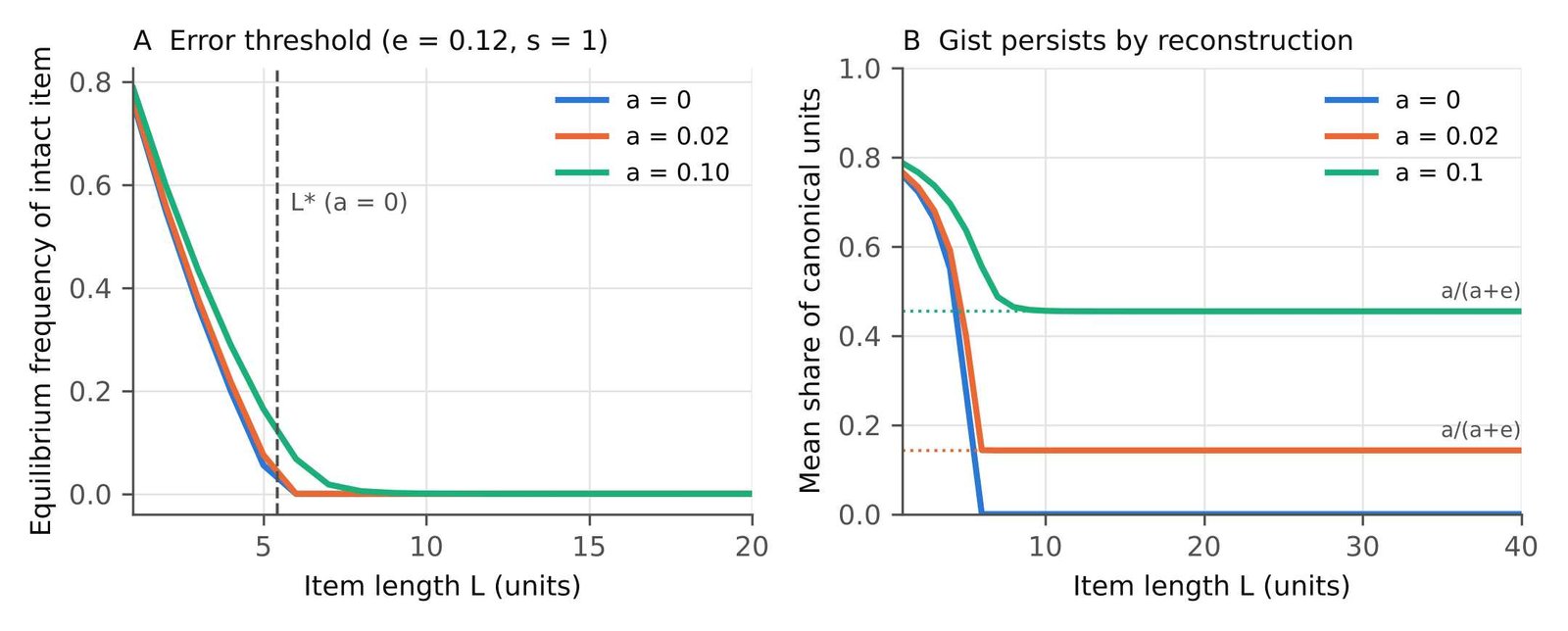
When a > 0, each unit becomes a two-state Markov chain with stationary probability a/(a + e) of being in its canonical state. Without selection, the expected share of canonical units in any descendant therefore converges to a/(a + e), whatever L is. Reconstruction can in principle return a damaged variant to the intact class, but the probability of doing so falls geometrically with the number of missing units. At reconstruction rates like those measured below (a ≈ 0.01–0.02) it barely moves the threshold; a much higher rate (a = 0.10) extends it by one or two units. Figure 1 shows both effects. Below L*, selection keeps a measurable fraction of the population intact (Fig. 1A); above it, the intact form disappears. The mean resemblance to the original, meanwhile, settles at a/(a + e) for items above the threshold, where selection no longer has an intact form to act on (Fig. 1B). Reconstruction keeps the gist. Only selection, below threshold, keeps the form.
Simulation check
I checked the deterministic results with a Wright–Fisher individual-based model: 2,000 items, each a vector of L units, 600 generations of fitness-weighted resampling followed by independent loss and restoration. For L = 10, e = 0.06, s = 1 and a = 0, the deterministic model predicts an intact frequency of 0.077 and the simulation gave 0.072. At L = 10, e = 0.12, a = 0.02 the predicted mean resemblance is a/(a + e) = 0.143 and the simulation gave 0.147; at L = 20, e = 0.06, a = 0.02 the values were 0.250 and 0.254. All checks used s = 1. Close to the threshold, the simulated intact frequency fell below the deterministic value (L = 5, e = 0.12, a = 0: 0.035 against 0.055), as expected because drift in finite populations lowers the effective threshold (Nowak & Schuster, 1989). The deterministic L* is therefore best read as an upper bound on the length that selection can maintain in finite populations.
Methods
Data
I used every open transmission-chain dataset I could locate that met three conditions: raw texts available for every generation, linear chains of at least six generations, and a record linking each text to its parent. Three sources, comprising four verbal experiments and one letter-string experiment, qualified.
Gistr experiments 1–3 (Lerique, 2017). Participants recruited online read a short text, waited, and then wrote down the text as they remembered it; their output was shown to the next participant. Each of 50 seed texts per experiment was passed down several branching chains. Experiment 1 used mostly short everyday sentences with a few longer passages, experiment 2 short film-quote-style sentences, and experiment 3 short news items and story openings, including seeds from Mesoudi, Whiten and Dunbar (2006). I used the experimenter’s spam codings and excluded any chain branch containing a text coded as spam. The data and analysis code are public at github.com/interpretation-experiment/analysis.
Meylan, Nair and Griffiths (2021). Participants heard a recorded sentence, most often ten words long, embedded in background noise; they recorded themselves repeating it, and their recording became the next participant’s input. Each participant also typed a transcription of their own response, and I used these transcriptions as the text of each generation. The data are public at github.com/smeylan/telephone-analysis-public. This dataset differs from Gistr in modality and in the main source of error (perception rather than memory), which makes it a useful contrast.
Cornish, Dale, Kirby and Christiansen (2017). Eight chains of ten generations each learned and recalled a set of 15 letter strings. I treated letters as units and asked whether each string reappeared exactly in the next generation’s set. The data are public at github.com/racdale/cornish-strings.
In total the analyses use 12,096 parent–child transmissions: 7,897 written, 2,999 spoken and 1,200 letter-string transmissions, descended from 190 seed texts and 8 letter-string chains. Each unique parent–child pair is counted once even when a parent had several children.
Measuring fidelity
For each transmission I asked whether the child text was an exact copy of its parent. In the main analysis, exact means the same sequence of lowercase alphanumeric tokens, so that case, punctuation and spacing are ignored. I modelled the exact-copy probability as Q(L) = exp(−μL), where L is the parent’s length in words (letters for Cornish), and estimated μ by binomial maximum likelihood. Confidence intervals come from a cluster bootstrap over seed items, or over chains for the letter strings (400 resamples for the pooled estimates, 300 for the per-generation estimates), which respects the dependence among transmissions descended from the same seed. To test whether fidelity changes along chains, I fitted μ separately to generations 1, 2–3, 4–6 and 7 onward.
I ran two robustness checks. The first added a length-independent intercept, Q(L) = q₀ exp(−μL), which absorbs failures that do not scale with length, such as a participant who paraphrases everything. With the intercept, the threshold becomes L* = [ln(1 + s) + ln q₀]/μ. The second varied the definition of an exact copy: a strict raw definition in which case and punctuation count, the main token definition, and a lenient content-set definition in which a copy counts as exact if it has the same set of content words (words of three or more letters not on a stop list), ignoring order and function words.
Measuring loss and reconstruction
For the four verbal datasets I tracked each seed word through each chain. For Gistr I used content words; for Meylan, whose sentences are short and often consist mostly of function words, I used all words. Both rates are computed over transmissions from generation 1 onward, because reconstruction cannot occur in the first transmission, when every seed word is present; this keeps e and a on the same footing. The loss rate e is the proportion of these transmissions in which a seed word present in the parent was absent in the child. The reconstruction rate a is the proportion of transmissions in which a seed word absent from the parent appeared in the child. A word that reappears may do so because a participant reconstructed it from context or because it is a common word that turned up by chance. To estimate the chance rate a₀, I gave each chain a control set of words, matched in number to its seed words, drawn from the seeds of other items in the same experiment. These words never appeared in the chain’s seed, so their rate of appearance in a child text, given absence from the parent, estimates chance entry. The attraction rate is a − a₀. Intervals come from a cluster bootstrap over seed items (1,000 resamples).
Separating attraction from heterogeneous loss
Retention curves in transmission chains often level off rather than decaying to zero. A plateau can arise from reconstruction, but it can also arise without any reconstruction if some words are almost never lost, for example a name or the main noun of a sentence. To separate the two, I restricted each dataset to chains that reached a fixed depth G (7, 6, 10 and 20 generations for Gistr 1, 2, 3 and Meylan) and split them into alternate halves. On the training half I estimated a loss rate (here including the first transmission) and a reconstruction rate for every word of every seed, shrunk toward the dataset mean with an empirical-Bayes beta-binomial prior. I then iterated each word’s two-state chain from p₀ = 1, averaged across words, and compared the predicted retention curve with the observed curve in the held-out half. I compared three models by root-mean-square error: word-specific e and a; word-specific e with a = 0; and a single pooled e and a.
Calibrating selection
The threshold depends on s, the advantage in transmission enjoyed by an intact item over its damaged variants. Direct estimates for cultural items are scarce. Brady, Wills, Jost, Tucker and Van Bavel (2017) analysed the diffusion of messages about contested political issues on Twitter and reported that moral-emotional words “increased their diffusion by a factor of 20% for each additional word” (p. 7313). I take s = 0.2 as a realistic advantage for a single feature of content and report s = 1 (doubling) and s = 9 (a tenfold advantage) as generous bounds.
Software and AI use
Analyses used Python 3 with NumPy, SciPy, pandas and Matplotlib. The random seed for all bootstraps was 20261011. Literature searching, data acquisition, analysis code, figures and a first draft of the text were produced with the assistance of Claude (Anthropic; model identifier claude-opus-5-5) on 11 October 2026, working under the author’s direction. The author checked every reference against its bibliographic record, reviewed the code and results, and takes full responsibility for the content. The AI system is not an author.
Results
Exact copies decay exponentially with length
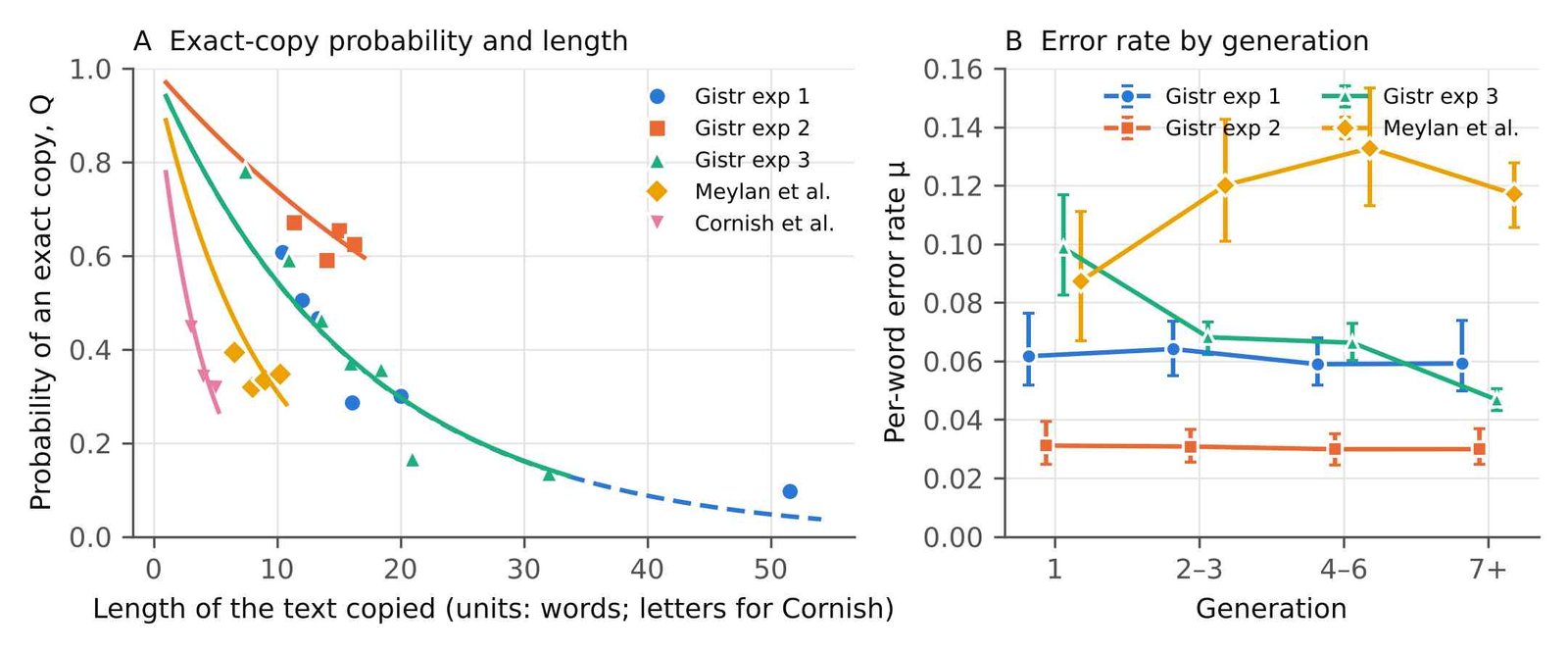
Exact copies became rarer with length in all five datasets (Fig. 2A), although for spoken sentences, whose lengths varied little, most failures did not depend on length (see the intercept analysis below). Per-word error rates were 0.061 (95% CI 0.054–0.068) in Gistr 1, 0.030 (0.026–0.036) in Gistr 2, 0.061 (0.057–0.065) in Gistr 3 and 0.117 (0.108–0.128) for spoken sentences in noise. The per-letter error rate for letter strings was 0.251 (0.219–0.280). Table 1 gives the full results. Between 35% and 64% of transmissions were exact copies. At the mean seed length, an intact item would need a selective advantage between 0.56 (Gistr 2) and 2.35 (Gistr 1) to persist, that is, between one and a half and more than three times the transmission success of its variants.
Table 1. Fidelity of transmission and the length of item that selection can maintain.
| Dataset | Unit | Transmissions | Seeds | Mean L | Exact copies | μ per unit (95% CI) | s* at mean L | L* at s = 0.2 | L* at s = 1 | L* at s = 9 |
|---|---|---|---|---|---|---|---|---|---|---|
| Gistr 1, written | word | 1,980 | 50 | 19.9 | 0.40 | 0.061 (0.054–0.068) | 2.35 | 3.0 | 11.4 | 37.8 |
| Gistr 2, written | word | 2,411 | 50 | 14.7 | 0.64 | 0.030 (0.026–0.036) | 0.56 | 6.0 | 22.9 | 75.9 |
| Gistr 3, written | word | 3,506 | 50 | 17.4 | 0.39 | 0.061 (0.057–0.065) | 1.88 | 3.0 | 11.4 | 38.0 |
| Meylan et al., spoken | word | 2,999 | 40 | 9.1 | 0.35 | 0.117 (0.108–0.128) | 1.91 | 1.6 | 5.9 | 19.6 |
| Cornish et al., strings | letter | 1,200 | 8 chains | 4.0 | 0.37 | 0.251 (0.219–0.280) | 1.76 | 0.7 | 2.8 | 9.2 |
Note. μ is the maximum-likelihood per-unit error rate under Q = exp(−μL), with 95% cluster-bootstrap intervals. s* = exp(μL̄) − 1 is the selective advantage needed to maintain an item of mean length. L* = ln(1 + s)/μ is the longest item that selection can maintain. Mean L is the mean parent length per transmission.
Error rates followed different courses along chains (Fig. 2B). In Gistr 1 and 2 the per-word rate was flat across generations. For spoken sentences it rose from 0.087 (0.067–0.111) in the first transmission to between 0.117 and 0.133 later, plausibly because recordings made by participants were harder to hear than the original studio recordings. In Gistr 3 the rate fell by half, from 0.099 (0.082–0.117) in the first transmission to 0.047 (0.043–0.051) after the sixth. Texts that had passed through several people were easier to copy than the seeds they came from. Selection on whole items cannot explain this, since participants did not choose what to pass on. It is what attraction predicts: transmission filters out hard-to-reproduce material and converges on forms that memory handles well (Tamariz & Kirby, 2015).
The results were robust to the definition of identity (Table S1). Under the strict raw definition, μ rose to between 0.064 and 0.117 per word and L* at s = 0.2 fell to between 1.6 and 2.8 words. Under the lenient content-set definition, μ fell to between 0.014 and 0.081 and L* at s = 0.2 rose to between 2.3 and 13.2 words. Adding a length-independent intercept (Table S2) lowered L* at s = 0.2. For Gistr 2, the intercept model gave q₀ = 0.87 and L* = 2.0 words; for spoken sentences, q₀ = 0.48, which means that no item of any length could be maintained unless s exceeded 1.09. At larger s the intercept model is more permissive, because its per-word slope is shallower (Gistr 2: L* = 104 words at s = 9, against 76).
Selection can maintain only short items
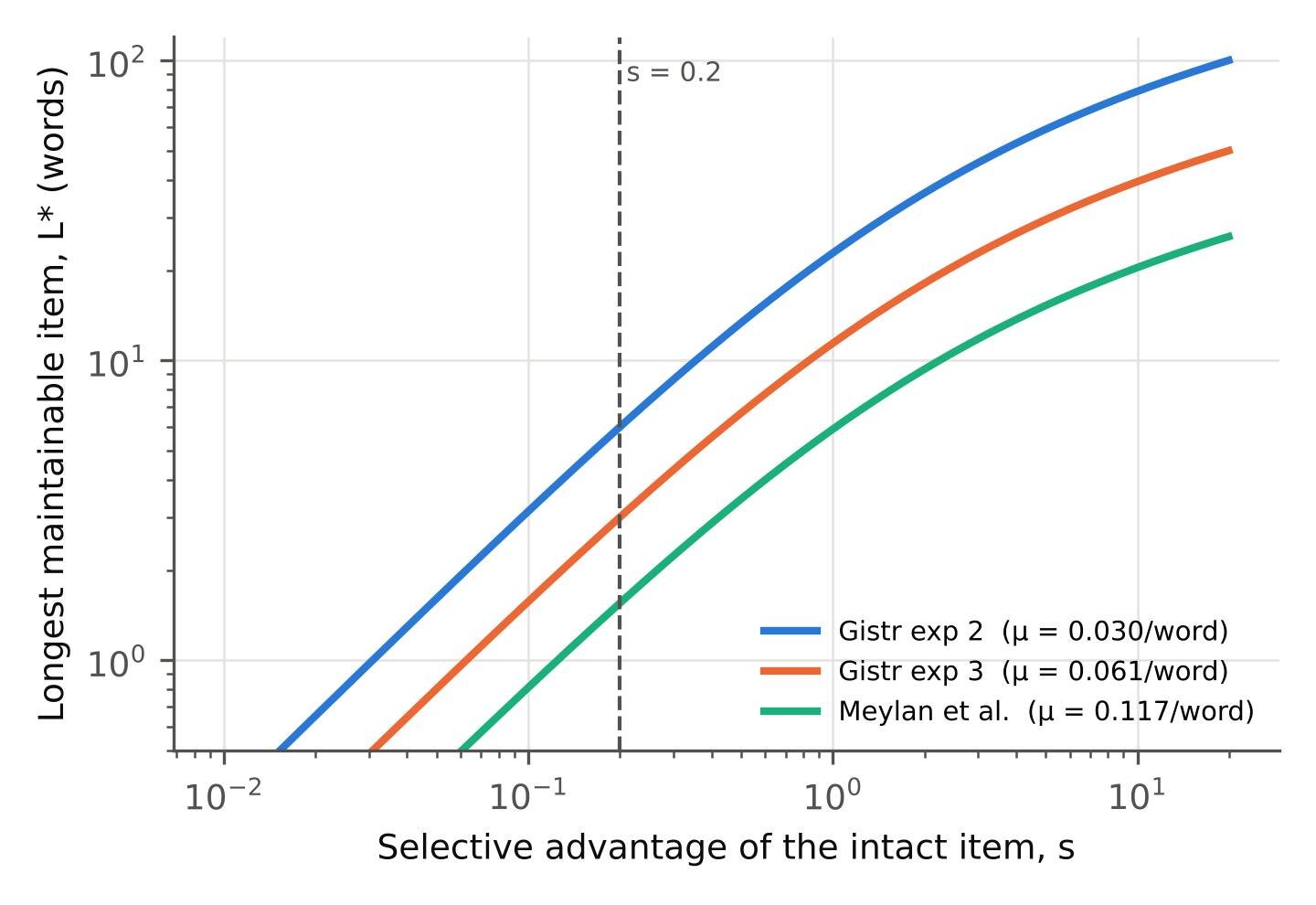
Figure 5 combines the error rates with the threshold. At s = 0.2, the longest intact item that selection could maintain was 3 words in Gistr 1 and 3, 6 words in Gistr 2 and under 2 words for spoken sentences. Even a tenfold advantage, much larger than the per-word effect used for calibration, extends the limit only to 20–76 words. The seed texts in these experiments had medians of 10 to 22 words, and most were 10 to 66 words long; three Gistr 1 seeds were longer (78 to 330 words). None of them sits below its threshold at s = 0.2. Even at s = 1, only the Gistr 2 seeds (14–17 words, against L* = 22.9) and the shortest Gistr 1 seeds would be maintained.
Lost words return far more often than chance
Seed words were lost at rates between 0.037 and 0.130 per transmission and returned at rates between 0.010 and 0.024 (Table 2; Fig. 3). Control words from other seeds entered chains at rates between 0.0001 and 0.0028. Reconstruction of lost words therefore exceeded chance by a factor of about 9 for spoken sentences, where the vocabulary was dominated by common words, and by factors of roughly 40 to over 100 for written texts. The attraction rate, a − a₀, was clearly above zero in all four datasets.
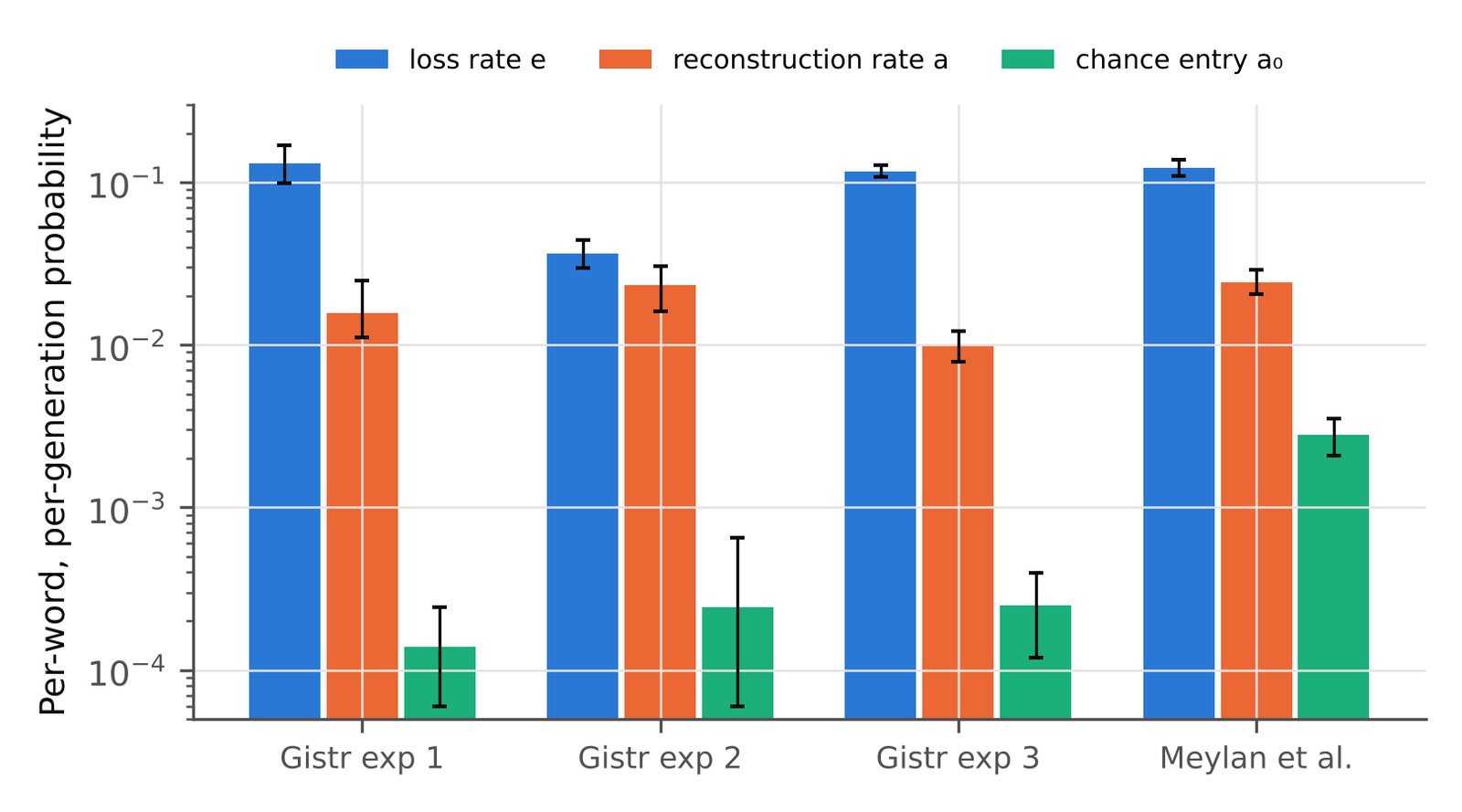
Table 2. Loss and reconstruction of seed words.
| Dataset | Chains | Loss e (95% CI) | Reconstruction a (95% CI) | Chance entry a₀ (95% CI) | Attraction a − a₀ (95% CI) |
|---|---|---|---|---|---|
| Gistr 1 (content words) | 309 | 0.130 (0.099–0.168) | 0.0157 (0.0111–0.0248) | 0.0001 (0.0000–0.0002) | 0.0156 (0.0110–0.0248) |
| Gistr 2 (content words) | 348 | 0.037 (0.030–0.044) | 0.0232 (0.0162–0.0306) | 0.0002 (0.0000–0.0007) | 0.0230 (0.0159–0.0301) |
| Gistr 3 (content words) | 349 | 0.117 (0.107–0.128) | 0.0099 (0.0079–0.0122) | 0.0002 (0.0001–0.0004) | 0.0096 (0.0075–0.0120) |
| Meylan et al. (all words) | 194 | 0.123 (0.110–0.137) | 0.0244 (0.0206–0.0289) | 0.0028 (0.0021–0.0035) | 0.0216 (0.0178–0.0261) |
Note. Rates are per word per transmission, from generation 1 onward. a₀ is the rate at which words from other items’ seeds, absent from the parent text, appear in the child text. Intervals are cluster-bootstrap percentiles over seed items.
Plateaus reflect both durable words and reconstruction
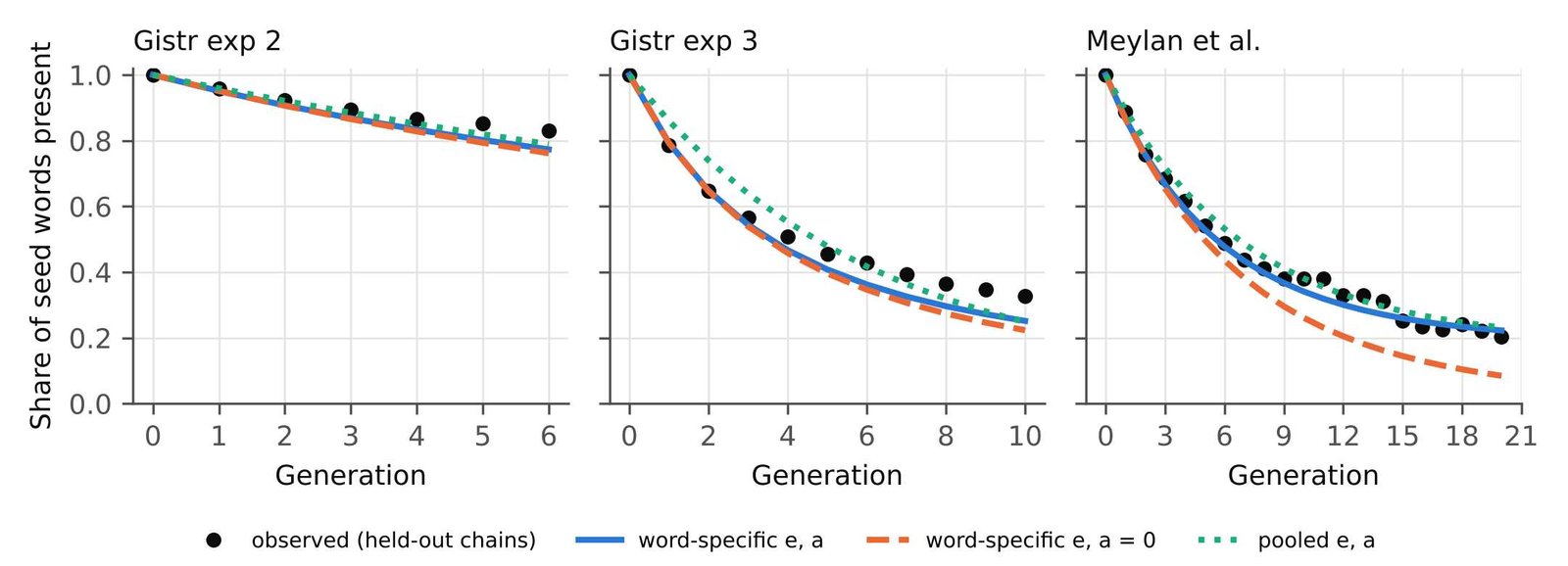
With pooled rates, the two-state model predicts plateaus of (a − a₀)/(e + a − a₀) = 0.11, 0.39, 0.08 and 0.15 for the four datasets. At the last generation analysed, observed retention was still above these values in every dataset (0.53, 0.82, 0.32 and 0.21 of seed words), though the curves had not yet levelled off. For the three Gistr experiments, fitting the same model directly to the mean curves gave much higher implied plateaus (0.54, 0.73 and 0.32), a discrepancy that signals heterogeneity: some words are far more durable than others. For spoken sentences the fitted plateau (0.16) matched the prediction. Per-word loss rates were indeed widely spread. In Gistr 3 the middle 80% of words had loss rates between 0.05 and 0.40, and in Gistr 2 more than two-thirds of words had loss rates below 0.05.
The held-out comparison separates the two sources of plateau (Fig. 4). Removing reconstruction worsened the prediction in every dataset. The effect was largest for spoken sentences, where the error rose from 0.024 to 0.098, and smaller for written texts (Gistr 3: 0.051 to 0.067; Gistr 2: 0.034 to 0.040). Word-specific rates outperformed pooled rates for Gistr 3 (0.051 against 0.057) and for spoken sentences (0.024 against 0.029), but not for Gistr 2 (0.034 against 0.021) or Gistr 1, whose chains were too few per seed (about 3.5) to estimate word rates reliably (pooled 0.133, word-specific 0.186). I therefore omit Gistr 1 from Figure 4. The conclusion is that reconstruction is needed to account for retention in every dataset, that a durable core of words adds to it in Gistr 3, and that in noisy spoken transmission reconstruction does most of the work.
Discussion
The question of whether memes are replicators has usually been argued in principle. Framed as an error threshold, it becomes a question about numbers, and the numbers are now available. Human recall of short texts loses or alters between 3% and 11% of words per transmission. At those rates, selection of plausible strength can hold an exact form in place only for items of a handful of words. Longer content does not vanish. It persists as gist, held near a stable level of resemblance by words that resist loss and by words that listeners restore. In the terms of the original debate, both sides were partly right, and the error threshold says where the boundary lies.
What the threshold implies
For memetics, the result sets a length limit on replicators in oral and memory-based culture. Slogans, catchphrases, proverbs, names and short formulae fall below or near the threshold; anything longer, from an anecdote to a news story, falls above it. This fits Rubin’s (1995) account of oral traditions, which are stabilised not by verbatim memory but by several constraints acting together (meaning, imagery and sound patterns such as rhyme, alliteration and rhythm), with wording most stable where these constraints converge. In the terms used here, such constraints lower the effective error rate. It also fits the finding that wording drifts in written quotation even on the web (Leskovec, Backstrom & Kleinberg, 2009; Simmons, Adamic & Adar, 2011; Lerique & Roth, 2018). The threshold does not show that selection is irrelevant to longer items. Selection still acts on variants. But what it acts on is a cloud of variants whose central tendency is set by reconstruction, not a lineage of copies. This is consistent with treating selection as one form of attraction (Claidière et al., 2014a).
For the theory of cultural attraction, the model gives attraction a precise and limited job. Reconstruction raises the long-run resemblance between descendants and their source to a/(a + e), independently of selection, but it hardly moves the threshold for exact forms. This supports the argument of Henrich and Boyd (2002) and Acerbi et al. (2021) that stable traditions do not require replication, and it adds a quantitative boundary: above about six words, in these data, stability of content must come from attraction or from durable words, because it cannot come from selection of intact forms. The fall in the per-word error rate along Gistr 3 chains is a further signature of attraction. Material became easier to transmit as it travelled, which is what iterated-learning studies find for languages and sequences (Kirby et al., 2008; Cornish et al., 2017; Tamariz & Kirby, 2015).
Predictions
The analysis yields testable predictions.
First, digital copying should remove the threshold. A retweet, a shared image or a pasted quotation has a per-unit error rate close to zero for the copied material. If μ is near zero, L* grows without limit and items of any length can be maintained by selection. Internet memes copied by sharing should therefore behave as replicators in Dawkins’s sense, while the same content retold from memory should not. The prediction can be tested by estimating μ along cascades of quotations online, where both copying and retelling occur (Leskovec et al., 2009; Adamic, Lento, Adar & Ng, 2016), and comparing it with the laboratory values reported here. I expect online per-word error rates to be at least an order of magnitude lower.
Second, the frequency distribution of variants should differ across the threshold. Below it, a dominant intact form should coexist with a cloud of rare mutants, as in a molecular quasispecies (Nowak, 1992). Above it, no single variant should dominate and the most common form need not be the original. Neutral and biased models of cultural frequency data could be applied to test this pattern (Kandler & Crema, 2019).
Third, constraints that lower μ should raise the length limit proportionally. Rhyme and meter, repeated rehearsal and written records each reduce per-unit error, and each should extend the length of the items that remain word-perfect.
Fourth, large language models used as transmitters should show their own thresholds. Recent experiments find that language models reproduce human-like content biases in transmission chains (Acerbi & Stubbersfield, 2023) and drift toward attractors when they retell each other’s text (Perez et al., 2024). Their error rates, and so their thresholds, can be measured with the methods used here.
Limitations
Several limitations qualify these conclusions. The data come from laboratory recall of single sentences and short passages by online participants, and the error rates of natural conversation, with its feedback and repetition, may differ. Exact identity is the strictest standard for replication; the content-set analysis shows that the conclusion holds under a lenient standard, but a definition based on meaning would require semantic coding not attempted here. The model assumes independent loss across units, while real errors cluster, for example when a clause is dropped whole. Clustered errors raise the exact-copy probability for a given mean loss rate, which partly explains why the intercept model fits some datasets better. The selection coefficient is borrowed from a diffusion study of tweets, which measures sharing rather than faithful reproduction, so s = 0.2 is a calibration and not a measurement of selection on intact forms. Finally, single-peak selection is a simplification: whether an error threshold exists, and where it lies, depends on the shape of the fitness landscape (Wilke, 2005). If many near-intact variants are almost as fit as the original, the loss of the original form may be more gradual than the single-peak model implies. These limitations affect the precise value of L* but not its order of magnitude, which is fixed by error rates of several percent per word.
Conclusion
Copying fidelity, the weakest of Dawkins’s three properties, can now be given a number. In human memory it is high enough for selection to maintain a phrase, and too low for it to maintain a story. Above that boundary, the stability of culture is the work of minds that rebuild what they receive. The boundary moves when the copying medium changes, and that movement is what a theory of memes in the digital age should explain.
Related on x9m8
- Open Questions: a series on what science and law have not settled
- Why does sex exist? The twofold cost and the case for sex, on mutation load and Muller’s ratchet in genes
- Are humans still evolving?, on selection acting in modern human populations
Acknowledgements
I thank Sébastien Lerique, Stephan Meylan, Hannah Cornish and their co-authors for making their transmission-chain data openly available. Literature search, data acquisition, statistical analysis, figure preparation and drafting were assisted by Claude (Anthropic; claude-opus-5-5) on 11 October 2026, as described in Methods.
Author contributions
P.K. conceived the study, directed the analysis, reviewed all results and wrote the paper with AI assistance as described above.
Financial support
This research received no specific grant from any funding agency, commercial or not-for-profit sectors.
Conflicts of interest
The author declares none.
Research transparency and reproducibility
All analyses use publicly available data. Gistr: github.com/interpretation-experiment/analysis (commit 72c3ed0). Meylan et al.: github.com/smeylan/telephone-analysis-public (commit 46784a1). Cornish et al.: github.com/racdale/cornish-strings. Analysis code, derived results and figure scripts are provided as supplementary material and at https://x9m8.com/wp-content/uploads/2026/10/kalafatis-2026-memes-error-threshold-code.zip.
Supplementary material
Table S1. Sensitivity of the per-word error rate to the definition of an exact copy.
| Dataset | Raw μ (95% CI) | Raw exact | Raw L* (s = 0.2) | Token μ (95% CI) | Token exact | Token L* (s = 0.2) | Content-set μ (95% CI) | Content-set exact | Content-set L* (s = 0.2) |
|---|---|---|---|---|---|---|---|---|---|
| Gistr 1 | 0.096 (0.088–0.105) | 0.25 | 1.9 | 0.061 (0.054–0.068) | 0.40 | 3.0 | 0.042 (0.036–0.047) | 0.52 | 4.4 |
| Gistr 2 | 0.064 (0.059–0.070) | 0.39 | 2.8 | 0.030 (0.026–0.035) | 0.64 | 6.0 | 0.014 (0.011–0.017) | 0.82 | 13.2 |
| Gistr 3 | 0.108 (0.102–0.115) | 0.20 | 1.7 | 0.061 (0.056–0.064) | 0.39 | 3.0 | 0.043 (0.039–0.046) | 0.51 | 4.2 |
| Meylan et al., spoken | 0.117 (0.107–0.127) | 0.35 | 1.6 | 0.117 (0.107–0.128) | 0.35 | 1.6 | 0.081 (0.071–0.089) | 0.48 | 2.3 |
Note. Raw: identical strings after whitespace normalisation. Token: identical sequence of lowercase alphanumeric tokens (main analysis). Content-set: identical set of content words. Intervals from 200 cluster-bootstrap resamples, run separately from Table 1, so token intervals differ slightly in the third decimal. The released Meylan transcriptions are already lowercase and unpunctuated, so raw and token estimates coincide.
Table S2. Threshold with a length-independent failure term, Q(L) = q₀ exp(−μL).
| Dataset | q₀ | μ | L* at s = 0.2 | L* at s = 1 | L* at s = 9 | Minimum s for any item |
|---|---|---|---|---|---|---|
| Gistr 1 | 1.00 | 0.061 | 3.0 | 11.4 | 37.8 | 0.00 |
| Gistr 2 | 0.87 | 0.021 | 2.0 | 26.6 | 104.2 | 0.15 |
| Gistr 3 | 1.00 | 0.061 | 3.0 | 11.4 | 38.0 | 0.00 |
| Meylan et al. (spoken) | 0.48 | 0.036 | none | none | 43.7 | 1.09 |
| Cornish et al. (letter strings) | 0.73 | 0.172 | none | 2.2 | 11.6 | 0.37 |
Note. L* = [ln(1 + s) + ln q₀]/μ. ‘None’ means that no item, however short, can be maintained at that s. For Gistr 1 and 3 the fitted q₀ was 1, so results equal the main analysis.
References
Acerbi, A. (2022). From storytelling to Facebook: Content biases when retelling or sharing a story. Human Nature, 33(2), 132–144. https://doi.org/10.1007/s12110-022-09423-1
Acerbi, A., Charbonneau, M., Miton, H., & Scott-Phillips, T. (2021). Culture without copying or selection. Evolutionary Human Sciences, 3, e50. https://doi.org/10.1017/ehs.2021.47
Acerbi, A., & Stubbersfield, J. M. (2023). Large language models show human-like content biases in transmission chain experiments. Proceedings of the National Academy of Sciences, 120(44), e2313790120. https://doi.org/10.1073/pnas.2313790120
Adamic, L. A., Lento, T. M., Adar, E., & Ng, P. C. (2016). Information evolution in social networks. In Proceedings of the Ninth ACM International Conference on Web Search and Data Mining (pp. 473–482). ACM. https://doi.org/10.1145/2835776.2835827
Atran, S. (2001). The trouble with memes. Human Nature, 12(4), 351–381. https://doi.org/10.1007/s12110-001-1003-0
Bartlett, F. C. (1932). Remembering: A study in experimental and social psychology. Cambridge University Press.
Biebricher, C. K., & Eigen, M. (2005). The error threshold. Virus Research, 107(2), 117–127. https://doi.org/10.1016/j.virusres.2004.11.002
Brady, W. J., Wills, J. A., Jost, J. T., Tucker, J. A., & Van Bavel, J. J. (2017). Emotion shapes the diffusion of moralized content in social networks. Proceedings of the National Academy of Sciences, 114(28), 7313–7318. https://doi.org/10.1073/pnas.1618923114
Breithaupt, F., Li, B., Liddell, T. M., Schille-Hudson, E. B., & Whaley, S. (2018). Fact vs. affect in the telephone game: All levels of surprise are retold with high accuracy, even independently of facts. Frontiers in Psychology, 9, 2210. https://doi.org/10.3389/fpsyg.2018.02210
Charbonneau, M. (2020). Understanding cultural fidelity. The British Journal for the Philosophy of Science, 71(4), 1209–1233. https://doi.org/10.1093/bjps/axy052
Claidière, N., Scott-Phillips, T. C., & Sperber, D. (2014a). How Darwinian is cultural evolution? Philosophical Transactions of the Royal Society B: Biological Sciences, 369(1642), 20130368. https://doi.org/10.1098/rstb.2013.0368
Claidière, N., Smith, K., Kirby, S., & Fagot, J. (2014b). Cultural evolution of systematically structured behaviour in a non-human primate. Proceedings of the Royal Society B: Biological Sciences, 281(1797), 20141541. https://doi.org/10.1098/rspb.2014.1541
Claidière, N., & Sperber, D. (2007). The role of attraction in cultural evolution. Journal of Cognition and Culture, 7(1–2), 89–111. https://doi.org/10.1163/156853707X171829
Cornish, H., Dale, R., Kirby, S., & Christiansen, M. H. (2017). Sequence memory constraints give rise to language-like structure through iterated learning. PLOS ONE, 12(1), e0168532. https://doi.org/10.1371/journal.pone.0168532
Dawkins, R. (1976). The selfish gene. Oxford University Press.
Domingo, E., Sheldon, J., & Perales, C. (2012). Viral quasispecies evolution. Microbiology and Molecular Biology Reviews, 76(2), 159–216. https://doi.org/10.1128/MMBR.05023-11
Eigen, M. (1971). Selforganization of matter and the evolution of biological macromolecules. Die Naturwissenschaften, 58(10), 465–523. https://doi.org/10.1007/BF00623322
Eigen, M., McCaskill, J., & Schuster, P. (1988). Molecular quasi-species. The Journal of Physical Chemistry, 92(24), 6881–6891. https://doi.org/10.1021/j100335a010
Griffiths, T. L., & Kalish, M. L. (2007). Language evolution by iterated learning with Bayesian agents. Cognitive Science, 31(3), 441–480. https://doi.org/10.1080/15326900701326576
Henrich, J., & Boyd, R. (2002). On modeling cognition and culture: Why cultural evolution does not require replication of representations. Journal of Cognition and Culture, 2(2), 87–112. https://doi.org/10.1163/156853702320281836
Henrich, J., Boyd, R., & Richerson, P. J. (2008). Five misunderstandings about cultural evolution. Human Nature, 19(2), 119–137. https://doi.org/10.1007/s12110-008-9037-1
Jacoby, N., & McDermott, J. H. (2017). Integer ratio priors on musical rhythm revealed cross-culturally by iterated reproduction. Current Biology, 27(3), 359–370. https://doi.org/10.1016/j.cub.2016.12.031
Kalish, M. L., Griffiths, T. L., & Lewandowsky, S. (2007). Iterated learning: Intergenerational knowledge transmission reveals inductive biases. Psychonomic Bulletin & Review, 14(2), 288–294. https://doi.org/10.3758/BF03194066
Kandler, A., & Crema, E. R. (2019). Analysing cultural frequency data: Neutral theory and beyond. In A. M. Prentiss (Ed.), Handbook of evolutionary research in archaeology (pp. 83–108). Springer. https://doi.org/10.1007/978-3-030-11117-5_5
Kashima, Y. (2000). Maintaining cultural stereotypes in the serial reproduction of narratives. Personality and Social Psychology Bulletin, 26(5), 594–604. https://doi.org/10.1177/0146167200267007
Kirby, S., Cornish, H., & Smith, K. (2008). Cumulative cultural evolution in the laboratory: An experimental approach to the origins of structure in human language. Proceedings of the National Academy of Sciences, 105(31), 10681–10686. https://doi.org/10.1073/pnas.0707835105
Komarova, N. L., Niyogi, P., & Nowak, M. A. (2001). The evolutionary dynamics of grammar acquisition. Journal of Theoretical Biology, 209(1), 43–59. https://doi.org/10.1006/jtbi.2000.2240
Langlois, T. A., Jacoby, N., Suchow, J. W., & Griffiths, T. L. (2021). Serial reproduction reveals the geometry of visuospatial representations. Proceedings of the National Academy of Sciences, 118(13), e2012938118. https://doi.org/10.1073/pnas.2012938118
Lerique, S. (2017). Epidemiology of representations: An empirical approach [Doctoral dissertation, École des hautes études en sciences sociales]. theses.fr. https://theses.fr/2017EHES0114
Lerique, S., & Roth, C. (2018). The semantic drift of quotations in blogspace: A case study in short-term cultural evolution. Cognitive Science, 42(1), 188–219. https://doi.org/10.1111/cogs.12494
Leskovec, J., Backstrom, L., & Kleinberg, J. (2009). Meme-tracking and the dynamics of the news cycle. In Proceedings of the 15th ACM SIGKDD International Conference on Knowledge Discovery and Data Mining (pp. 497–506). ACM. https://doi.org/10.1145/1557019.1557077
Lewis, H. M., & Laland, K. N. (2012). Transmission fidelity is the key to the build-up of cumulative culture. Philosophical Transactions of the Royal Society B: Biological Sciences, 367(1599), 2171–2180. https://doi.org/10.1098/rstb.2012.0119
Mesoudi, A., & Whiten, A. (2008). The multiple roles of cultural transmission experiments in understanding human cultural evolution. Philosophical Transactions of the Royal Society B: Biological Sciences, 363(1509), 3489–3501. https://doi.org/10.1098/rstb.2008.0129
Mesoudi, A., Whiten, A., & Dunbar, R. (2006). A bias for social information in human cultural transmission. British Journal of Psychology, 97(3), 405–423. https://doi.org/10.1348/000712605X85871
Meylan, S. C., Nair, S., & Griffiths, T. L. (2021). Evaluating models of robust word recognition with serial reproduction. Cognition, 210, 104553. https://doi.org/10.1016/j.cognition.2020.104553
Moussaïd, M., Brighton, H., & Gaissmaier, W. (2015). The amplification of risk in experimental diffusion chains. Proceedings of the National Academy of Sciences, 112(18), 5631–5636. https://doi.org/10.1073/pnas.1421883112
Nowak, M. A. (1992). What is a quasispecies? Trends in Ecology & Evolution, 7(4), 118–121. https://doi.org/10.1016/0169-5347(92)90145-2
Nowak, M. A., Komarova, N. L., & Niyogi, P. (2001). Evolution of universal grammar. Science, 291(5501), 114–118. https://doi.org/10.1126/science.291.5501.114
Nowak, M., & Schuster, P. (1989). Error thresholds of replication in finite populations: Mutation frequencies and the onset of Muller’s ratchet. Journal of Theoretical Biology, 137(4), 375–395. https://doi.org/10.1016/S0022-5193(89)80036-0
Perez, J., Kovač, G., Léger, C., Colas, C., Molinaro, G., Derex, M., Oudeyer, P.-Y., & Moulin-Frier, C. (2024). When LLMs play the telephone game: Cultural attractors as conceptual tools to evaluate LLMs in multi-turn settings (arXiv:2407.04503). arXiv. https://doi.org/10.48550/arXiv.2407.04503
Rubin, D. C. (1995). Memory in oral traditions: The cognitive psychology of epic, ballads, and counting-out rhymes. Oxford University Press.
Scott-Phillips, T., Blancke, S., & Heintz, C. (2018). Four misunderstandings about cultural attraction. Evolutionary Anthropology: Issues, News, and Reviews, 27(4), 162–173. https://doi.org/10.1002/evan.21716
Simmons, M., Adamic, L., & Adar, E. (2011). Memes online: Extracted, subtracted, injected, and recollected. Proceedings of the International AAAI Conference on Web and Social Media, 5(1), 353–360. https://doi.org/10.1609/icwsm.v5i1.14120
Sperber, D. (1996). Explaining culture: A naturalistic approach. Blackwell.
Stevenson, D. (2023). Modeling the structure and evolution of cultural information as quasispecies [Preprint]. Qeios. https://doi.org/10.32388/S8VD03
Stubbersfield, J. M., Tehrani, J. J., & Flynn, E. G. (2015). Serial killers, spiders and cybersex: Social and survival information bias in the transmission of urban legends. British Journal of Psychology, 106(2), 288–307. https://doi.org/10.1111/bjop.12073
Tamariz, M., & Kirby, S. (2015). Culture: Copying, compression, and conventionality. Cognitive Science, 39(1), 171–183. https://doi.org/10.1111/cogs.12144
Wilke, C. O. (2005). Quasispecies theory in the context of population genetics. BMC Evolutionary Biology, 5, 44. https://doi.org/10.1186/1471-2148-5-44
Xu, J., & Griffiths, T. L. (2010). A rational analysis of the effects of memory biases on serial reproduction. Cognitive Psychology, 60(2), 107–126. https://doi.org/10.1016/j.cogpsych.2009.09.002
