






Nobody knows exactly how life began, but several hypotheses are testable. This guide separates the evidence from the guesses.
How did life begin? Nobody knows for certain, and that is the honest starting point. Scientists have a handful of serious hypotheses, a growing pile of laboratory results that make some of them more plausible, and a stubborn gap between “these molecules can form” and “this is what happened on the young Earth.” The field is called abiogenesis, and it is one of the few big questions in science where even the broad outline is still open.
What follows sorts the question into pieces: when life appeared, what it might have started from, where it might have happened, and which claims are well supported versus merely attractive.
Is the origin of life the same thing as evolution?
No, and mixing them up causes endless confusion. Evolution by natural selection explains how living things change and diversify once they exist and reproduce with inherited variation. Abiogenesis asks how non-living chemistry became the first living system. Darwin’s theory does not need an answer to the second question to work, any more than the theory of gravity needs to explain how the Earth formed.
Researchers do disagree about where to draw the line. If life is defined as anything capable of Darwinian evolution, then the origin of life is the moment chemical systems first became capable of heredity and variation. That is a definition chosen for convenience. Others stress metabolism or cell-like boundaries. The disagreement over definitions is one reason the problem is hard.
When did life first appear on Earth?
The Earth is about 4.54 billion years old, based on radiometric dating of meteorite material. Not long after the Moon-forming impact, around 4.48 billion years ago, conditions may have allowed oceans to form. Zircon crystals suggest liquid water existed by 4.4 billion years ago.
The oldest evidence of life is contested, and the contest is part of the story. The most widely accepted fossil evidence includes stromatolites, layered structures built by microbial communities, from the Dresser Formation in Western Australia, dated to about 3.48 billion years ago, and microbial mat fossils from the Pilbara region of about 3.49 billion years. Chemical signs of life, such as carbon with an isotope ratio typical of biology, have been reported from rocks in Greenland about 3.7 billion years old. A 2017 report claimed microbial structures in Quebec’s Nuvvuagittuq belt that might be as old as 3.77 billion years or even 4.3 billion, but later work argued that non-living processes could produce them. Graphite inside zircons from the Jack Hills of Australia has been interpreted by some as a sign of life around 4.1 billion years ago; that interpretation is disputed.
So a defensible summary is that life existed at least 3.5 billion years ago, and possibly earlier, with the window for its start stretching between roughly 4.3 and 3.5 billion years ago. Genetic reconstruction of the last universal common ancestor, or LUCA, adds a hint. A 2024 analysis estimated LUCA at about 4.2 billion years ago, with a range of 4.09 to 4.33, which would put it surprisingly close to the planet’s early history. LUCA was a population already complex enough to have DNA and ribosomes, so it is not the first life, only the common ancestor of all life we know.
What is the RNA world hypothesis?
It is the most widely discussed proposal, though not a proven one. The idea, suggested by Alexander Rich in 1962 and named by Walter Gilbert in 1986, is that early life used RNA for both jobs that now belong to separate molecules: storing information (like DNA) and speeding up reactions (like protein enzymes).
There are good reasons to take it seriously. RNA enzymes, called ribozymes, were discovered in the early 1980s. The ribosome, the cell’s protein factory, uses RNA at its core to join amino acids. Many cellular helper molecules resemble pieces of RNA, as if they were leftovers. And DNA’s building blocks are made in cells from RNA’s, which suggests RNA came first.
The problems are just as real. RNA breaks down easily. Making its parts under realistic early-Earth conditions was long a puzzle. In 2009, John Sutherland’s team in Manchester showed a route to the pyrimidine building blocks that bypasses free sugars, using small starting molecules. Some chemists took it as strong support, while Sutherland himself said it did not strictly support the classic RNA-world picture. On the copying side, a 2016 study by Horning and Joyce produced a polymerase ribozyme that could amplify some RNAs as much as 10,000-fold, a first RNA version of the lab technique PCR.
Honest verdict: RNA-first is a leading hypothesis, with some missing steps.
What is the metabolism-first idea?
This view reverses the order. Before any molecule could copy itself, chemical reactions that capture and release energy might have started cycling on mineral surfaces, producing a growing supply of organic compounds. Genetic molecules would come later, built by a world that was already chemically busy.
Its appeal is that metabolism is, in every known cell, universal and ancient. Its weakness is that no one has demonstrated a self-sustaining, evolving cycle without genes. A complete experimental case for it is still missing. Many researchers now think the two ideas need not be rivals, and that early life may have developed metabolism and genetics together in some interlocked form.
Did life start at deep-sea hydrothermal vents?
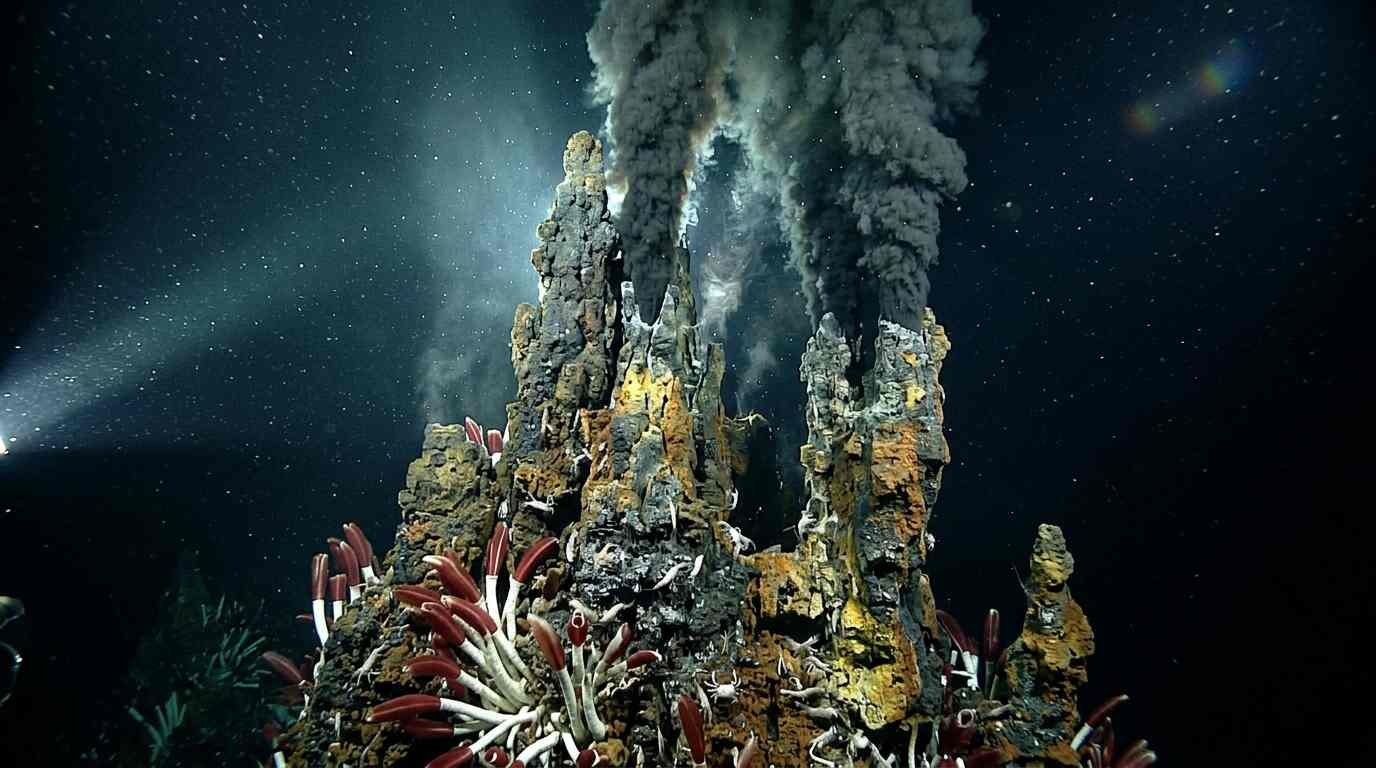
That is one of the leading settings. Alkaline vents, studied by Michael Russell and William Martin among others, release warm, mineral-rich fluid through porous rock chimneys. These produce natural chemical gradients, comparable to the ones all modern cells use to make energy, along with tiny compartments in the rock where molecules could concentrate. In 2016, researchers reported making short RNA chains of up to four units in simulated vent-chimney conditions.
There are competing locations. Warm shallow ponds on land, with cycles of wetting and drying, have been argued to be better for building long molecules. A 2024 laboratory study found that a heated sapphire surface with cracks could concentrate prebiotic building blocks by up to three orders of magnitude, a result that points to mineral surfaces as helpful anywhere. These are laboratory demonstrations, and none has been shown to be the actual route.
What about the Miller–Urey experiment?
In 1952, Stanley Miller and Harold Urey ran electric sparks through a mixture of gases meant to mimic the early atmosphere, and produced amino acids. It was a landmark because it showed that the building blocks of life form from simple ingredients without any living help.
The picture has since been revised. Current thinking is that the early atmosphere was only weakly reducing or neutral, and that gas mix would produce fewer amino acids than the original setup. The experiment is still taught for what it demonstrated, which was a principle: prebiotic chemistry is possible. It is not offered as a recipe for what actually took place.
Could life have come from space?
Panspermia is the idea that life, or its starting materials, arrived from elsewhere. The first part, living organisms traveling between planets, is old (the idea goes back to Anaxagoras in the 5th century BC) and untested. It also does not solve the origin problem; it just moves it somewhere else.
The second part, that space delivered ingredients, has real support. The Murchison meteorite, for example, holds the nucleobases uracil and xanthine, which appear to have formed in space, and NASA studies suggest all four DNA nucleobases may form there. In January 2025, scientists analyzing samples from the asteroid Bennu, returned by NASA’s OSIRIS-REx mission in 2023, reported 14 of the 20 amino acids used in terrestrial proteins and all five nucleobases found in DNA and RNA. The amino acids showed a mix of left-handed and right-handed forms, unlike life on Earth, which uses almost exclusively one form.
What this shows is that the raw materials were widespread in the early solar system. It does not show that life began in space, or that these materials were necessary on Earth, where they could also have been made locally.
Why is the origin of life so hard to solve?
There are several reasons. The event happened four billion years ago and left almost no direct record, since most rocks from that time have been destroyed or altered. Chemistry in a flask is a poor stand-in for a planet-sized, billion-year experiment. And the target keeps shifting: what counts as “life” depends on the definition used.
Progress comes mostly from two directions. Laboratories test whether plausible steps work under realistic conditions, and genetic and geological studies narrow the timeline. Each new result can eliminate a hypothesis or make it more plausible, but a single decisive experiment is unlikely.
Common questions
Has scientists created life in a lab?
No. Researchers have made building blocks and simple self-assembling structures, but no one has produced a living cell from non-living chemicals. Synthetic biology projects that modify existing cells are a different thing.
How long did it take for life to appear?
The evidence suggests relatively quickly in geological terms, within several hundred million years of the Earth becoming habitable, though the precise timing is uncertain and depends on which early signs of life are accepted.
What was the first life form?
Unknown. The last universal common ancestor is the earliest organism we can infer from comparing living cells, but it was probably already complex and was likely preceded by simpler systems.
Is the origin of life a matter of luck?
Nobody knows. If life requires a rare chain of events, it could be extremely uncommon; if the chemistry is easy given the right conditions, life could be common. With only one example, scientists cannot yet estimate the odds.
Is the Miller–Urey experiment still valid?
Yes, as a demonstration that organic molecules can form from simple gases. The gas mixture it used is now considered less likely for the early Earth.
Does the origin question disprove evolution?
No. Evolution explains how life diversified after it began and stands independently of how the first living system arose.
What to remember
Life was probably on Earth by about 3.5 billion years ago and possibly much earlier, but how it started is unsettled. RNA-first, metabolism-first and vent-based ideas each explain some of the evidence, while none is confirmed. Space delivered organic ingredients, a point the Bennu samples support, though that is different from life originating there. The question is open, not unanswerable.
Further reading
Well-regarded popular science book that includes a chapter on the origin of life. See it on Amazon (affiliate link)
As an Amazon Associate I earn from qualifying purchases. A commission may be earned if you buy through this link, at no extra cost to you.
Sources



