






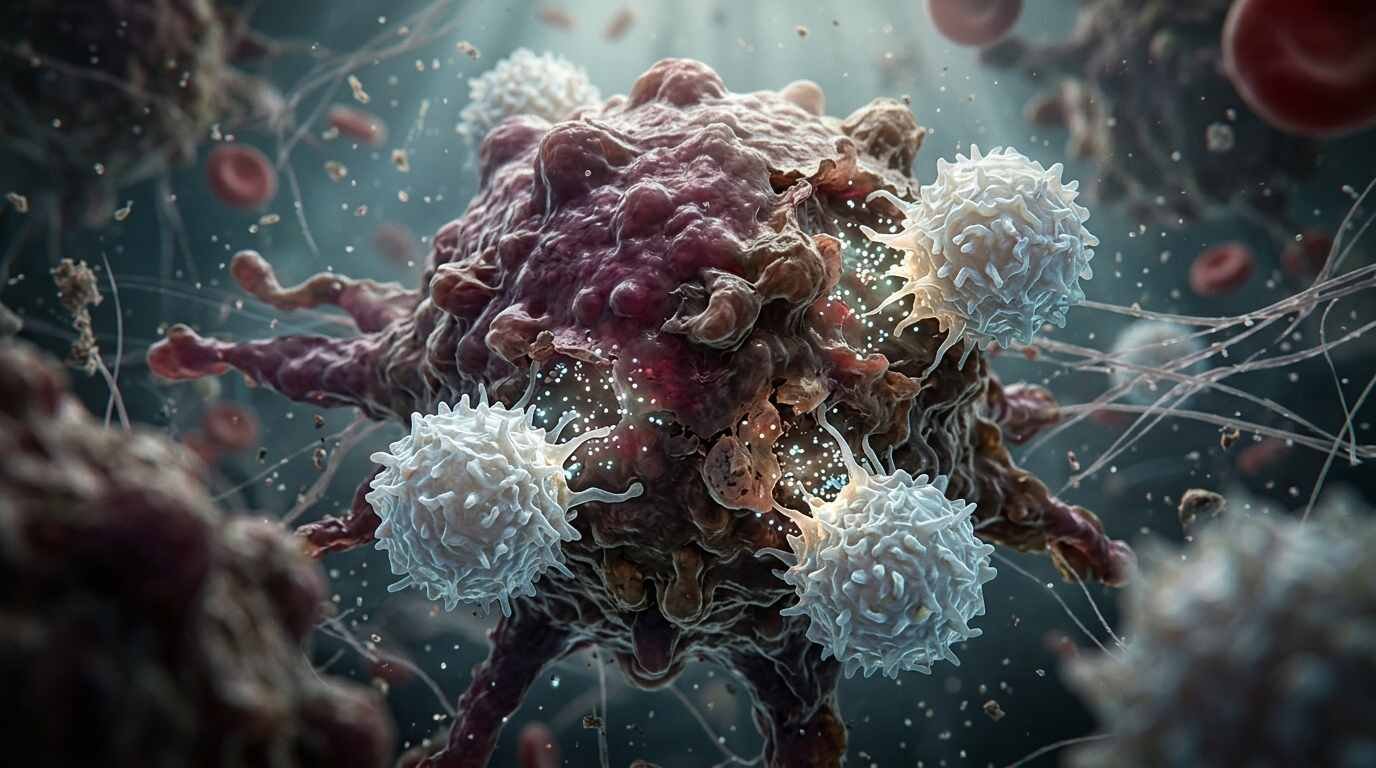
CAR-T cell therapy turns a patient's immune cells into targeted cancer fighters. Here is how it is made, what it treats, and what the risks are.
CAR-T cell therapy is a treatment that takes a patient’s own immune cells, rebuilds them in a laboratory so they can recognize a specific cancer, and returns them to the body as a one-time infusion. The name stands for chimeric antigen receptor T cells. “Chimeric” means the receptor is stitched together from parts of different molecules, and that engineering is what makes the approach different from a drug in a vial. It has produced remarkable remissions in some blood cancers, it can also cause serious side effects, and it is expensive. All three things are true at once.
What is CAR-T cell therapy?
T cells are white blood cells that patrol the body and kill cells that look infected or abnormal. Cancer cells often evade them. A CAR-T therapy gives T cells a new sensor, a synthetic receptor that locks onto a protein, called an antigen, on the surface of cancer cells.
The receptor has four main parts. On the outside is a piece of an antibody, usually a single-chain fragment, that recognizes the target. A hinge and a transmembrane segment connect it to the cell. On the inside sits a signaling region, typically built from a T cell signal called CD3-zeta plus one or two helper signals, that tells the cell to attack and multiply.
The concept dates to the late 1980s, when researchers first described receptors joining antibody and T cell components. Early versions did little. The first clinical trial in the mid-1990s, which targeted HIV-infected cells, showed no clinical improvement. Efficacy became clear only in the early 2010s, when trials targeting a protein called CD19 produced complete remissions in heavily pretreated patients.
How are the cells made, step by step?
The process runs through five stages.
First, blood is drawn through a machine that collects white blood cells, a procedure called leukapheresis. Most approved products use the patient’s own cells, which are called autologous. Experimental products use donor cells, called allogeneic.
Second, the T cells are activated with signaling molecules so they will divide. Third, a gene encoding the receptor is delivered into the cells, most often by a disabled virus, such as a lentivirus or gammaretrovirus. Researchers have also used CRISPR to insert the gene at a chosen location in the genome.
Fourth, while the cells multiply in a manufacturing facility, the patient typically receives chemotherapy to lower existing white cell counts. This lymphodepletion step reduces competition and helps the engineered cells expand. Fifth, the cells are infused. When they meet their target, they activate, multiply and kill, and they release chemical messengers that influence other immune cells.
Which cancers does it treat?
Mostly blood cancers. The first two FDA approvals came in 2017, and the products now on the market target one of two proteins, CD19 or BCMA.
- Kymriah (tisagenlecleucel), approved 30 August 2017, targets CD19 and is used for B-cell acute lymphoblastic leukemia and certain lymphomas.
- Yescarta (axicabtagene ciloleucel), approved 18 October 2017, targets CD19 in large B-cell and follicular lymphoma.
- Tecartus, approved in July 2020, treats mantle cell lymphoma and some leukemia.
- Breyanzi, approved in February 2021, and Abecma, approved in March 2021, extended the list; Abecma targets BCMA in multiple myeloma.
- Carvykti, approved in February 2022, also targets BCMA in multiple myeloma.
- Aucatzyl (obecabtagene autoleucel), approved in November 2024, targets CD19 in B-cell precursor acute lymphoblastic leukemia.
Indications have been widened over time, and they differ by product and by line of therapy, so a patient’s own situation depends on a specialist’s assessment. This article does not offer medical advice and cannot say who qualifies.
What are the side effects?
The two best known are cytokine release syndrome and neurological toxicity. In cytokine release syndrome, the activated T cells set off a surge of inflammatory signals. The result can look like a severe infection: high fever, low blood pressure and, in serious cases, organ dysfunction. Doctors manage it with steroids and with tocilizumab, a drug that blocks one of the inflammatory messengers, interleukin-6.
Neurological toxicity can include confusion, trouble finding words, reduced alertness and seizures. Its mechanism is not well understood. A few trial deaths involved brain swelling.
Because a CD19-targeting therapy also destroys healthy B cells, some patients end up with low antibody levels and an elevated risk of infection. Allergic reactions are possible because the receptor contains a foreign antibody piece. Movement problems resembling parkinsonism have been reported with some BCMA-directed products.
There is also a long-term question. Gene delivery by a virus can in theory disrupt a gene that normally restrains cell growth, causing a new cancer. The reference source calls that outcome unlikely, and regulators require makers to follow patients for 15 years to learn how often it happens.
What changed in 2025?
On 26 June 2025, the FDA removed the special safety program, known as a REMS, from six approved CD19- and BCMA-directed products. The agency said that hospitals and doctors now have enough experience managing the main risks, and that adverse event reports for cytokine release and neurological problems had remained stable.
The practical effects are concrete. Hospitals no longer need special certification or an on-site stock of tocilizumab. Labels now call for monitoring for at least two weeks, with daily checks for the first week, and patients are advised to stay near a treatment facility and avoid driving for two weeks. The FDA expects this to help patients in rural areas reach treatment.
Not everything was loosened. The boxed warning for cytokine release and neurologic toxicity remains, as do requirements for long-term observational studies of secondary cancers. One hematology outlet described the decision as reflecting growing confidence in managing the toxicities.
Why do the targets matter, and how have the receptors changed?
A CAR can only attack what it can see, so the choice of target decides almost everything. CD19 is a protein found on B cells, including the cancerous ones in many leukemias and lymphomas. BCMA serves the same purpose in multiple myeloma. The price of a good target is collateral damage: healthy cells carrying the same protein are hit too, which is why CD19 therapy depletes normal B cells.
The receptor design itself has gone through generations. First-generation versions carried only the CD3-zeta signal and performed modestly. Second-generation versions added a co-stimulatory domain, either CD28 or 4-1BB, and every currently approved product belongs to this group or a close relative. Third-generation designs add two such domains, and fourth-generation versions, sometimes called TRUCKs, also secrete a cytokine such as interleukin-12 to stir up the surrounding tissue.
Newer ideas keep arriving. A 2018 design called SUPRA CAR splits the receptor into parts so that one set of T cells can be redirected to different antigens without new genetic engineering. In 2026, a group reported in mice a therapy aimed at a gene segment in B cell receptors, which matched CD19 CAR-T against a lymphoma without touching CD19. Mouse results often fail to carry over to people, so it is a lead, not a treatment.
Why does it cost so much?
Each dose is a custom-made product. Cells must be collected, shipped, engineered and returned under strict manufacturing standards, and the infusion is followed by intensive hospital care. Initial list prices were about $375,000 for tisagenlecleucel and $475,000 for axicabtagene ciloleucel, and these figures do not include the cost of the hospital stay.
Medicare covers the therapy, and so do many private insurers, though not all. Some manufacturers have offered payment programs tied to a complete remission. Access is also uneven geographically: the treatment is available in a limited number of countries, and even within approving countries it is concentrated at specialized centers.
One research direction aims directly at cost. In vivo CAR-T delivers the receptor gene to T cells inside the patient, skipping the factory step. The reference source estimates it could cut costs by roughly an order of magnitude, but it is under investigation, and the claim remains a projection.
Can it work against solid tumors or other diseases?
Solid tumors are the hard frontier. There are three problems. Few antigens appear on cancer cells but are absent from healthy tissue. CAR-T cells do not travel well into the middle of a solid mass. And the tumor environment actively suppresses T cells.
There are early signals. A small trial of a CAR-T variant in glioblastoma, a brain tumor, reported rapid tumor regression after one infusion, though the study was small and the long-term outcome was not part of the reference reviewed. Another early-stage study in recurrent ovarian cancer reported stable disease at 90 days for one patient at the highest dose, which is a single data point and nothing more.
Autoimmune disease is the other expansion. Because CD19-directed cells wipe out B cells, which drive diseases such as lupus, researchers have begun trials in lupus, systemic sclerosis, myositis and rheumatoid arthritis. Engineered regulatory T cells are being explored to induce tolerance in transplantation and lupus. These are trial-stage ideas, not approved treatments.
Common questions
Is CAR-T a form of chemotherapy?
No. Chemotherapy is a drug that kills dividing cells. CAR-T is a living, engineered cell product. Patients usually receive a short course of chemotherapy first, but only to prepare the body for the infusion.
Is CAR-T a cure?
Some patients have remained in remission for long periods, but this article does not offer a cure rate, and relapse does occur. Outcomes depend on the cancer, the product and the patient.
How long does the process take?
Manufacturing and preparation usually take a number of weeks from the collection of cells to infusion. Monitoring after infusion is intensive, and the FDA’s 2025 label guidance calls for at least two weeks.
Does CAR-T use donor cells?
Approved products so far use the patient’s own cells. Donor-derived versions are in development.
What does the FDA still require?
The 2025 decision removed the REMS but kept the boxed warning, the medication guide, and long-term follow-up studies for secondary malignancies.
What to remember
CAR-T therapy is engineered immune cells given as a single infusion, approved in the United States since 2017 for several blood cancers. It can produce deep responses, and it carries real risks, including cytokine release and neurological effects. In 2025 the FDA eased the safety program around it. Solid tumors and autoimmune disease are active research areas without approvals yet, and cost is a major barrier.
Further reading
A widely read history of cancer and its treatments, useful background. See it on Amazon (affiliate link)
As an Amazon Associate I earn from qualifying purchases. A commission may be earned if you buy through this link, at no extra cost to you.
Sources



