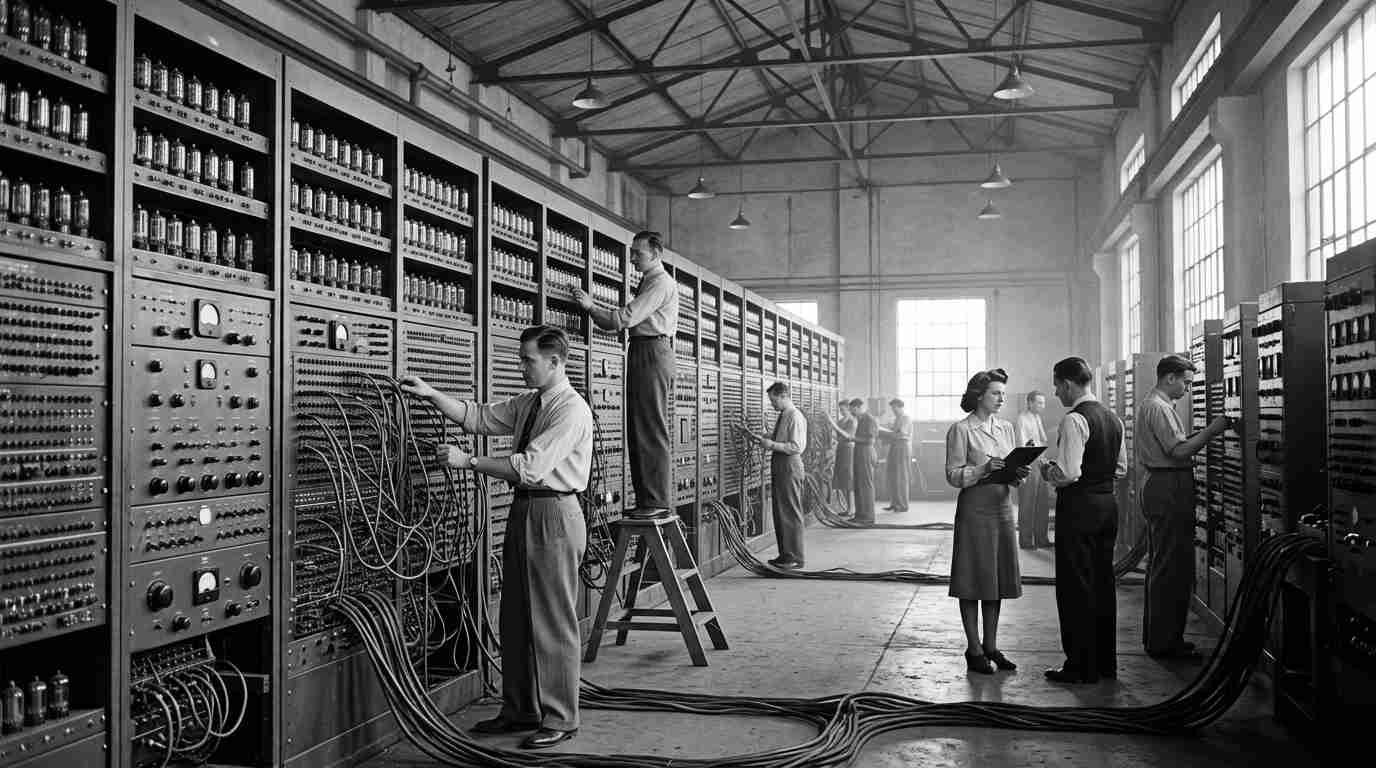
Babbage, Zuse, Atanasoff, Colossus, ENIAC and the Manchester Baby all have a claim to the first computer. Which one wins depends on the adjectives you insist on.
The question “what was the first computer?” sounds like it should have a one-line answer, the kind you could put on a museum placard. It doesn’t. Depending on how strictly you define the word, the title can go to a design from the 1830s, a German relay machine from 1941, a small Iowa device, a British codebreaking engine, a room-sized American calculator, or a lab prototype that ran in Manchester in 1948. Each has a real claim, and each claim collapses if you add one more requirement to the definition.
That is why the argument has lasted for decades. It is less a fight over facts, most of which are settled, than a fight over adjectives: electronic, digital, programmable, general-purpose, stored-program. Pick your adjectives and you pick your winner.
Why is there no single answer?
A computer, in the modern sense, is a machine that can carry out any procedure you can describe step by step, given enough memory and time, and that takes its instructions as data. Early machines met some of those conditions and not others. Some did arithmetic quickly but could only do one kind of job. Some could be given new jobs but ran on slow mechanical parts. Some did everything except keep their instructions in memory, so changing the task meant rewiring.
So the useful move is to split the claim into separate firsts. Who built the first working programmable machine? The first electronic one? The first to be fully general? The first to store its program the way your phone does? Those have different answers, and most of the heat in the debate comes from people answering different questions.
Did Babbage build the first computer?
No, though he designed something astonishingly close. Charles Babbage conceived his Analytical Engine in 1833. On paper it had an arithmetic unit, memory, conditional branching, loops, and punched cards for instructions. By modern reasoning it would have been Turing-complete, meaning it could in principle compute anything computable.
It was never finished. The money ran out and the precision engineering of the day could not keep up with the design. Babbage’s engine is the first general-purpose design, which is a different thing from a machine that ever ran a program. It earns an honorable mention in nearly every account, but not the trophy.
Was it Konrad Zuse’s Z3?
The Z3, completed in 1941 in Germany, was the first working programmable, fully automatic digital computer, and it was built from electromechanical relays rather than tubes. It used binary floating-point numbers and read its program from punched film.
It lacked a conditional jump, which looks like a fatal gap, yet researchers later showed that with some contortions it could still compute anything a general computer can. That demonstration came only in 1998, long after the machine itself was gone. If your definition is “programmable and digital, never mind electronic,” Zuse has a very strong case. The word doing the work is electronic, and that is where the other contenders enter.
What did the Atanasoff-Berry Computer actually do?
In Ames, Iowa, physicist John Vincent Atanasoff and his student Clifford Berry built a binary machine around 300 vacuum tubes. An 11-tube prototype was shown in October 1939, and the full machine was working by 1942. Its memory was a pair of rotating drums holding 3,000 bits in capacitors, and it handled 50-bit binary numbers.
It had a single job: solving systems of simultaneous linear equations, up to 29 of them. Settings were made with switches and jumpers, and there was no way to give it a different kind of task. It was electronic and digital, but not programmable. When the university converted its basement in 1948, nearly all of it was thrown out; one memory drum survived, and a working replica was finished at Ames Laboratory in 1997.
The machine matters for a second reason. John Mauchly, who would later co-design ENIAC, spent a week with Atanasoff in 1941 discussing the design. How much he took from that visit is still argued. One standard history calls the evidence “massive and conflicting,” and the extent of the borrowing remains unknown.
What was Colossus, and why was it forgotten?
Colossus was built at the British Post Office research station by engineer Tommy Flowers, working from codebreaking requirements at Bletchley Park. The first version worked on 8 December 1943 and attacked a real message on 5 February 1944. A faster Mark 2 with 2,400 valves ran on 1 June 1944, days before D-Day. Twelve machines were shipped, and ten were in use by the end of the war in Europe.
Its target was the Lorenz cipher, used by the German high command for teleprinter traffic. Colossus did not decrypt messages by itself; it counted the results of Boolean tests on tape to help find the starting positions of the cipher’s wheels, which let the human codebreakers finish the job. Tape ran through at about 5,000 characters per second, and a Mark 2 processing five streams in parallel reached an effective 25,000.
Colossus was set up with switches and plug panels rather than a stored program, and it was designed for one family of tasks. A single machine is not considered Turing-complete, though one researcher has argued that the ten machines wired together in a particular cluster could have simulated a universal machine. That is a hypothesis about an arrangement nobody built.
The reason almost nobody knew about it is secrecy. The machines were broken up after the war, Flowers was ordered to destroy the paperwork and burned it, and the existence of the project stayed classified for roughly thirty years. By the time it came out in the mid-1970s, ENIAC had been on the front pages for a generation. A volunteer team under Tony Sale rebuilt a working Mark 2 between 1993 and 2008, and it now sits at The National Museum of Computing at Bletchley Park.
So why does ENIAC get the credit?
Because it was public, enormous, and the first of its kind that most of the world ever saw. ENIAC (Electronic Numerical Integrator and Computer) was designed by Mauchly and J. Presper Eckert at the University of Pennsylvania’s Moore School and paid for by the US Army, which wanted artillery firing tables faster. The contract was signed in June 1943. It was finished in 1945 and put to its first real work, calculations connected to nuclear weapons research at Los Alamos, on 10 December 1945. The public announcement came on 14 February 1946, and the press called it a “Giant Brain.”
The numbers were big. About 18,000 vacuum tubes, 7,200 crystal diodes, 6,000 relays, and some 5 million hand-soldered joints, in a machine weighing more than 30 tons and drawing 150 kilowatts. It was far faster than anything electromechanical, performing roughly 5,000 additions per second, and a demonstration computed a missile trajectory in 15 seconds that would have taken a person weeks. The final bill was about $487,000, against an original contract of $61,700.
Unlike Colossus, ENIAC was a general-purpose machine that could be set up for many different problems, and it was Turing-complete. That is the basis of its claim: electronic, digital, programmable, and general, all at once. The Wikipedia entry puts it neatly, saying ENIAC was the first to have them all, even though others had some.
How did you program ENIAC?
You rewired it. There was no stored program; instead, programmers set switches on three portable function tables and plugged cables between its units. Turning a problem into a wiring plan could take weeks, and entering it could take days more.
The work was done by six women, chosen from about 200 human “computers” employed at the Moore School: Kay McNulty, Betty Jennings, Betty Snyder, Marlyn Wescoff, Fran Bilas, and Ruth Lichterman. They learned the machine from its blueprints and hardware, because no programming languages existed to teach them. At the formal dedication in February 1946 they were not invited to the celebratory dinner.
A conversion in 1948 let ENIAC run from instructions entered on cards, with a demonstration in April of that year. The change slowed the machine by a factor of about six and ended its parallel operation, but it cut reprogramming from days to hours, a trade that nobody regretted.
What happened in court in 1973?
A patent fight settled part of the argument, at least legally. The ENIAC patent, applied for in 1947 and granted in 1964, became the center of a lawsuit between Honeywell and Sperry Rand. On 19 October 1973, Judge Earl Larson ruled the patent invalid, finding that Eckert and Mauchly had derived the core idea of the automatic electronic digital computer from Atanasoff’s work.
The ruling is often summarized as “Atanasoff invented the computer.” That overstates it. The court addressed a patent, not the whole history, and historians still point out that the ABC was neither programmable nor general. What the decision did do was put the idea in the public domain and make clear that ENIAC was not a bolt from nowhere.
What about the first stored-program computer?
If your standard is the architecture inside every modern device, with instructions and data living in the same memory, ENIAC and Colossus both fall short. The idea had two parents. Alan Turing’s 1936 paper supplied the theory of a universal machine, and John von Neumann’s 1945 report on a design called EDVAC laid out the practical layout, so strongly associated with his name that people still say “von Neumann architecture.”
The first machine to actually run a stored program was the Manchester Baby, on 21 June 1948. It was a small test rig with 32 words of memory, and its first program took 52 minutes to find the highest proper divisor of 2 to the 18th power. Cambridge’s EDSAC followed, running its first programs on 6 May 1949 and becoming one of the first stored-program machines put to regular use.
Hold that definition and the Manchester team wins, with no real rival. It is a perfectly good answer, though most people asking about the “first computer” are not asking about that.
Common questions
Is ENIAC the first computer?
It is the first electronic computer that was programmable and general-purpose, and the first one the public heard about. It is not the first digital computer, the first electronic one, or the first with a stored program.
Was Colossus a real computer?
It was electronic, digital, and programmable by switches and plugs, so many historians call it the first programmable electronic digital computer. It was built for codebreaking and is not considered general-purpose, which is why it usually sits just outside the “first computer” title.
Who is the father of the computer?
Several people have been given the title: Babbage for the design, Zuse for the first working programmable machine, Turing for the theory, and Mauchly and Eckert for ENIAC. The label depends on which part of the story you value, and it is not a settled fact.
Did the Atanasoff-Berry Computer inspire ENIAC?
Mauchly visited Atanasoff in 1941, and a court found in 1973 that ENIAC’s inventors had derived the idea from his work. Mauchly denied it, and historians describe the evidence as conflicting.
What was the first stored-program computer?
The Manchester Baby, which ran its first program on 21 June 1948.
What to remember
There is no single first computer, only a sequence of firsts. Babbage designed the general machine. Zuse built the first programmable digital one. Atanasoff and Berry built an electronic digital calculator that could do one job. Colossus was the first programmable electronic one. ENIAC combined electronic speed with general-purpose use. The Manchester Baby stored its program.
When someone asks for the first, ask which adjective they care about. The honest answer then takes one sentence, and it is rarely the sentence people expect.
Further reading
- The Innovators by Walter Isaacson: Popular history of the people behind early computing, including the ENIAC programmers. See it on Amazon (affiliate link)
- ENIAC by Scott McCartney: Book-length account of ENIAC and the Mauchly-Eckert story. See it on Amazon (affiliate link)
As an Amazon Associate I earn from qualifying purchases. A commission may be earned if you buy through this link, at no extra cost to you.
Sources