






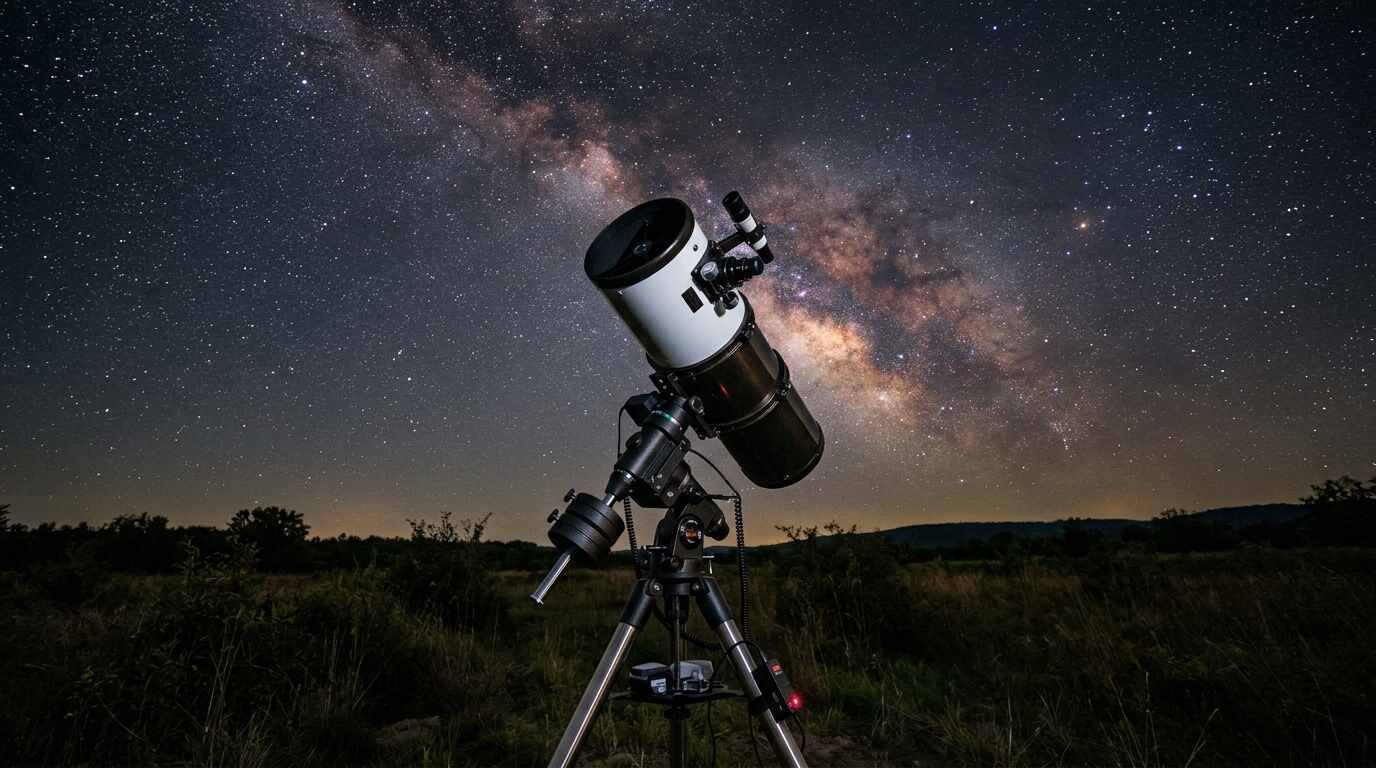
A 130 mm reflector on a manual equatorial mount for under $300. Reviewers split sharply on whether it is a good first telescope, and the mount is the sticking point.
As an Amazon Associate I earn from qualifying purchases. A commission may be earned if you buy through this link, at no extra cost to you.
This Celestron AstroMaster 130EQ review starts with a plain question: does a 130 mm mirror on a wobbly equatorial mount make a good first telescope? Reviewers disagree, and the disagreement is instructive. I haven’t tested this unit; this review is based on published tests and shopper feedback. Check the current price on Amazon before buying.
What the AstroMaster 130EQ is
It is a Newtonian reflector with a 130 mm (5.1 in) primary mirror and a 650 mm focal length, which works out to f/5. Celestron sells it as item 31045. The mirror is spherical rather than parabolic, a cost-saving choice that comes up again in the criticism.
It sits on a CG-3 manual German equatorial mount. That type of mount is designed to follow the sky’s rotation with a single motion once it is aligned, and it has setting circles and slow-motion controls. There is no motor in this version. A separate 130EQ-MD model adds single-axis tracking on a 9V battery and costs more; everything below refers to the manual scope unless I say otherwise.
| Optics | 130 mm Newtonian reflector, spherical primary, f/5, 650 mm focal length |
| Eyepieces | 20 mm (33x, erect image) and 10 mm (65x); no Barlow, no diagonal |
| Finder | Red-dot StarPointer |
| Mount | CG-3 manual German equatorial with setting circles and slow-motion controls |
| Weight | Kit about 17 lb per Celestron; Digital Camera World lists a much higher figure |
| Extras | 2-year warranty, Starry Night Basic, SkyPortal app |
Celestron quotes a maximum useful magnification of 307x. Astronomics lists 217x for the motor-drive version. I could not reconcile the two, so I would not plan around either number.
What Amazon shoppers say
Amazon shoppers do not agree about this scope. Amazon’s summary of the text reviews reads like an argument. On clarity, some owners describe incredible views while others say they could not get a decent look at the Moon. On assembly, some found it easy and others found the instructions inadequate and the scope unsuited to beginners.
Build quality splits the same way. Buyers describe the telescope as fragile in places and the adjustment controls as poor.
That spread usually means two things at once: expectations differ, and so does the unit-to-unit quality. Celestron’s equatorial mount takes patience, and a beginner who expected point-and-look may come away disappointed. A Google or Google Shopping rating was not checked for this post, so shoppers who want another data point can compare it themselves.
What the independent reviewers found
Digital Camera World, reviewing the scope in November 2021, called it an affordable beginner package. It praised the Moon and planet views, including Saturn’s rings and Jupiter’s moons, and said setup takes around 20 minutes. It also found the stock eyepieces weak, the 20 mm eyepiece short on eye relief for glasses wearers, and the mount shaky. Serious astrophotography is off the table, though basic snapshots are possible.
Telescopic Watch was much harsher. It scored the scope 2.4 out of 5, ranked it 23rd of 29 in its price category, and does not recommend it. Its argument is that better beginner scopes beat the 130EQ on optics, focuser and accessories, and that some units deliver poor high-power views. The review was updated in June 2025.
A Stargazers Lounge forum thread adds an owner’s regret. The poster found the mount weaker than the Sky-Watcher alternative and the red-dot finder close to useless. That thread is undated and anecdotal, so it counts as color, not data.
Telescope School’s 2026 budget roundup does not review the 130EQ. It covers the smaller 114EQ as a narrow pick for people who specifically want an equatorial, notes that mount’s wobble, and favors the Sky-Watcher Heritage 130P overall.
It is worth weighing the dates. Digital Camera World wrote its review in 2021 and was fairly warm. Telescopic Watch updated its much colder verdict in 2025, and ranks it among 29 scopes. The first reads as a verdict on the scope alone; the second weighs it against what else the money could buy. Both are fair, and the second is the more useful for a shopper with a budget.
What it does well
Aperture is the headline. A 130 mm mirror gathers noticeably more light than the small refractors that share its price bracket, according to Digital Camera World. That shows up as brighter Moon detail and a more convincing look at bright planets.
The short focal ratio gives a wide field of view, which Telescopic Watch says suits bright deep-sky objects. Sweeping across a star cluster is more pleasant with a wide field than with a narrow one.
It needs no electronics, so there are no batteries to forget and no hand controller to puzzle over. Telescopic Watch rates portability 4 out of 5 and describes the scope as lighter than many 130 mm Dobsonians.
And the equatorial mount, for all its irritations, teaches something. Once polar alignment clicks, you can follow an object across the sky with a single slow-motion knob. In my view that is a genuine skill, and the 130EQ is a cheap place to learn it.
Where it falls short
The mount draws the most complaints. Digital Camera World and Stargazers Lounge posters both describe it as lightweight and wobbly, and it struggles with extra accessories. In my view a shaky mount is worse than it sounds, because at 65x any touch of the focuser can set the image trembling.
The eyepieces are modest. Both Digital Camera World and Telescopic Watch fault them, and the 20 mm has poor eye relief. Plan on buying better ones, probably within the first month.
Equatorial mounts confuse newcomers. There is no polar scope here, so alignment is by eye and by trial. The red-dot finder is another weak point in forum and reviewer comments.
Optical quality seems to vary. Telescopic Watch says some units give poor high-power views, and Digital Camera World mentions quality-control variation. Celestron’s own spherical mirror may be part of the story, though neither source proves it. Even the motor-drive version has no drive corrector, so photography stays limited to quick snapshots.
Two smaller points. Price varies by seller: Celestron’s own site, B&H and Astronomics (for the motor-drive model) each listed a different figure, and the capture dates are unknown, so check the current price on Amazon before buying. And the kit weight is reported inconsistently, at 17 lb by Celestron and well above that by Digital Camera World, so I would not rely on either when planning storage or travel.
Taken together, the evidence draws a consistent picture. The optics are adequate for the Moon and bright planets, the aperture is the real advantage, and nearly every complaint traces back to the mount, the eyepieces or the finder. Those are all things a buyer can partly fix: better eyepieces are a modest upgrade, and patience with alignment is a skill that improves. What cannot be fixed is the mount’s wobble, which is why Telescopic Watch and Telescope School both lean toward the Dobsonian alternative. A buyer who accepts that trade will probably be content; one who expects it to behave like a point-and-look scope will not.
Video reviews
Two independent videos show the scope under the sky rather than on a spec sheet. Their appeal is that you can judge the views for yourself.
How it compares
The scope reviewers bring up most is the Sky-Watcher Heritage 130P. It has the same aperture in a tabletop Dobsonian design, which means no equatorial alignment at all. Telescopic Watch rates it 4.4, and Telescope School makes it a top pick. You give up tracking and a stand; you gain simplicity.
Stepping up in size, the Apertura AD6 or the Sky-Watcher Heritage 150P offer more aperture and better build, per Telescopic Watch, which rates the 150P at 4.5. They cost more, and I did not verify current prices.
A different route is the Celestron StarSense Explorer DX 102AZ. Telescope School points it at people who struggle to find objects, since a phone guides the search. It is smaller in aperture, but a telescope you can actually point is a telescope you will use.
Verdict: who should buy it, and who should skip
The 130EQ suits a beginner who wants to learn an equatorial mount, mostly to look at the Moon and bright planets, and who is happy to upgrade eyepieces. It also suits someone who values a light, battery-free kit.
Skip it if you want the easiest setup, the best optics per dollar or any real astrophotography. Kids and casual users who dislike aligning a mount will likely get frustrated. For most first-time buyers, I think the Heritage 130P is the safer choice.
Three questions help settle it. Will you enjoy learning the mount, or only want to look? Are you willing to spend more on eyepieces? And will anyone in the house be put off by a few evenings of fiddling? Yes, yes and no points toward the 130EQ. Any other combination points elsewhere.
Still, the 130EQ is not a bad telescope so much as a demanding one. Go in with realistic expectations, and a replacement eyepiece fund.
- Celestron AstroMaster 130EQ: a 130 mm reflector on a manual equatorial mount, best for patient beginners who want to learn the mount. See it on Amazon (affiliate link)
As an Amazon Associate I earn from qualifying purchases. A commission may be earned if you buy through this link, at no extra cost to you.



