






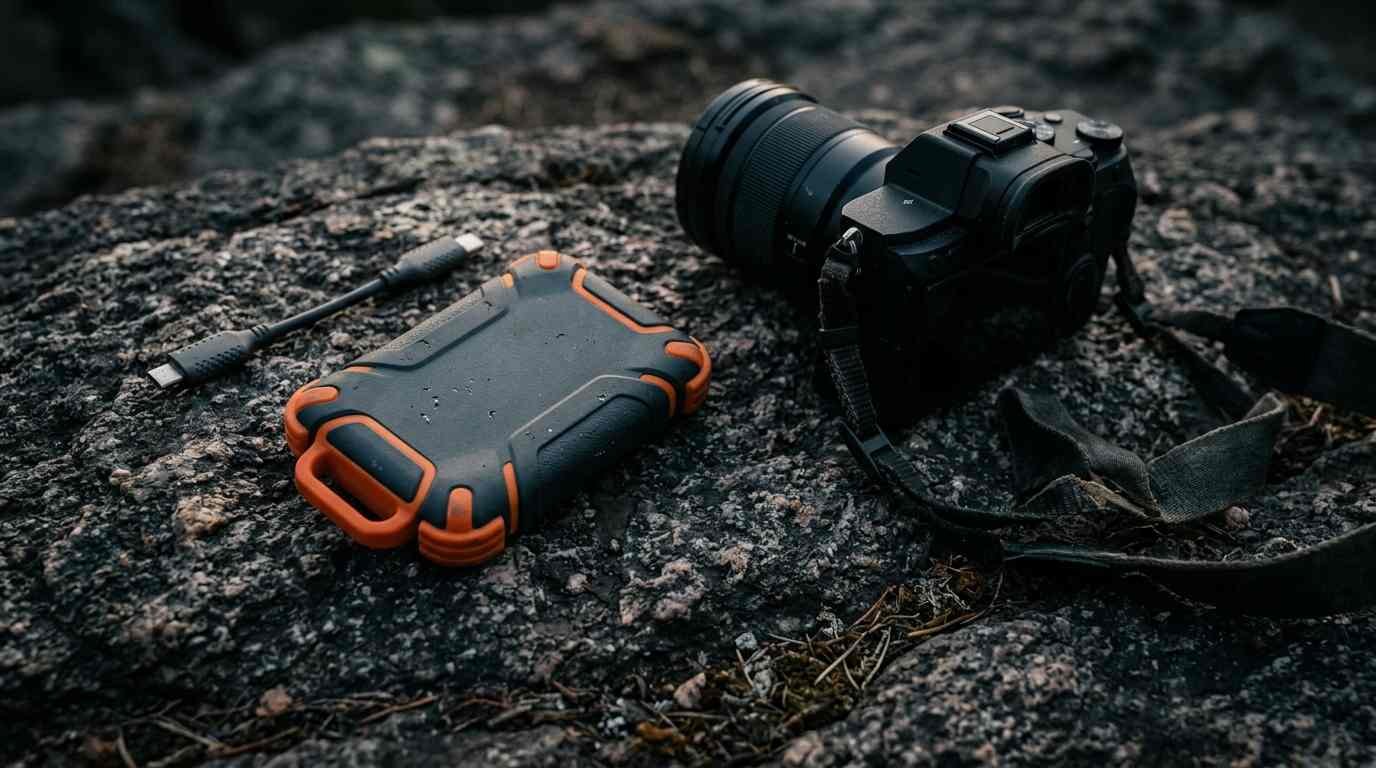
A Samsung T7 Shield review built from published tests and Amazon feedback: a rugged, fast-enough portable SSD with a speed cap and some reliability complaints.
As an Amazon Associate I earn from qualifying purchases. A commission may be earned if you buy through this link, at no extra cost to you.
This samsung t7 shield review comes down to a simple question: do you need a portable SSD that can take a beating, and are you willing to pay a little more than the standard Samsung T7 for it? The Shield is the same 10 Gbps drive in a rubber shell. The reviewers agree the shell is the point, because the speed barely changed.
What it is and who it is for
The T7 Shield is a portable solid-state drive from Samsung, released in early 2022. It plugs in over USB-C at up to 10 Gbps, and Samsung rates it at up to 1,050 MB/s for reads and 1,000 MB/s for writes. A rubber coating wraps the body, with an IP65 dust and water resistance rating and a 3-meter drop rating.
I haven’t tested this unit; this review is based on published tests and shopper feedback. Most of the numbers below come from Tom’s Hardware and StorageReview, with a few from The PC Enthusiast and Windows Central.
| Interface | USB 3.2 Gen 2, 10 Gbps, USB-C |
| Rated speed | Up to 1,050 MB/s read, 1,000 MB/s write |
| Durability | IP65 dust and water resistance, 3 m drop rating |
| Encryption | 256-bit AES hardware |
| Size and weight | 88 x 59 x 13 mm, 98 g |
| Warranty | 3 years; water, dust and drop damage not covered |
| Internals | Samsung Pablo controller, ASMedia ASM2362 bridge, TLC NAND, no DRAM |
| Capacities | 1TB and 2TB in 2022 reviews; a 4TB version was listed later |
It suits photographers, travelers and anyone who carries data into messy places: a camera bag, a job site, a rainy shoot. StorageReview noted broad compatibility with phones and cameras, which helps if you offload in the field.
What Amazon shoppers say
I read Amazon’s summary of buyer comments on the listing on Oct 10, 2026. The capacity that listing sells wasn’t verified, so check it before you order.
The summary of buyer comments is upbeat. Shoppers praise performance, speed and ease of use, and they say it works on both Mac and Windows. One reviewer backed up tens of thousands of photos, another moved about 2,000 photos in roughly a minute, and a few like that it fits in a pocket.
There is a split on reliability. Some owners report no problems at all, and others call the drive extremely unreliable. A pair of single-user threads on a Samsung forum describe disconnects. One involved a phone, where a reply blamed the phone’s USB port. The other described a 2TB unit with Windows warnings and drops that cable swaps and settings changes did not cure. Two threads can’t tell you a failure rate, but they do match the mixed note in Amazon’s summary.
A Google or Google Shopping rating was not checked for this post. Shoppers can compare it themselves before buying.
What reviewers found
Four outlets covered the drive in 2022, and they reached similar conclusions.
What stands out is how little they argued about speed. StorageReview’s measured figures sat close to the rating, Tom’s Hardware found the writes steady, and even the more critical PC Enthusiast review took issue with random performance, not the headline numbers. The disagreement was over how much the shell is worth, not over whether the drive works.
Tom’s Hardware called it tough and consistent. Sustained writes held up, a thermal guard keeps the casing under about 57 degrees Celsius, and the main limit is the bridge chip, which caps the drive at 10 Gbps.
StorageReview tested the 2TB model and measured 939 MB/s write and 914 MB/s read in Blackmagic, close to the rating. It also saw weaker single-thread results and described the update as one of ruggedness, not speed.
Windows Central recommended the drive for outdoor or rough use. Its complaints were that it costs more than other T7 drives, has fewer capacities, and lacks the fingerprint reader of the T7 Touch.
The PC Enthusiast gave it a Highly Recommended badge and picked it over SanDisk’s Extreme Portable SSD V2 for protection. But it called the speed a letdown, noting weaker random performance and that the rubber coating attracts dust and lint.
What is good
The drive delivers what it advertises. Sequential speeds in testing landed near the rating, and Tom’s Hardware found writes steady over time, which matters when you’re offloading a full memory card.
There is some engineering behind the consistency. Tom’s Hardware lists a Samsung Pablo controller, TLC flash and no DRAM cache, and describes a Dynamic Thermal Guard that keeps the casing under about 57 degrees Celsius. The aim is to keep the drive comfortable to hold during long transfers, and the steady sustained-write results suggest it does that. Tom’s Hardware’s throttling test results weren’t in the text I had, so I can’t quote them.
Protection is the headline. The rubber shell, the IP65 rating and the 3-meter drop rating make it a more forgiving travel companion than a bare aluminum drive. Hardware encryption adds some peace of mind, and StorageReview noted broad compatibility with phones and cameras.
At 98 grams it is also light. Add a three-year warranty and the sizable discounts PCWorld listed in May 2025 on both the 1TB and 2TB models, and it becomes a hard drive to criticize on value, provided you buy on sale.
What is not so good
Speed is capped. Ten gigabits per second is plenty for most people, but Tom’s Hardware and The PC Enthusiast both point out that 20 Gbps and Thunderbolt drives are faster. If you edit high-bitrate video straight off the drive, you might notice.
Random performance is weaker than the sequential numbers imply. In my view, that matters mostly if you plan to work from the drive directly, not just copy files on and off it.
The list price is higher than a standard T7, according to Tom’s Hardware. Street prices have moved a great deal since launch, and the figures I found conflict by date, so check the current price on Amazon for the size you want.
Capacity options are limited as well. Windows Central marked down the Shield for offering fewer sizes than other T7 drives. Reviews from 2022 cover 1TB and 2TB only, while a 4TB version appeared later, and sources disagree on whether it is officially part of the lineup. Check the exact size on any listing.
Resistance is not invulnerability. The drive isn’t built for submersion, and the warranty excludes water, dust and drop damage, so the protection is partly on you. The coating also collects lint, and the Amazon feedback and forum reports about disconnects are worth a glance before you commit.
Video reviews
Three independent videos follow. Titles came from a search and I haven’t watched them. One covers the 1TB drive and another the 2TB, so you can see both common sizes.
How it compares
The closest rival is SanDisk’s Extreme Portable SSD V2 in the same rugged class. The PC Enthusiast preferred the Shield for protection. SanDisk’s Extreme Pro is faster at 2,000 MB/s, according to the same review.
Inside Samsung’s own range, the standard T7 costs less and skips the rubber. The T7 Touch adds a fingerprint reader. For desk-only use, a plain T7 probably makes more sense in my view, since Windows Central recommends the Shield specifically for outdoor or rough use.
The practical choice is a three-way one. Pay more for the Shield if you need protection, pay less for a standard T7 if you don’t, or pay more again for a 20 Gbps drive if raw speed matters most. The reviews don’t suggest the Shield wins on all three counts, and nobody claimed it did.
I did not research drives from other makers, and the AnandTech review couldn’t be used because of site restrictions.
Who should buy it and who should skip it
Buy it if you carry data into unpredictable places and you can find it on sale. Photographers and field workers are the natural fit.
Think about the way you work before you decide. A photographer who copies cards to the drive in a car, a tent or a hotel room benefits from the shell every trip. Someone who plugs it into a desktop once a week and leaves it in a drawer is paying for a feature that sits idle. Neither choice is wrong, but only one of them gets value from the rubber.
Skip it if you need Thunderbolt-class speeds, if the drive will sit on a desk, or if you’d be paying near list price. And if disconnects worry you, plan to test the drive on your own devices soon after buying, while the return window is open.
Verdict
The T7 Shield is a sturdy, fast-enough drive that does its one job well. Reviewers liked it, and Amazon shoppers mostly praise its speed and ease of use. The costs are a speed ceiling, a higher price than the standard T7, and a minority of buyers who report unreliable behavior.
My take: it’s a good buy for people who need the toughness, and an unnecessary one for people who don’t.
- Samsung T7 Shield portable SSD: the rugged 10 Gbps drive reviewed above (check the capacity on the listing). See it on Amazon (affiliate link).
As an Amazon Associate I earn from qualifying purchases. A commission may be earned if you buy through this link, at no extra cost to you.



