





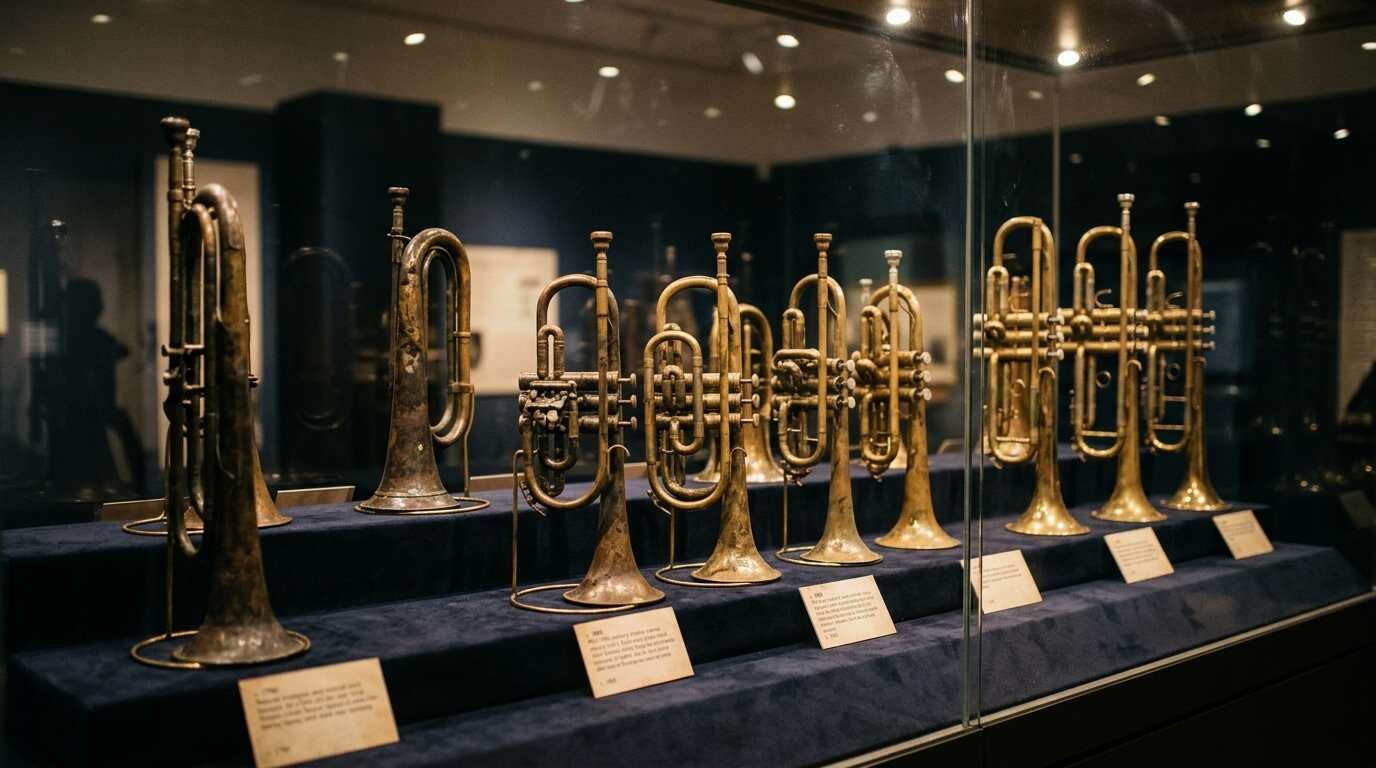
Researchers use biology's tree-building methods on artifacts from cornets to car models, but borrowing between designs may make those trees unreliable. This article weighs the evidence and reports a small simulation of horizontal transfer.
Cultural phylogenetics borrows the tree-building tools of evolutionary biology and points them at things people make: pottery styles, projectile points, woven carpets, musical instruments, even car models. The bet is that a cornet or a stone blade carries traces of its ancestry in its features, much as a bird carries traces of its dinosaur ancestors in its bones. If the bet pays off, archaeologists and historians of technology get a rigorous way to reconstruct who copied whom. If it does not, the trees they draw are pictures of a history that never happened.
Nobody has settled which outcome holds, or under what conditions. This article sets out the evidence on both sides, adds a small simulation built for it, and ends with the author’s own reading and some tests that could decide the matter.
The question, stated precisely
“Does technology evolve like life?” is too loose to answer. Almost everyone accepts that designs change, that some variants spread and others vanish, and that new things are built from old ones. The live dispute is narrower and more technical. When we record the features of a set of artifacts and ask a phylogenetic algorithm for the best branching tree, does that tree reflect real lines of descent? Or does the copying of features across lineages, which engineers do constantly, smear the signal so badly that the tree becomes an artifact of the method?
Two sub-questions follow. First, an empirical one: how tree-like are real datasets of technology compared with real biological datasets? Second, a methodological one: can we tell, from the data alone, when a tree is trustworthy? The second matters more, because a clean-looking tree can be produced by processes that are not branching at all.
This is not only a seminar topic. In 1996 the physicist John Ziman argued in a Times Higher Education essay that the parallels between technical and biological change are striking but the mechanisms differ: inventions are designed on purpose and freely combine ideas from many lineages (Ziman 1996). A 2009 thread on the Online Literature forum titled “The Force: has Technology trumped evolution?” ran for pages on a related theme (Online Literature forum 2009), and an undated blog post at World of Weird Things rejected Kevin Kelly’s view of technology as an evolving system as a clumsy metaphor (World of Weird Things, n.d.). The informal debate tends to be about whether the analogy is poetic. The scholarly one is about whether it is quantitatively usable.
What is established
Several points are not seriously contested.
Artifacts do carry historical information. Ilya Tëmkin and Niles Eldredge open their 2007 paper in Current Anthropology with a sentence that both camps would sign:
“Cultural artefacts, like genes and languages, reflect their history.”
Tëmkin and Eldredge, 2007, Current Anthropology 48(1)
Their disagreement with earlier work lay elsewhere. Studying two instruments, the stringed psaltery and the brass cornet, they concluded that conventional phylogenetic techniques help in some cases but supply no general theoretical or operational framework for reconstructing the history of material culture, and that the instruments reveal paths of information transfer and sources of innovation peculiar to culture (Tëmkin and Eldredge 2007).
Second, tree-likeness is measurable. Phylogeneticists score how well a dataset fits a branching tree with statistics such as the ensemble retention index (RI), which runs from 0 (features scattered with no regard for the tree) to 1 (every shared feature marks one clean group). Michael Collard, Stephen Shennan and Jamshid Tehrani compared 21 biological datasets with 21 cultural ones and reported that the cultural sets fit a bifurcating tree on average about as well as the biological sets, with no significant difference (Collard, Shennan and Tehrani 2006). Their stated lesson was that branching and blending should be tested case by case rather than assumed.
Third, biology is not perfectly tree-like either. Plants hybridize, and bacteria and archaea swap genes horizontally; a later preprint reanalysing the Collard comparison makes exactly this point about plants and prokaryotes (bioRxiv preprint 006486). For readers who want the background on how mutation, selection and drift shape lineages, our explainer on whether evolution is random covers the basics, and the piece on how the eye evolved shows a case where descent with modification is well documented.
Fourth, the macro-patterns of technology can be modelled with biology’s toolkit even without a tree. Erik Gjesfjeld and colleagues applied Bayesian birth-death models, the kind used for fossil diversification, to 3,325 American car models (dated from eBay parts-compatibility listings) and to 2,626 radiocarbon dates from 22 Neolithic pottery cultures (Gjesfjeld et al. 2020). Their framing line is blunt:
“Just like the majority of biological organisms, most innovations in human history are functionally extinct.”
Gjesfjeld et al., 2020, PLOS ONE 15(2): e0227579
Hypothesis one: technology mostly branches
The strongest version of the pro-tree case runs like this. Most technical knowledge is learned inside a tradition: an apprentice copies a master, a firm reuses its own drawings, a programming language inherits syntax from its predecessor. Borrowing happens, but it is the exception, and the bulk of variation is inherited vertically. If that is right, tree methods should work on technology roughly as well as on morphology, and the Collard 2006 result is what you would predict.
The evidence for it is real. A fit statistic that does not differ from biology’s is not nothing, and the authors used dozens of datasets rather than one showcase. Teaching material assembled by the Cultural Evolution Society lists a long line of artifact phylogenies, including Tehrani and Collard on Turkmen textiles and O’Brien and colleagues on taxon construction and outgroup choice in archaeological phylogenetics (Cultural Evolution Society reference list), which suggests that the method is productive enough to sustain a research program.
Against it: a fit statistic averages over a whole dataset. A tree with a respectable RI can still have its deep branches wrong. And the comparison depends on which biological datasets serve as the yardstick. A later reanalysis posted on bioRxiv by David A. Morrison (2014) compared anthropological datasets directly with both anatomical (phenotype) and genetic (genotype) datasets from biology, and concluded:
“The anthropology datasets fit the tree model approximately as well as do the genotype data, which is detectably worse than the fit of the phenotype data.”
Morrison, 2014, bioRxiv preprint (not peer-reviewed in the version cited)
So the verdict depends on the comparison class: next to genetic data, cultural datasets look ordinary; next to anatomical data, they look messier. That is a preprint, and the gap it reports is modest. It shifts the burden slightly rather than reversing the earlier finding.
Hypothesis two: technology is a network, and trees mislead
The opposing view says borrowing is not an exception in technology but the main engine. A modern phone is an assembly of components with separate histories: radios, batteries, touch sensors, cameras, operating systems. Our history of smartphones reads less like a lineage than a convergence of several. Chips tell a similar story; the piece on Moore’s law traces how process and design advances moved between firms. If features routinely jump between lineages, a tree is the wrong shape for the data, and a network or a set of overlapping trees fits better.
Tëmkin and Eldredge are the best-known advocates of a softened form of this view. Their claim is not that trees never work but that cultural transmission produces patterns that standard methods were not built to handle, so a general framework has to come from elsewhere (Tëmkin and Eldredge 2007).
Simulation work adds a further worry: tree-fit statistics are not clean detectors of blending. Enrico Crema, Tim Kerig and Stephen Shennan built an agent-based model that generated artificial archaeological records, then tested four methods, including the retention index, at picking up branching and blending. They found that the outcome also depended on fission frequency, population dynamics and innovation rates (Crema, Kerig and Shennan 2014). Put plainly, a low score might mean borrowing, or it might mean fast innovation with no borrowing at all.
The weakness of the network view is that it is harder to falsify. Networks can fit almost anything, and “everything borrows from everything” is not a historical claim. The camp still owes a method that says which links are real and how strong they are.
Hypothesis three: the wrong unit of analysis
A third position, so far mainly argued in preprints, says both sides measure the wrong thing. Liane Gabora and colleagues argue that relatedness among cultural items often sits at the level of concepts, such as function or underlying idea, rather than in measurable surface attributes, and they propose a network architecture that combines the two (Gabora et al., arXiv preprint 1309.2981). Applied to the Baltic psaltery, Tomas Veloz, Ilya Temkin and Gabora report a pattern of historical relationship that, by their account, matches geographic and temporal data better than other approaches (Veloz, Temkin and Gabora, arXiv preprint 1310.0737).
This is an attractive idea for technology, where two devices can look alike because they solve the same problem in the same way, not because one descends from the other. Convergence happens in biology too, but engineers converge on purpose. The cost is subjectivity: deciding which concepts an artifact embodies requires judgment, and judgment is precisely what phylogenetic methods were adopted to discipline. Neither preprint, as far as these sources show, has been tested against a case where the true history is independently known.
A small simulation: how borrowing scrambles a tree
To make the trade-offs concrete, a toy model was written for this article. It does not reanalyse any real dataset. Instead it grows artificial artifact lineages on a known tree, lets them borrow features, and asks how well a standard method recovers the truth.
Each run starts with one design described by binary traits (present or absent). In every time step, each lineage may split in two (probability 0.04) until there are 12 lineages; occasionally two splits land in the same step and the run ends with 13 or slightly more. Every trait flips with a small probability mu, standing in for invention and loss. With probability h per lineage per step, a lineage copies 6 percent of its traits from a randomly chosen contemporary, which stands in for borrowing. After branching stops, the lineages evolve for 20 more steps. The final trait table is then turned back into a tree using UPGMA, a simple distance method, and compared with the true tree using the normalized Robinson-Foulds distance (0 means identical topology, 1 means no shared groups). The retention index of the true tree is also scored with Fitch parsimony. Each setting was run 200 times with a fixed random seed.
import numpy as np
from scipy.cluster.hierarchy import linkage, to_tree
from scipy.spatial.distance import pdist
rng = np.random.default_rng(34)

def simulate(n_tips=12, n_traits=100, mu=0.002, h=0.1, kfrac=0.06,
             p_split=0.04, extra=20):
    traits, ids, children, nxt, after = [np.zeros(n_traits, int)], [0], {}, 1, None
    while after is None or after < extra:
        new_t, new_i = [], []
        for t, i in zip(traits, ids):          # branching: a lineage splits in two
            if after is None and len(traits) < n_tips and rng.random() < p_split:
                children[i] = (nxt, nxt + 1); new_t += [t.copy(), t.copy()]
                new_i += [nxt, nxt + 1]; nxt += 2
            else:
                new_t.append(t); new_i.append(i)
        traits, ids = new_t, new_i
        for t in traits:                        # vertical change: invention, loss
            t[rng.random(n_traits) < mu] ^= 1
        for j, t in enumerate(traits):          # horizontal transfer: copy a neighbour
            if len(traits) > 1 and rng.random() < h:
                d = rng.choice([x for x in range(len(traits)) if x != j])
                cols = rng.choice(n_traits, max(1, round(kfrac * n_traits)), replace=False)
                t[cols] = traits[d][cols]
        if len(traits) >= n_tips:
            after = 0 if after is None else after + 1
    return np.array(traits), ids, children

def splits_of_upgma(X):                       # rebuild a tree from trait distances
    out = set()
    def walk(n):
        if n.is_leaf(): return frozenset([n.id])
        s = walk(n.left) | walk(n.right); out.add(s); return s
    walk(to_tree(linkage(pdist(X, "hamming"), "average"))); return out

# For each setting: 200 runs; compare UPGMA splits with the true splits
# (normalized Robinson-Foulds distance) and score the true tree's
# ensemble retention index by Fitch parsimony (full script in work folder).| Traits | mu | Borrowing h | Mean RI (true tree) | Mean normalized RF | Runs with exact topology |
|---|---|---|---|---|---|
| 100 | 0.002 | 0 | 0.591 | 0.417 | 1.0% |
| 100 | 0.002 | 0.05 | 0.498 | 0.533 | 0.5% |
| 100 | 0.002 | 0.1 | 0.457 | 0.577 | 0.0% |
| 100 | 0.002 | 0.2 | 0.348 | 0.728 | 0.0% |
| 100 | 0.002 | 0.4 | 0.256 | 0.885 | 0.0% |
| 100 | 0.008 | 0 | 0.364 | 0.449 | 1.0% |
| 100 | 0.008 | 0.1 | 0.313 | 0.614 | 0.0% |
| 100 | 0.008 | 0.4 | 0.232 | 0.891 | 0.0% |
| 1000 | 0.002 | 0 | 0.594 | 0.118 | 32.5% |
| 1000 | 0.002 | 0.1 | 0.449 | 0.224 | 13.0% |
| 1000 | 0.002 | 0.2 | 0.346 | 0.385 | 5.0% |
| 1000 | 0.002 | 0.4 | 0.253 | 0.680 | 0.0% |
Three things stand out in this run.
- Borrowing degrades both measures steadily. With 100 traits and slow change (mu = 0.002), the mean RI fell from 0.591 without borrowing to 0.256 at h = 0.4, and the reconstruction error rose from 0.417 to 0.885.
- More data cures noise but only partly cures borrowing. Going from 100 to 1,000 traits cut the error without borrowing from 0.417 to 0.118 and lifted exact recoveries from 1.0 to 32.5 percent. At h = 0.4 the error with 1,000 traits was still 0.680, and no run recovered the exact tree.
- The retention index alone cannot say why fit is poor. Fast change with no borrowing (mu = 0.008, h = 0) gave a mean RI of 0.364; slow change with substantial borrowing (mu = 0.002, h = 0.2) gave 0.348. The two scores are nearly equal, yet the second scenario’s reconstruction error was much worse, 0.728 against 0.449.
What this does not show matters as much. The model is crude: borrowing picks a donor at random, while real borrowing favors neighbors and prestigious sources, which can produce false groupings rather than mere noise. The traits are independent coin flips, while real design features are linked. The numbers depend on every parameter chosen, and nothing here is calibrated to cornets, cars or anything else. The value of the exercise is qualitative: it reproduces, in a few dozen lines, the confound that Crema and colleagues reported with a far richer model, and it shows why a respectable RI is weak evidence that a tree’s branches are right.
The author’s reading, and what would settle it
What follows is opinion, labeled as such. The evidence reviewed here suggests that “does technology evolve like life?” has no single answer, because technologies differ in how they are transmitted. Crafts learned through long apprenticeship inside a community, such as textile patterns or stone-tool traditions, plausibly behave like branching lineages over long stretches. Engineered products assembled from modular, separately sourced parts plausibly do not. The Collard result and the bioRxiv reanalysis are both compatible with that split; they differ mainly in the yardstick.
The author also reads the simulation literature, this article’s toy included, as a warning against the most common shortcut: reporting a tree with a tree-fit score and treating the score as validation. A score measures fit to a tree, not whether the tree is the right history.
Several studies could move the question forward:
- Ground-truth tests. Choose a technology whose lineage is documented independently, such as patents with citation records, software with version-control history, or instrument makers with workshop archives, code its features blind to that history, and measure how often standard methods recover it. Prediction: recovery will be good for internally transmitted crafts and poor for modular products.
- Pre-registered comparisons. Fix the biological yardstick in advance (anatomical datasets with a matched number of informative characters) and test whether technology datasets fall below it. A clear gap, replicated across categories, would favor the network view.
- Borrowing-aware models. Fit methods that explicitly allow reticulation and ask whether they beat trees by a formal criterion on the same data. If the extra borrowing parameters rarely improve fit, the tree camp gains ground.
- Tests of the concept-level approach. Apply the Gabora-style conceptual networks to a case with known history and score them against tree and network baselines. Without such a test the third hypothesis stays a proposal.
Any of these would turn an argument about analogy into a measurement, which is the step this field still needs.
Common questions
What is cultural phylogenetics, in one sentence?
It is the use of methods built for reconstructing biological family trees to infer the history of cultural things, from languages to tools. The methods compare shared features across items and search for the branching pattern that explains them most economically.
If biology also has horizontal transfer, why single out technology?
Because the amount matters. Animals inherit most of their genome vertically, so trees work well for them, while bacteria swap genes often and are harder to place on a single tree. The open question is where technologies sit on that spectrum, and the answer probably varies by technology.
Does a high retention index prove a technology tree is correct?
No. The retention index measures how well features fit a given tree, not whether that tree is the true history. Simulation studies, including the toy one above, show that different processes can produce similar scores.
Are the car and pottery studies phylogenies?
Not in the tree sense. The Gjesfjeld team used birth-death models that estimate how fast new types appear and disappear over time, which borrows from paleobiology but does not need a tree of who descended from whom.
Further reading
- The Nature of Technology: What It Is and How It Evolves by W. Brian Arthur. A book-length argument that technologies evolve by combining earlier technologies, the view behind the network hypothesis. See it on Amazon (affiliate link)
- Cultural Evolution: How Darwinian Theory Can Explain Human Culture and Synthesize the Social Sciences by Alex Mesoudi. An accessible survey of how evolutionary methods, including phylogenetics, are applied to culture. See it on Amazon (affiliate link)
As an Amazon Associate I earn from qualifying purchases. A commission may be earned if you buy through this link, at no extra cost to you.
References
- Tëmkin, I., and Eldredge, N. (2007). Phylogenetics and material cultural evolution. Current Anthropology, 48(1), 146–154. doi:10.1086/510463
- Collard, M., Shennan, S., and Tehrani, J. (2006). Branching, blending, and the evolution of cultural similarities and differences among human populations. Evolution and Human Behavior, 27(3), 169–184. doi:10.1016/j.evolhumbehav.2005.07.003; repository record Durham Research Online
- Morrison, D. A. (2014). Are phylogenetic patterns the same in anthropology and biology? bioRxiv preprint 10.1101/006486, version 1. https://www.biorxiv.org/content/10.1101/006486v1
- Crema, E. R., Kerig, T., and Shennan, S. (2014). Culture, space, and metapopulation: a simulation-based study for evaluating signals of blending and branching. Journal of Archaeological Science, 43, 289–298. doi:10.1016/j.jas.2014.01.002; open copy at UCL Discovery
- Gjesfjeld, E., Silvestro, D., Chang, J., Koch, B., Foster, J. G., and Alfaro, M. E. (2020). A quantitative workflow for modeling diversification in material culture. PLOS ONE, 15(2), e0227579. doi:10.1371/journal.pone.0227579
- Gabora, L., Leijnen, S., Veloz, T., and Lipo, C. (2013, revised 2019). A non-phylogenetic conceptual network architecture for organizing classes of material artifacts into cultural lineages. arXiv preprint 1309.2981. https://arxiv.org/abs/1309.2981
- Veloz, T., Temkin, I., and Gabora, L. (2013, revised 2019). A conceptual network-based approach to inferring the cultural evolutionary history of the Baltic psaltery. arXiv preprint 1310.0737. https://arxiv.org/abs/1310.0737
- Cultural Evolution Society. Diversification module: references (teaching resource listing Tehrani and Collard on Turkmen textiles and O’Brien et al. 2002, Journal of Theoretical Biology 215(2), 133–150). https://learn.culturalevolutionsociety.org/diversification_module/references
- Ziman, J. (1996, June 14). The industrial evolution. Times Higher Education. https://www.timeshighereducation.com/node/8363
- Online Literature forum (2009). The Force: has Technology trumped evolution? https://www.online-literature.com/forums/archive/index.php/t-45620.html
- World of Weird Things (n.d.). Mixing technology and evolution yet again. https://worldofweirdthings.com/2010/11/10/mixing-technology-and-evolution-yet-again