





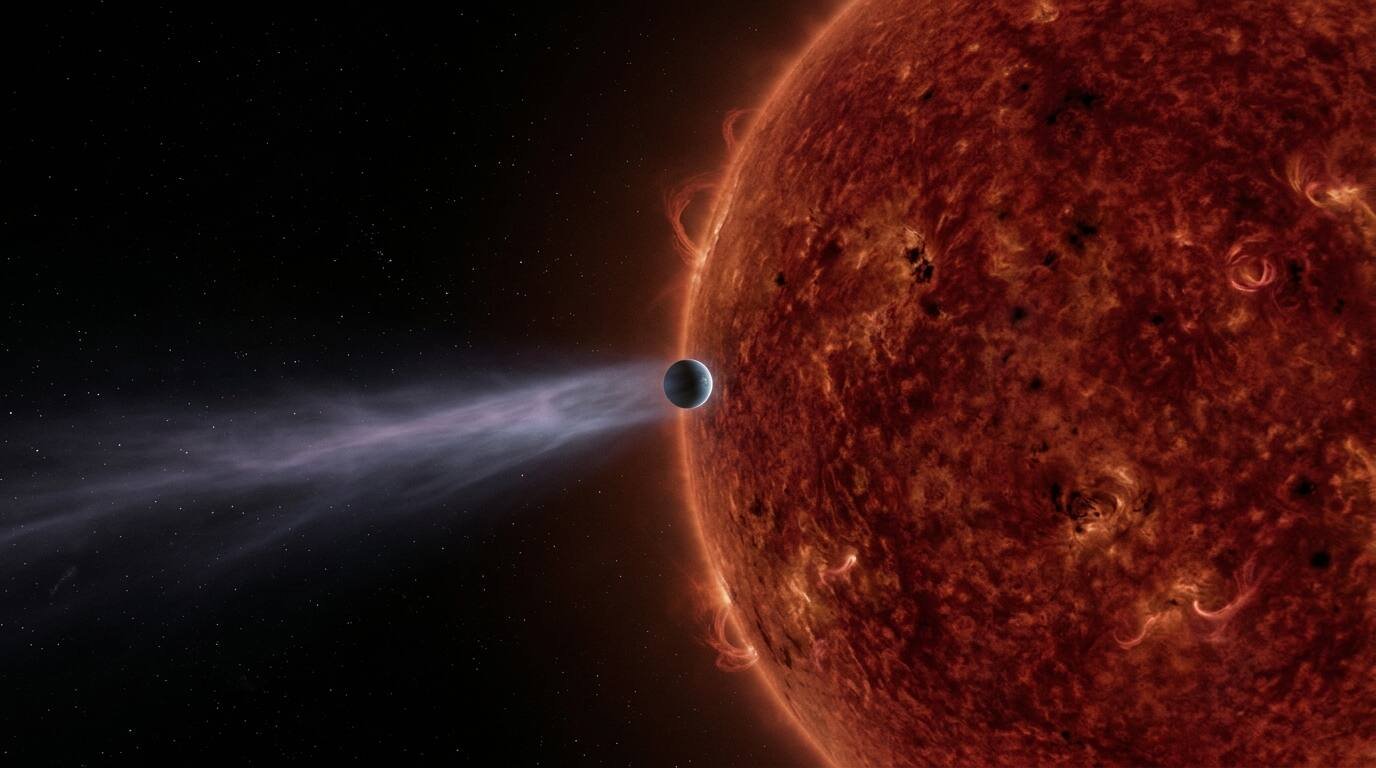
A September 13 preprint reports strong metastable-helium absorption from the sub-Neptune GJ 3090b, about 2% in one transit. Here is the evidence, the models and the weak points.
GJ 3090b is a sub-Neptune, a planet larger than Earth and smaller than Neptune, that circles a small red dwarf every 2.85 days. On September 13, 2026, a team first-authored by Shreyas Vissapragada posted a preprint reporting that metastable helium is streaming away from GJ 3090b, and the absorption is large: about 2.0% of the starlight during one transit, about 1.6% during the next.
Worlds of this class have no counterpart in the Solar System, yet they crowd the catalogue of planets found around other stars. Whether they keep thick hydrogen-helium envelopes or shed them under stellar radiation is one of the central questions about how they age. A signal this strong makes GJ 3090b a test case.
The numbers deserve a careful reading. They land between two earlier expectations, and the data behind them are thin: two transits, one disturbed by a stellar flare. What follows covers the planet, the measurement, the models and the weak points. The work is an arXiv preprint (version 1) and has not been through peer review.
A Small Planet Around a Small Star
GJ 3090 is an M2 dwarf with a gyrochronological age of about 1.02 billion years. Its planet has a mass of 4.5 ± 0.5 Earth masses, a radius of 2.2 ± 0.1 Earth radii and a density of 2.4 ± 0.3 g cm−3, according to the parameters adopted in the preprint. The orbit takes 2.85 days, the equilibrium temperature is 723 ± 13 K, and a transit lasts only 1.28 hours.
That density is consistent with a solid core wrapped in a modest envelope, although density alone cannot say what the core is made of. The star supplies plenty of fuel for escape. The eROSITA X-ray telescope measured an X-ray luminosity of 1027.96 erg s−1, and high-energy radiation of this kind heats and ionises the upper layers of a planet’s atmosphere.
Two earlier studies frame the new measurement. A JWST NIRISS transit spectrum (Ahrer et al., 2025, The Astrophysical Journal Letters) detected escaping helium at 5σ while showing a heavily muted spectrum, and its title reads the combination as a metal-enriched atmosphere. A ground-based CRIRES+ study, cited in the preprint alongside the JWST work, put limits on the planet’s metallicity and aerosols. Neither instrument confidently detected molecular absorption from the lower atmosphere.
Why Metastable Helium Works as an Escape Gauge
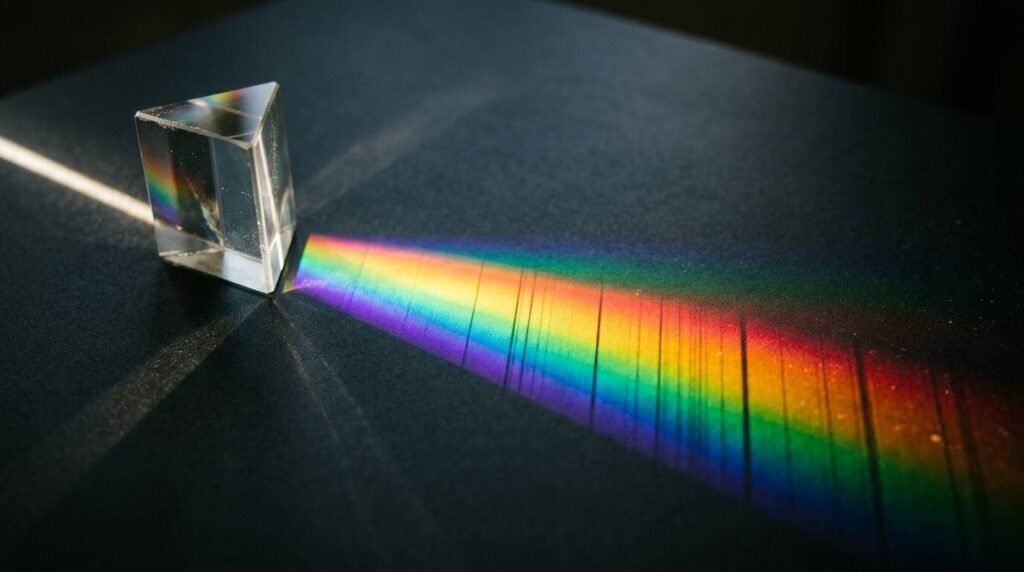
Helium in its metastable triplet state absorbs light near 10,830 Å, in the near-infrared. Atoms reach that state when ultraviolet light ionises helium high in the atmosphere and the ions recombine, so the absorption appears where escaping gas is both present and illuminated. Because the gas reaches far beyond the planet’s visible edge, the line can block several percent of the starlight even though the planet itself blocks a sliver.
The preprint’s own figures make the point. The white-light transit depth is 0.14%. The helium absorption peaks near 2.0%, roughly fifteen times deeper (my arithmetic from the two numbers).
The triplet also carries a built-in diagnostic. In optically thin gas, the stronger line should be about eight times deeper than the weaker. The measured depth ratios are 2.95 (+0.36/−0.30) on the first night and 2.59 (+0.54/−0.39) on the second, far below eight, which tells the authors that the gas is opaque. The opaque helium extends 2.9 and 2.5 planetary radii above the planet’s optical edge on the two nights. The total opaque radius, near 3.9 planetary radii, exceeds half of the planet’s Roche radius (about 7.0 planetary radii), the distance at which the planet’s gravity stops holding gas.
What WINERED Recorded on Two Nights in September 2024
The observations used the WINERED spectrograph on the 6.5-metre Magellan II (Clay) telescope, in its HIRES-Y mode with a 100 µm slit and a resolving power near 68,000. Two consecutive transits were captured, on September 22 and September 25, 2024, so the data were about two years old when the preprint appeared. The team took 180-second exposures in an ABBA nodding pattern, yielding 64 spectra on the first night and 80 on the second, with a median signal-to-noise per pixel of about 142 and 146.
Data handling was careful in ways that matter for a 2% signal. One low-quality spectrum was dropped on night 1, and the first ten spectra of night 2 were discarded while detector persistence settled. A flux offset between the two nod positions near 10,810 Å was estimated and corrected. Telluric water lines, which come from Earth’s atmosphere, were used to refine the wavelength solution and then masked, along with residuals from sky-line subtraction.
A line model of three Gaussians, fitted with MCMC sampling and a Gaussian-process noise term, produced these results:
| Quantity | Night 1 (Sept 22, 2024) | Night 2 (Sept 25, 2024) |
|---|---|---|
| Peak absorption | 2.033 ± 0.086% (23.6σ) | 1.619 ± 0.122% (13.3σ) |
| Line width (FWHM) | 25.9 (+1.4/−1.3) km/s | 24.9 (+2.5/−2.2) km/s |
| Doppler shift | −0.5 ± 1.0 km/s | +2.0 ± 1.2 km/s |
| Depth ratio of the two features | 2.95 (+0.36/−0.30) | 2.59 (+0.54/−0.39) |
Neither night shows a significant velocity shift, and the 25 km/s width is what the authors attribute to photoevaporation, meaning gas heated and driven off by stellar radiation. The two peak depths differ by 0.414 ± 0.149 percentage points, a 2.8σ gap.
Night 1 was hit by a stellar flare. Helium brightened suddenly just before egress, and impulsive brightening in the Paschen γ and δ lines confirmed a flare rather than a planetary effect. The final 17 spectra of that night were excluded from the out-of-transit template and the transmission spectrum. Stellar-surface effects alone, the authors estimate, could mimic at most a 0.06% signal, far below what was seen.
A Signal Between Two Predictions
The comparison with JWST is where the result gets interesting.
| Quantity | Value | Origin |
|---|---|---|
| JWST NIRISS helium detection (resolving power about 650) | 434 ± 79 ppm, 5σ | Ahrer et al. 2025, as quoted in the preprint |
| That detection expressed as a high-resolution signal | 1.0 ± 0.2% | Preprint’s conversion |
| WINERED, degraded to NIRISS resolution | 1304 ± 38 ppm and 1174 ± 37 ppm | This preprint |
| Model predictions | 3.5% (mass loss 1010.1 g/s) and 3.76% (1010.0 g/s) | Ahrer et al. and a published model grid, as quoted |
Each WINERED night exceeds the JWST value by at least 5σ, and by 8.5σ on average, yet falls well short of the 3.5% to 3.76% the models expected. The authors conclude that those earlier models overpredict the signal. The plain summary is that predictions and measurements of this one helium line now span more than a factor of three, which points to genuine variability, to model error, or to both.
What the Outflow Models Imply
To turn a line depth into a mass-loss rate, the team ran two radiative-transfer and hydrodynamic codes, sunbather (Cloudy with p-winds) and pyTPCI (PLUTO with Cloudy). The star’s ultraviolet and X-ray output matters enormously here, so the authors started from the GJ 176 spectrum from the MUSCLES survey and rescaled it to match GJ 3090’s measured X-ray and ultraviolet fluxes. The proxy was 17.3 times fainter in X-rays than GJ 3090 and 2.3 times fainter in the far-ultraviolet before scaling.
The nominal models use a mass-loss rate near 1011 g/s. The pyTPCI nominal value is 1011.06 g/s, falling to 1010.53 g/s only at 300 times solar metallicity. The data prefer a solar-metallicity atmosphere that is depleted in helium: a nominal hydrogen-to-helium ratio of 90.9 to 9.1 by number was tested against helium-poor (99 to 1) and helium-rich (80 to 20) cases, which predict signals of 0.90% and 4.67% respectively.
On composition, the preprint pushes against the earlier reading. Models spanning 10 to 300 times solar metallicity lead the authors to conclude that the atmosphere is unlikely to exceed roughly 100 times solar. The muted lower-atmosphere spectra seen by JWST and CRIRES+ are then more plausibly the work of aerosols, hazes or clouds that hide molecular features, than of an extremely metal-rich gas.
The lifetime estimate follows. Dividing the envelope mass (the preprint takes a maximum hydrogen-helium fraction of 4.3% of the planet’s mass) by the mass-loss rate gives an envelope loss timescale of about 300 million years. A quick check: 4.3% of 4.5 Earth masses is about 1.2 × 1027 g, and dividing by 1011.06 g/s gives roughly 320 million years, consistent with the quoted figure. An earlier estimate based on the whole planet’s mass came to near 50 billion years, two orders of magnitude longer, though the two quantities are defined differently. Given an age near one billion years, the authors describe a planet in an active phase of photoevaporative evolution.
Where the Claim Is Fragile
Several limits keep this from being settled.
- Only two transits were observed, and their depths differ at 2.8σ, so variability is suggestive rather than established.
- A flare struck the first night, and short-timescale changes in the star’s irradiance could contribute to differences between visits.
- A non-zero orbital eccentricity (below 0.25 is still allowed) could mimic Doppler shifts, which complicates the claim of no net velocity.
- Model results depend on assumptions. The sunbather outputs are sensitive to the assumed Parker-wind structure, and pyTPCI struggles to converge at high metallicity.
- The stellar spectrum is a scaled stand-in from a different star, and the 300-million-year lifetime leans on a maximum envelope fraction of 4.3%.
- Core-powered mass loss, a different escape mechanism, may be harder to detect in helium, so a weak signal on another planet would not prove it is not losing gas.
What Comes Next
The authors name a program, the WINERED Helium Consortium, which aims to survey at least thirty sub-Neptunes to 0.2% precision in the line core. For GJ 3090b specifically, more transits are needed to confirm variability, and higher-resolution data would let the models test a multi-component outflow instead of a single wind profile.
Frequently Asked Questions
What is metastable helium, and why do astronomers use it?
It is helium in a long-lived excited state that absorbs near-infrared light at about 10,830 Å. Because it traces gas that is escaping and lit by its star, and because the line is reachable from ground-based telescopes, it has become a standard gauge of atmospheric escape.
Is GJ 3090b about to lose its atmosphere?
No. The 300-million-year figure is a loss timescale for the hydrogen-helium envelope under assumed conditions, not a countdown. The preprint’s reading is that the planet, about a billion years old, is in an active evolutionary phase.
Has this result been peer reviewed?
Not as of September 13, 2026. It is arXiv version 1, and numbers can change between a first posting and a published paper.
Sources and Verification Notes
- Vissapragada et al., “WINERED Detects a Strong Atmospheric Outflow on the Sub-Neptune GJ 3090b,” arXiv:2609.14704, submitted September 13, 2026, with the full-text HTML version
- Ahrer et al., “Escaping Helium and a Highly Muted Spectrum Suggest a Metal-enriched Atmosphere on Sub-Neptune GJ 3090 b from JWST Transit Spectroscopy,” The Astrophysical Journal Letters (title and link taken from a search listing; I could not open the page)
- CRIRES+ study of GJ 3090 b’s metallicity and aerosols (title and link taken from a search listing; I could not open the page)
Verification notes: every measurement above comes from the preprint’s text as retrieved on the posting date. I did not independently check the numbers against the PDF. The fifteen-times depth ratio and the 320-million-year check are my own arithmetic from quoted values. The explanation of how metastable helium forms and why it traces escape is standard background that I did not source from the preprint. I did not retrieve the star’s distance, brightness, radius or mass, and I could not confirm which authors wrote the CRIRES+ paper that the preprint cites.