






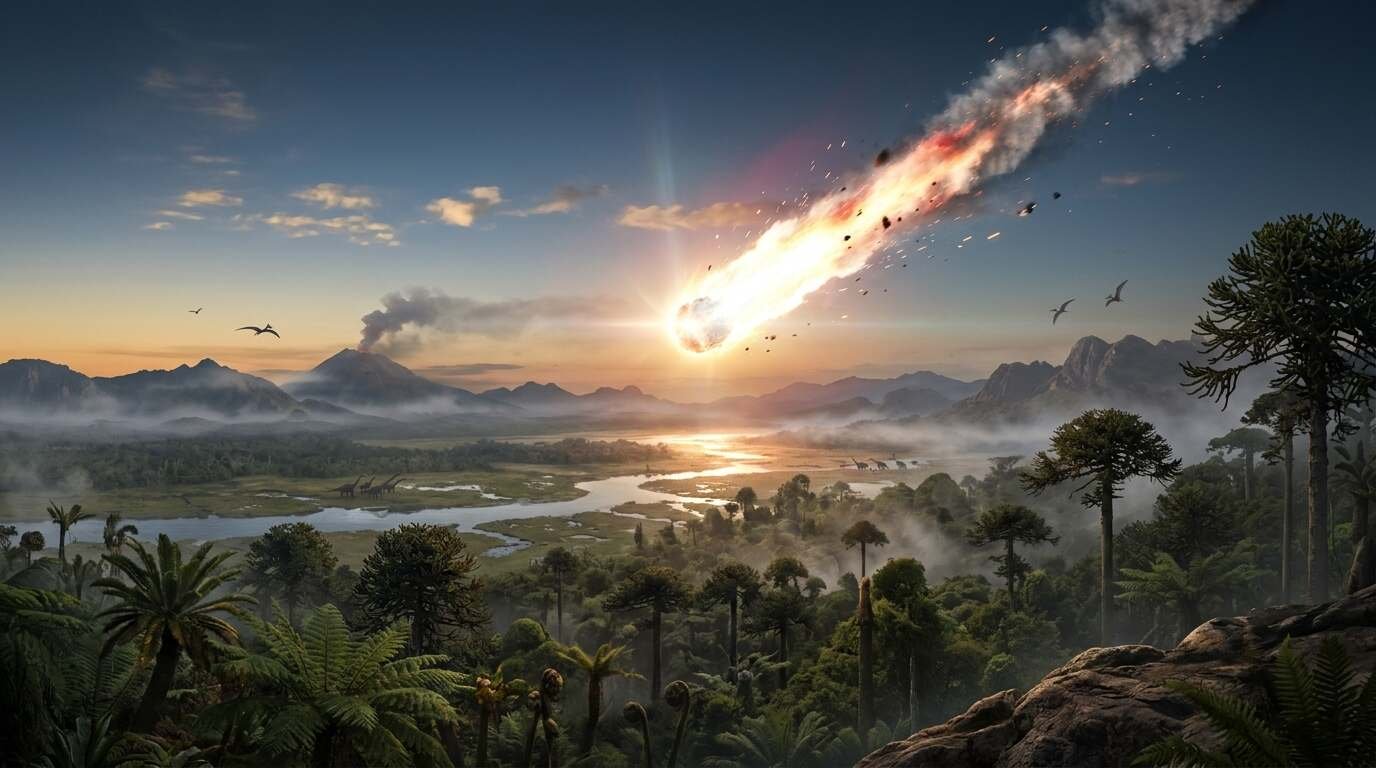
A large asteroid struck Mexico about 66 million years ago. Here is the evidence for it, the role of volcanoes, who survived, and the open questions.
Why did the dinosaurs go extinct? The best-supported answer is that a large asteroid struck what is now Mexico’s Yucatán Peninsula about 66 million years ago, and the environmental fallout killed roughly three out of four species on Earth. That part rests on several independent lines of evidence and is accepted by most researchers. The arguments that remain concern how much other factors, especially massive volcanism in India, contributed, how quickly the die-off unfolded, and what happened in the first hours and months.
This article lays out the evidence, then separates what is settled from what is not.
What happened 66 million years ago?
At the end of the Cretaceous period, the Earth lost about 75 percent of its species in what geologists call the Cretaceous-Paleogene (K-Pg) extinction. The non-avian dinosaurs vanished, along with pterosaurs, the marine reptiles known as mosasaurs and plesiosaurs, and the coiled-shelled ammonites. The event marks the end of the Mesozoic era and the start of the Cenozoic.
How precise is the date? A 2013 study led by Paul Renne used argon-argon radiometric dating to place the impact at 66.043 million years ago, give or take 11,000 years, and argued that the extinction unfolded within about 32,000 years of it. On a geological scale that is close to instantaneous, although it is still thousands of generations.
The word “dinosaurs” needs one qualification, which we will come back to: birds are living dinosaurs, and they came through the event.
How was the asteroid evidence found?
By a clay layer. In 1980, the physicist Luis Alvarez, his son the geologist Walter Alvarez, and colleagues Frank Asaro and Helen Michel reported unusually high concentrations of iridium in a thin layer of clay marking the K-Pg boundary. Iridium is rare in the Earth’s crust, since most of it sank into the core when the planet formed, but it is more common in asteroids. A large impact could have spread iridium-rich dust around the globe.
Their proposal was met with skepticism at first, which is how science is supposed to work. Over the following years, supporting evidence accumulated: tiny glass beads called spherules, shocked quartz (a form of the mineral altered only by very high pressure), and deposits that look like tsunami debris around the Gulf of Mexico and the Caribbean.
What was missing was the crater. Geophysicist Glen Penfield identified a buried structure near Chicxulub on the Yucatán Peninsula in 1978, from geophysical survey data. By around 1990 it was confirmed as the impact site, and the pieces fit.
What do we know about the Chicxulub crater?
It lies about a kilometer below younger sediments, partly under land and partly under the Gulf of Mexico. The visible ring is roughly 180 kilometers wide, and some more recent evidence suggests the full structure may be larger, around 300 kilometers. The impactor was probably 10 to 15 kilometers across.
In 2016, an international team drilled into the crater’s peak ring from the sea floor, reaching 1,335 meters below the sea bed. The core showed granite thrown up from deep in the crust. It also contained very little gypsum, a sulfur-rich mineral that, if it had been abundant in the target rock, would have vaporized into aerosols that cool the climate. That detail has fed an argument about how much sulfur the impact actually released.
Researchers estimate that the impact ejected up to 25 trillion metric tons of material. Tsunamis taller than 100 meters may have formed, and the earthquake it produced has been estimated at magnitude 9 to 11. A layer of sudden burial only about 10 centimeters thick in New Jersey, about 2,500 kilometers away, is one of the traces of the event.
Studies in 2021 estimated an impact speed of about 20 kilometers per second at a steep angle, and analysis of chromium isotopes and platinum-group metals favored a carbonaceous chondrite-type asteroid over a comet.
What actually killed the animals?
The killing was probably done by a series of environmental shocks, not the blast itself. Several mechanisms have been proposed, and they likely overlapped.
- Immediate effects near the impact: heat, shock waves, earthquakes and tsunamis.
- Wildfires, which may have burned a large share of the world’s forests. Estimates run as high as nearly 70 percent, but this is a modeling-based figure, not a measurement.
- Darkness and cooling, caused by dust, soot and sulfate aerosols blocking sunlight. Plants stopped photosynthesizing, and food webs built on them collapsed from the bottom.
- Ocean acidification, which a 2019 study proposed as rapid and long-lasting.
Animals that depended on sunlight-driven food chains, including open-ocean plankton and the animals feeding on it, fared worst. This pattern is exactly what a long “impact winter” would be expected to produce.
The details remain debated. If the target rock held less gypsum than some models assumed, the climate effects from sulfur would have been smaller, and soot may have mattered more. These are open parameters, not reasons to doubt that the impact happened.
Did volcanoes play a part?
This is the main alternative, and it is more than a fringe idea. The Deccan Traps in India are an enormous pile of lava flows erupted around the same time, and volcanic gases can alter climate. Some researchers, including Gerta Keller, have argued that Deccan volcanism was a major cause of the extinction.
Others argue that the heaviest eruptions came before the impact and that volcanism mainly influenced which species survived. A 2010 panel of 41 scientists reviewed the evidence and endorsed the asteroid as the main cause, ruling out volcanism as the primary driver. Climate modeling in 2020 again favored the impact over volcanism.
A middle position also exists. A 2015 study proposed that the Chicxulub impact may have triggered the largest Deccan eruptions, so the two events could be linked instead of being rivals. That idea is a hypothesis, and research continues.
The current mainstream view: the impact was the decisive event, and volcanism may have stressed ecosystems beforehand or added to the effects. How much, and in what order, is unresolved.
Who survived, and why?
The survivors are informative. Crocodilians and sea turtles made it through, and more than 80 percent of Cretaceous turtle species crossed the boundary. Freshwater and aquatic animals generally did better than marine and open-water ones. Small mammals survived, perhaps because they could burrow or live partly in water, and they diversified afterward. Some teleost fishes and lizards also radiated into new forms.
The pattern points to a few advantages: being small, being able to shelter underground or underwater, eating food that could last through a dark period such as seeds, insects or detritus, and not depending on a food chain that began with fast-growing plants.
Large body size was a liability. A big animal needs a lot of food and reproduces slowly, so recovery takes many generations. That helps explain why the largest land animals disappeared completely.
Did all the dinosaurs die?
Not quite. Birds are the only dinosaur lineage known to have survived. Only a fraction of bird species, mostly ground-dwelling and water-dwelling ones, made it through, and they then diversified into the modern groups. Neoaves, which includes most living birds, radiated after the boundary, and flightlessness evolved several times in ratites such as ostriches.
So the statement “dinosaurs went extinct” is accurate for the non-avian dinosaurs, such as Tyrannosaurus and Triceratops. The sparrow outside the window belongs to a surviving branch.
A related question is whether any non-avian dinosaurs lingered into the Paleocene. Most researchers consider the supposed late finds to be fossils eroded from older rock and redeposited in younger layers.
What are scientists still arguing about?
Quite a bit, and it is worth listing:
- Speed. Was the extinction sudden, within thousands of years, or spread across a longer period? The Signor-Lipps effect complicates the picture, because the last fossil of a species almost always appears earlier than the true time of extinction, which can make a sudden event look gradual.
- Deccan volcanism’s role, as above.
- The Tanis site in North Dakota, which some researchers say records the first hours after the impact. Others question that interpretation.
- The season of the impact. A 2021 study of fish bones at Tanis proposed spring or summer, and a 2024 critique argued that the study lacked primary data and clear methods and that its June dating had been refuted.
- The impactor’s origin. A 2007 proposal linked it to the Baptistina asteroid family, but later work in 2009 and 2011 undermined that link.
- The decline of marine plankton such as foraminifera, which some think declined abruptly and others gradually.
None of these disputes revive the question of whether an impact occurred. They are about details of mechanism and timing.
Common questions
Was it an asteroid or a comet?
Chemical evidence, including chromium isotopes and platinum-group metal ratios, favors a carbonaceous chondrite-type asteroid. A comet hypothesis has been proposed, but a 2021 analysis argued against it.
How big was the asteroid?
Estimates put it at 10 to 15 kilometers across. It struck at roughly 20 kilometers per second, according to a 2021 estimate, and carved a crater that was about 100 kilometers wide at its deepest transient stage before collapsing.
Where is the impact crater?
Chicxulub, on and off the northern coast of Mexico’s Yucatán Peninsula. It is buried under younger sediment, so you cannot see it from the ground. Its rim shows up in a ring of sinkholes called cenotes.
How do we know the date so precisely?
Argon-argon radiometric dating of material from the boundary layer. The 2013 argon-argon work placed the impact at 66.043 million years ago, with an uncertainty of 11,000 years.
Did mammals take over because dinosaurs died?
The extinction opened ecological space, and small surviving mammals diversified in the following period. That does not mean mammals were waiting in the wings; they had existed alongside dinosaurs for a long time.
Could the dinosaurs have survived without the impact?
Nobody can say for sure. Most researchers think the impact was the decisive factor, and the volcanism debate shows that other pressures were present. Whether dinosaurs would have continued flourishing without the impact is a counterfactual that evidence cannot settle.
What to remember
The asteroid explanation is supported by iridium and other chemical traces in the boundary clay, shocked quartz, tsunami deposits, a buried crater of the right age and size, and drill cores taken from its peak ring. That is as close to a settled result as paleontology gets, though a few caveats stay in play.
The open parts are the share of blame for the Deccan Traps, the exact killing mechanisms and their order, and the interpretation of the Tanis site. If a headline says the mystery has been “solved” or “overturned,” read it with the open questions in mind.
Further reading
First-person account by one of the scientists behind the asteroid hypothesis, covering the discovery of the clay layer and the crater. See it on Amazon (affiliate link)
As an Amazon Associate I earn from qualifying purchases. A commission may be earned if you buy through this link, at no extra cost to you.
Sources



