






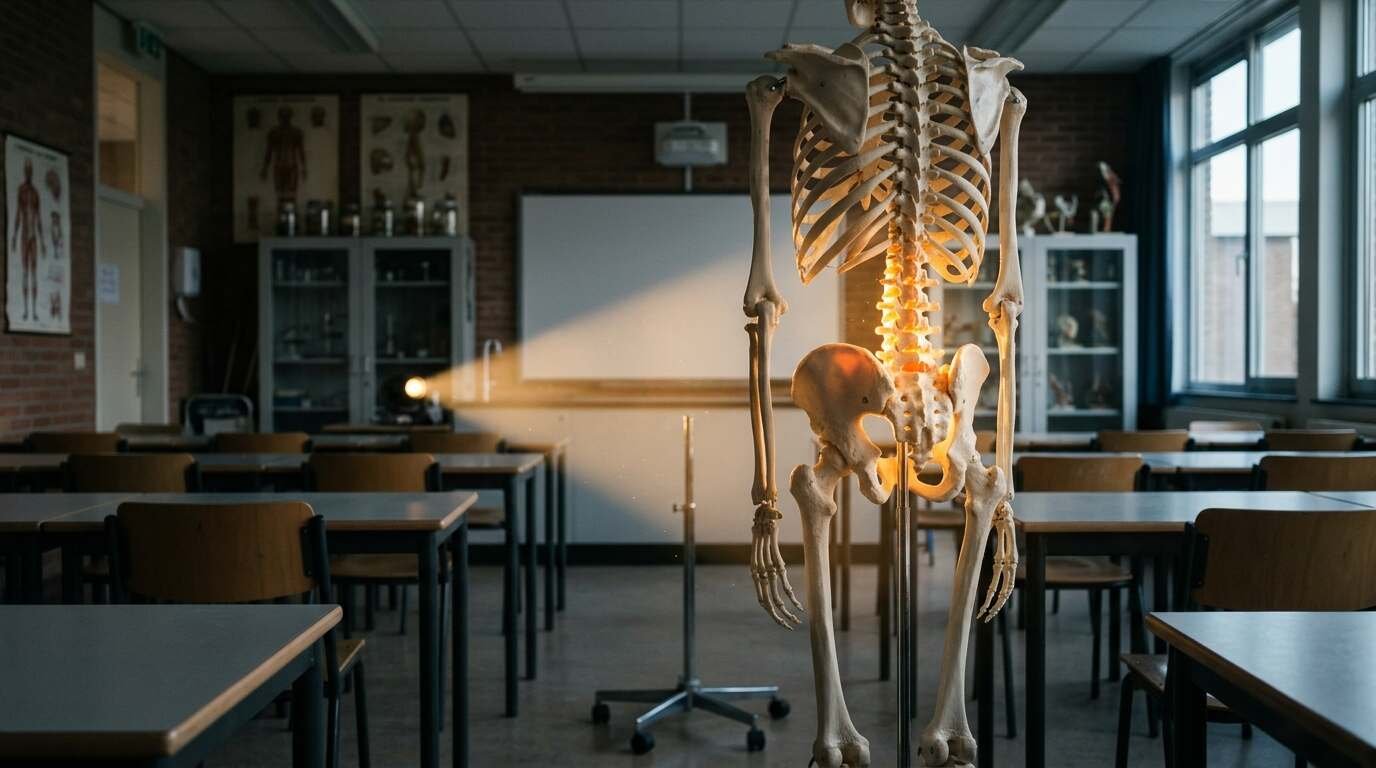
Vestigial means reduced from an earlier function, not worthless. Here is what the appendix, tailbone and wisdom teeth actually do.
Vestigial organs are body parts that have lost most or all of their original function over evolutionary time, and the appendix and tailbone are the textbook examples. The question people ask is whether they are leftovers with no purpose or whether they still do something. The accurate answer is that “vestigial” does not mean “useless,” and that these two structures are good illustrations of why.
Below are the facts as researchers currently see them, with a clear line between what has been shown and what is still argued over.
What does “vestigial” actually mean?
A vestigial structure is one that has lost much of its ancestral function, typically because the environment or lifestyle of the species changed. Biologists use the word for the reduced pelvis in whales, the wings of flightless beetles, and the nonfunctional eyes of some cave animals.
The definition is looser than it sounds. Function comes in degrees, and deciding what counts as a “major” function is partly arbitrary. A part may keep a minor role and still be vestigial, or serve a completely new purpose, which biologists call exaptation. The two ideas overlap, depending on how you look at the structure.
Vestigial features also tend to vary more between individuals than their non-vestigial counterparts, since selection is no longer holding them in place. That variability turns out to be a useful clue.
Why did early lists of vestigial organs get so long?
In 1893 the German anatomist Robert Wiedersheim published a list of 86 human organs he considered vestigial. Later versions of such lists grew as large as 180. Many items on those lists were included because anatomists of the day could not find a use for them. As physiology advanced, a lot of those organs turned out to have jobs, and the lists shrank as functions were found.
That history is a good reminder about the reasoning. “We do not know what it does” is a statement about knowledge, not about the organ. Wikipedia’s discussion of the topic notes that the old lists mainly reflect the anatomical knowledge of their time.
Darwin did include the appendix as an example in his 1871 book The Descent of Man, so the idea has a long pedigree. The details have been revised since.
Does the appendix have a purpose?
Probably yes, and this is an area where scientific opinion has shifted. For a long time the appendix was assumed to be a leftover from ancestors who fermented plant material in a large pouch called the cecum. Because people can live without it after surgery with no obvious problems, it was taken as proof that it did nothing.
Two lines of evidence have changed that. First, the appendix is rich in immune tissue. It is surrounded by gut-associated lymphoid tissue, a part of the mucosal immune system that is particularly involved in antibody-producing B cell responses.
Second, in 2007 William Parker, Randy Bollinger and colleagues at Duke University proposed the “safe house” hypothesis: the appendix shelters beneficial gut bacteria, so that after diarrheal illness or antibiotics flush the intestine, the colony can restock it. A 2012 study found that people without an appendix were about twice as likely to have a recurrence of Clostridioides difficile colitis, which fits the idea. The hypothesis is still just that, a hypothesis supported by suggestive data, and it is not settled.
A third argument comes from comparative biology. A 2013 analysis of mammals concluded the appendix evolved independently 32 to 38 times and was lost no more than six times. A 2017 update with a larger database found at least 29 gains and at most 12 losses. A structure that keeps reappearing in separate lineages looks like it offers some advantage. Later studies have connected the appendix to longer maximum lifespan in mammals (2021) and to protection from diarrhea in young primates (2023).
So the appendix is better described as a structure whose original digestive role has shrunk but which seems to have found other uses. Whether any single one of those uses is crucial for humans is not established.
Then why is it removed so often?
Because of appendicitis. When the appendix becomes blocked and inflamed, it can rupture, leading to infection of the abdominal cavity that can be fatal if untreated. Removal is the standard treatment, usually done as an emergency procedure, though antibiotics can delay surgery when facilities are unavailable.
The fact that most people do fine without an appendix says that the organ is not essential for survival in modern conditions. It does not say it has no function. People also live without a spleen or one kidney. This is one of the clearest examples of how “can be removed” and “has no purpose” are different claims.
This is general information about anatomy, not medical advice; anyone with abdominal pain should consult a clinician.
Is the tailbone a leftover tail?
Yes, in an evolutionary sense. The coccyx is the remnant of the tail that our primate ancestors had, and it is shared by tailless apes. It typically consists of three to five small fused or partly fused vertebrae, with two or three segments the most common arrangement.
Humans still have a tail early in development. The human embryo briefly shows a tail-like structure, which is later absorbed, and what remains is the coccyx. That developmental detail is among the cleaner pieces of evidence for common ancestry with other primates.
Does the tailbone do anything?
Quite a bit, as it happens. The coccyx anchors several muscles and ligaments, including parts of the levator ani group that form the pelvic floor and the gluteus maximus. It sits at the base of the spine, where it contributes to the structure of the pelvic outlet.
There is a caveat. Wikipedia notes that many of those muscles also attach elsewhere, so it is doubtful the coccyx is vital for their function. That is consistent with a structure that has been repurposed from an old role into a supporting one.
The strongest practical evidence comes from medicine. The coccyx can be injured, and when it is, the result is coccydynia, a painful condition. In rare cases surgeons remove it, in a procedure called coccygectomy, and reviews covering more than 700 cases reported pain relief in 84 percent, with infection in about 12 percent. Those figures indicate people can function without it, though with a risk of complications, including a higher chance of perineal hernia.
What other body parts are called vestigial?
Wisdom teeth are the best-known case. As cooking, agriculture and tools softened human diets, jaws became shorter and wider, and the third molars had less room. Researchers have linked softer diets to more crowding, and one study cited by Wikipedia reports that impaction became about ten times more common with the Industrial Revolution. The extent of tooth loss varies greatly: congenital absence of wisdom teeth ranges from almost nonexistent in Aboriginal Tasmanians to nearly universal in indigenous Mexican populations, a pattern tied to the genes PAX9 and MSX1.
The palmaris longus is a thin muscle in the forearm that is missing in roughly 10 to 20 percent of people, depending on the group studied. Its absence does not affect grip strength. Surgeons often use its tendon as a graft because removing it causes no functional deformity, which tells you something about how little it contributes.
Genes can be vestigial too. Humans carry a broken copy of a gene for making vitamin C, a so-called pseudogene, whose loss means we must get the vitamin from food.
Pseudogenes fit the definition well because the gene once worked and no longer does. Not every vestigial DNA stretch descends from a functional ancestral one, though, which is a point biologists are careful about when they use the term for genetic material.
Wisdom teeth also show how common the problem is. One estimate cited on Wikipedia says impacted wisdom teeth cause pathology in about 12 percent of cases, and a 2024 YouGov poll reported that 53 percent of Americans had had them removed. Whether removal is needed for teeth that cause no symptoms is a question for a dentist, since the evidence cited there shows many people with symptom-free impacted teeth end up having at least one extracted within a few years.
Why does it matter for evolution?
Vestigial structures are predicted by the idea of descent with modification. If species change by modifying existing forms, then features that lose their use should be reduced, not erased, and they should resemble working versions in relatives. That is exactly what shows up: reduced pelvic bones in whales, a tailbone in apes, and so on.
It also demonstrates the limits of casual intuition. A body part can be reduced, variable, prone to problems and still useful. The fairest conclusion is that vestigial describes a history of reduced function, and it makes no claim about present value.
Common questions
Is the appendix useless?
Evidence suggests not. It contains immune tissue and may serve as a refuge for gut bacteria, though people can live normally without it.
Why do humans have a tailbone?
It is the remnant of the tail of ancestors, shared with other apes. In humans it also serves as an attachment point for pelvic muscles and ligaments.
Can you live without a coccyx?
Yes. Surgical removal is done for severe pain or tumors, and many patients report relief, though complications can occur.
Are wisdom teeth vestigial?
They are often described that way, since softer diets and smaller jaws left less room for them. Some people never develop them at all.
Do vestigial organs disprove design or prove evolution?
They are consistent with evolution by descent with modification, and that is how biologists use them. They do not settle philosophical questions on their own.
Why did scientists once say the appendix had no function?
People without one seemed healthy, and its function was not obvious. Later work on its immune tissue and bacterial role changed that view.
What to remember
Vestigial means reduced from an earlier function, not worthless. The appendix probably supports immunity and gut bacteria, and the coccyx anchors pelvic muscles. Both can be removed when needed without ending a person’s life, which has encouraged the false idea that they do nothing. Treat any claim of total uselessness with suspicion.
Further reading
Popular book on how human anatomy reflects evolutionary history. See it on Amazon (affiliate link)
As an Amazon Associate I earn from qualifying purchases. A commission may be earned if you buy through this link, at no extra cost to you.
Sources



