






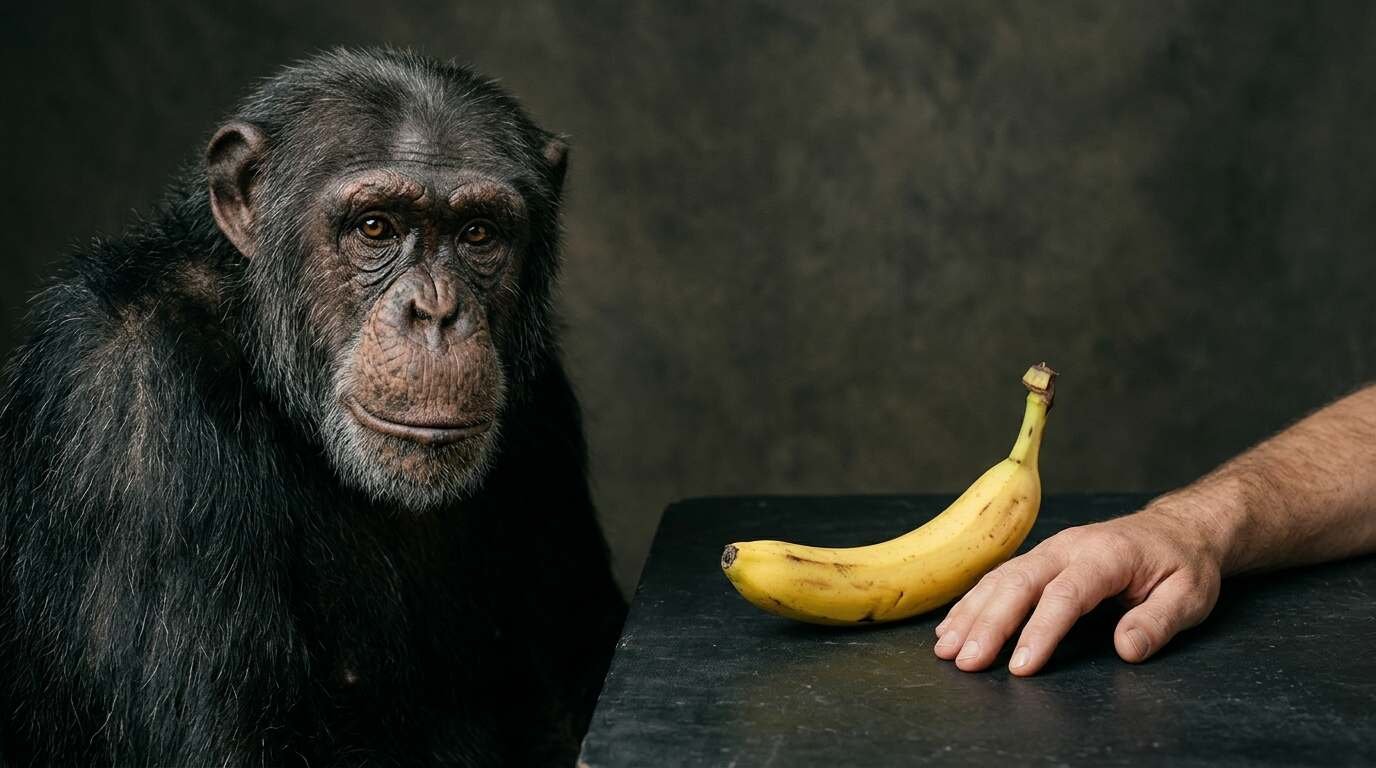
Humans are about 99.6 to 99.9 percent identical on single letters, chimps differ by a bit over 1 percent, and the banana claim is a myth. Here is how those numbers work.
How much DNA do we share with other people, with chimpanzees, and with a banana? The honest answer is that every one of those numbers depends on what you decide to count, which is why the same fact gets reported as 99.9 percent in one place and 85 percent in another. The numbers are not wrong so much as they are answers to different questions.
This article sorts out the questions. It starts with the comparison closest to home, you versus a stranger, then moves to our nearest relatives, and ends with the famous banana claim, which turns out to be a good lesson in how a loose statement becomes a fact on the internet.
How much DNA do two humans share?
Almost all of it. The nucleotide diversity between two people runs from about 0.1 to 0.4 percent of base pairs, which implies roughly 99.6 to 99.9 percent identity for single-letter differences. When larger changes are included, such as stretches of DNA that are duplicated or missing in one person, the total difference between two people is at least 0.5 percent.
In absolute terms that still adds up. The 1000 Genomes Project reported in 2015 that a typical person’s genome differs from the reference human genome at 4.1 million to 5.0 million sites, affecting around 20 million bases. The project, which examined 2,504 people, cataloged 84.7 million single-nucleotide polymorphisms, or SNPs, across the group. A SNP is a single-letter variation present in at least 1 percent of a population.
Small variants get the attention, yet larger structural changes affect more bases in total. A typical person carries roughly 2,100 to 2,500 structural variants, such as deletions, duplications, and inversions.
What is the “reference genome” everyone compares against?
When a report says your genome differs at 4 million sites, it means differs from the reference. That reference is not a typical person, and not even one person. It is a mosaic assembled from a small number of anonymous donors of African, European, and East Asian ancestry. More than 70 percent of the public Human Genome Project sequence came from a single anonymous man from Buffalo, New York, identified by the code RP11.
The reference is therefore a yardstick, nothing more. It has been improved since: a gap-free version of the 22 autosomes and the X chromosome appeared in 2022, the Y chromosome followed in August 2023, and a draft pangenome built from 47 people of varied ancestry was released in 2023 to capture more of the diversity that a single reference misses.
Where does the difference between people come from?
Mostly from inheritance and a little from new mutation. Each of us picks up about 60 brand-new mutations that neither parent had. Most land in parts of the genome that do nothing noticeable.
Even identical twins are not perfectly identical, since mutations arise during development and add small differences over a lifetime.
Only a small share of the sites that vary do anything biologically. One source puts the share of functional SNPs at around 3 to 5 percent. The rest are neutral, though geneticists still find them useful as markers for tracing relationships.
Do the differences between groups of people run deep?
No, and this is one of the more settled findings in human genetics. Of the genetic variation among humans, roughly 85 percent exists within local populations. Another 7 percent or so separates local populations on the same continent, and about 8 percent separates continents.
The pattern explains why the genetic differences that are real, such as variants for lactose digestion or malaria resistance, follow particular traits and not tidy social categories. This is an established finding in population genetics, though how to interpret and use it remains a topic of public argument, which this article does not try to settle.
How much DNA do we share with chimpanzees?
A lot, but the single figure you see depends on method. The chimpanzee genome draft was published in Nature on September 1, 2005. It catalogued about 35 million single-letter changes between humans and chimpanzees, and about 5 million insertions and deletions. Spread across a genome of roughly 3 billion letters, 35 million single-letter changes works out to a bit over 1 percent, which is where the often-quoted “98 to 99 percent” originates.
The larger rearrangements tell a fuller story. Duplications and deletions account for about 2.7 percent of the genome, according to that analysis, and they involve more sequence than the single-letter changes do. That is why a statement like “humans and chimps are 99 percent the same” hides as much as it shows.
Proteins give another angle. A typical human protein differs from its chimpanzee counterpart by about two amino acids, and roughly 30 percent of human proteins are identical to the chimpanzee version.
Where do humans and chimps actually differ?
In how genes are arranged and switched on, as much as in the genes themselves. Humans have 23 pairs of chromosomes, and other great apes have 24. Human chromosome 2 arose when two ancestral ape chromosomes fused. Another nine major chromosomal differences exist, mostly inversions of segments.
Individual genes matter too. FOXP2, which is involved in speech and language circuits, differs functionally between the two species, and around 600 genes may have been under positive selection along the human and chimpanzee lineages.
More recent work has sharpened the picture. In April 2025, Nature published complete, gap-free sequences of six ape genomes: siamang, Sumatran orangutan, Bornean orangutan, gorilla, bonobo, and chimpanzee. Each assembly is more than 99 percent resolved, including repetitive regions that earlier drafts left unclear. The study put the split between the human and chimp lineages at roughly 5.5 to 6.3 million years ago, and showed that chimps, bonobos, and gorillas carry more segmental duplications than humans do.
How close are we to other animals?
The pattern holds across the family tree: closer relatives share more. Gorillas are further from us than chimps are, and the genetic evidence places humans and chimpanzees closer to each other than either is to gorillas. African apes diverged from the human lineage about 10.6 to 10.9 million years ago, according to the 2025 study.
Elephants make a useful comparison. When researchers mapped much of the woolly mammoth’s DNA in 2008, it came out 98.55 to 99.40 percent identical to the African elephant’s. Two different animals, then, can land in the same neighborhood as the human-chimp comparison, a reminder that a percentage alone does not say how long ago two lineages split.
So how much DNA do we share with a banana?
You may have heard 50 percent. It is false as a statement about DNA, and the story of where it came from is instructive.
The earliest version that fact-checkers found traces back to a PBS Nova program in 2001 on the Human Genome Project, in which the point was about shared genes rather than shared DNA. Roughly half of human genes, in the loosest sense, have a counterpart in other organisms that does the same sort of job, even when the sequences differ a lot. Somewhere along the way “genes with counterparts” turned into “DNA in common.”
Better numbers exist. The computational biologist Natasha Glover, writing in December 2020, used the Orthologous Matrix database to look for human genes with banana equivalents. Even with methods designed to maximize similarity, at most about 25 percent of human genes matched banana genes. She estimated DNA sequence identity to be well below 1 percent, based on comparisons with zebrafish. Snopes rates the 50 percent claim False because no definition of genetic similarity produces a figure near it.
Bananas are also awkward to compare. The common Cavendish banana is a triploid, carrying three sets of chromosomes, where we carry two. The plant is not simply a smaller, greener human.
What does “sharing DNA” even mean?
The phrase hides at least four different measurements:
- Identity of aligned letters, which gives the 99.9 percent figure for two people.
- Identity including insertions, deletions and duplications, which pulls the numbers down.
- Share of genes with a recognizable counterpart, which is how the banana claim got going.
- Share of proteins with identical amino acid sequences, which is lower than any of the DNA figures.
None is the true one. They answer different questions, and an honest comparison names which question it is answering. A news headline that says scientists found humans and chimps to be far less similar than assumed is usually swapping one of these measurements for another, not overturning the earlier one. The older and newer numbers can both be correct, because each was built from a different definition of similarity.
Common questions
Are we really 99.9 percent the same as every other human?
For single-letter differences, close to it. Including larger structural changes, the difference between two people is at least 0.5 percent.
Is it true that humans and chimps are 99 percent the same?
Only for one kind of count. Single-letter changes come to a bit over 1 percent, but duplications and deletions add roughly 2.7 percent more, and chromosome rearrangements add another layer.
Do we share 50 percent of our DNA with bananas?
No. That figure appears to come from a loose statement about genes with counterparts, not about DNA. A more careful estimate puts sequence identity well below 1 percent.
Why do we have fewer chromosomes than other apes?
Human chromosome 2 formed when two ancestral ape chromosomes fused. The genetic material is largely still there; it is packaged differently.
Does sharing more DNA mean being more alike?
Not directly. A few changes in regulatory switches or in key genes such as FOXP2 can matter a great deal, while huge amounts of sequence differ without any visible effect.
What to remember
Percent identity is a measurement with a method attached. Humans are about 99.6 to 99.9 percent identical on single letters and at least 99.5 percent when bigger changes are counted. Chimps differ by a bit over 1 percent in single letters and by several percent once duplications and deletions come in. Bananas share many gene families with us but almost no matching sequence.
When someone quotes one number, ask what was counted.
Further reading
Popular book comparing human biology and genome with other animals. See it on Amazon (affiliate link)
As an Amazon Associate I earn from qualifying purchases. A commission may be earned if you buy through this link, at no extra cost to you.
Sources



