






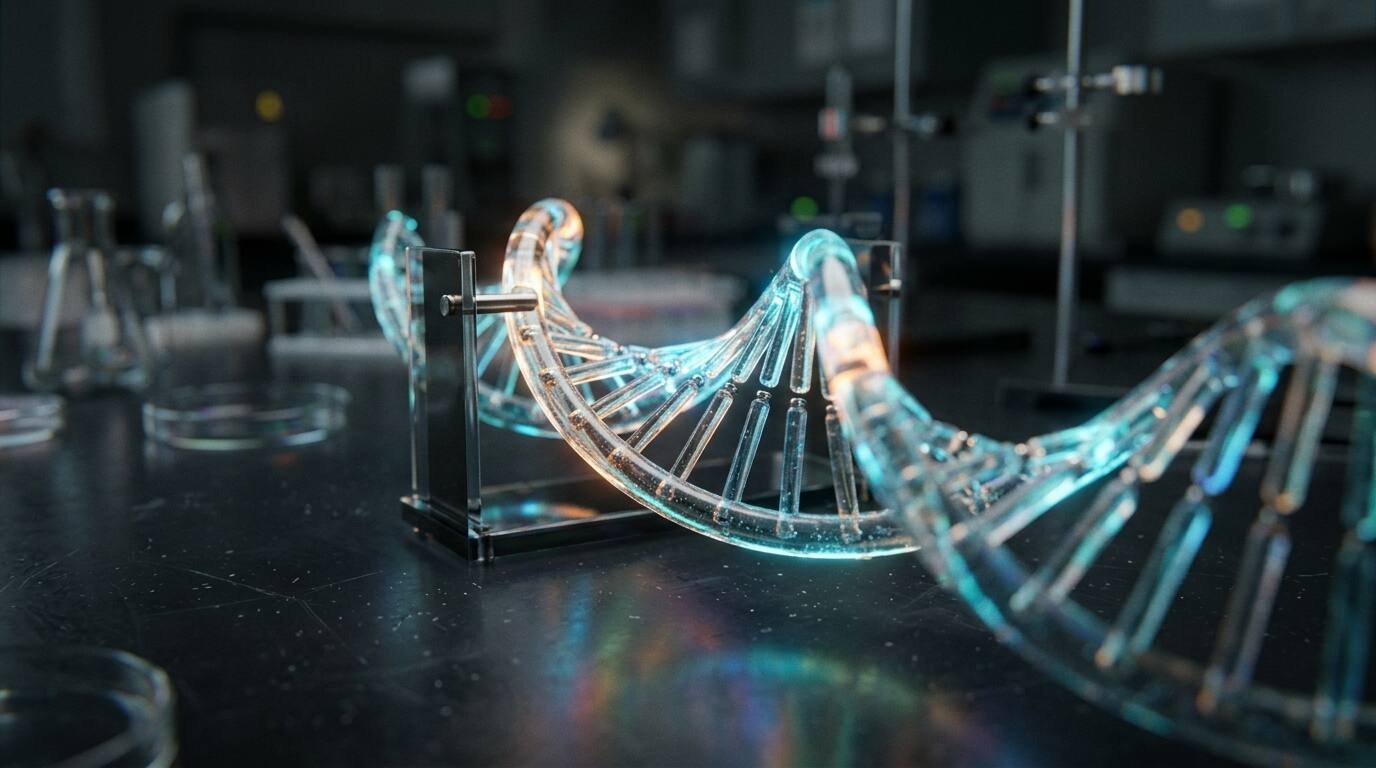
DNA is a chain of nucleotides whose base order works like a code. This article covers its structure, copying, the genetic code and the 1953 discovery.
What is DNA made of? The short answer is four chemical letters, a sugar, and a phosphate, strung into a very long thread. The longer answer explains why that unremarkable-sounding recipe is enough to build a bacterium, a sequoia, or you.
DNA is not a blueprint in the sense of a drawing that shows the finished building. It behaves more like a set of instructions that cells read, copy, and sometimes misread. Getting that distinction right clears up most of the confusion about genes, mutations, and what a genome actually is.
What is DNA made of?
DNA stands for deoxyribonucleic acid. It is a polymer, meaning a long chain of repeating units called nucleotides. Each nucleotide has three parts: a sugar called deoxyribose, a phosphate group, and one of four bases. The bases are adenine (A), thymine (T), guanine (G), and cytosine (C).
The sugars and phosphates link up into a backbone, joined by phosphodiester bonds. That backbone is the same all the way along. What varies is the order of the bases hanging off it, and that order is the information. Think of it as an alphabet of four letters, with meaning in the sequence rather than in any single letter.
DNA usually comes as two strands wound around each other. The two strands run in opposite directions, a feature called antiparallel, with a 5-prime end and a 3-prime end on each. Chemists name the ends after the carbon atoms in the sugar, and the directionality turns out to matter a great deal when cells copy the molecule.
Why does DNA form a double helix?
Because the bases fit together in a very particular way. A pairs with T, and G pairs with C. The pairs are held by hydrogen bonds, two for A and T and three for G and C. Hydrogen bonds are individually weak, but there are billions of them, which makes the molecule stable overall and still easy to unzip locally when a cell needs to read it.
The geometry is tidy. In the common form, the helix has a radius of about one nanometer and completes a full turn about every 3.4 nanometers, with about 10.4 base pairs per turn in relaxed DNA. Two grooves run along the outside, a wider major groove and a narrower minor groove, and many proteins recognize particular sequences by reaching into them.
Because A always pairs with T and G with C, either strand contains all the information in the other. That redundancy is the whole trick behind copying, and it is also what lets cells repair damage by using one strand as a template for fixing the other.
Who discovered what DNA is?
The history is longer and more crowded than the famous 1953 story suggests. In 1869 the Swiss chemist Friedrich Miescher isolated a phosphorus-rich substance from the nuclei of white blood cells taken from pus on surgical bandages. He called it nuclein. Albrecht Kossel later identified the nucleic acid component, and in 1929 Phoebus Levene identified deoxyribose.
For decades most scientists assumed proteins carried heredity, because proteins seemed complex enough. Frederick Griffith’s 1928 bacterial experiments showed that some substance could transfer a trait from one strain to another. Oswald Avery, Colin MacLeod, and Maclyn McCarty identified that substance as DNA in the early 1940s, and Alfred Hershey and Martha Chase confirmed in 1952 that DNA, not protein, is the genetic material of a virus that infects bacteria.
The structure came in 1953, when James Watson and Francis Crick proposed the double helix. They worked with X-ray data produced by others, and the part of that story that gets debated is credit.
What did Rosalind Franklin contribute?
A lot, and exactly how much is a matter of interpretation. At King’s College London, Franklin built a humidity-controlled camera and produced exceptionally sharp X-ray images of DNA fibres. She identified two forms of the molecule, A and B, and argued that the phosphate groups sat on the outside. Her student Raymond Gosling took the B-form image now known as Photo 51.
In January 1953 Maurice Wilkins showed that image to Watson. A report of her data also reached Crick through Max Perutz. Watson and Crick’s paper acknowledged her work only in a footnote, though her own data were published in the same issue of Nature. Biographers disagree about whether the image was shared without her permission, and about how far she had gotten toward the answer herself: her unpublished draft from March 1953 shows she was moving toward a double helix, but analyses suggest she had not worked out the base pairing.
She died in 1958. The 1962 Nobel Prize in Physiology or Medicine went to Watson, Crick, and Wilkins, and Nobel rules then barred posthumous awards. Some historians describe her as an equal partner in a joint effort; others consider that overstated. The facts of who did what are documented. The weight to assign them is opinion.
How does a cell copy its DNA?
Replication begins when the two strands separate. An enzyme called DNA polymerase then builds a new strand along each old one, adding nucleotides that match by base pairing. The result is two molecules, each containing one original strand and one new one.
Polymerase can only add nucleotides in one direction, 5-prime to 3-prime. Since the two strands run in opposite directions, one is copied smoothly and the other in short pieces that are stitched together afterward. This is a clue to why the antiparallel structure matters in practice and not only in diagrams.
Copying is remarkably accurate, thanks in part to proofreading by polymerase and repair systems, but not perfect. The errors that slip through are mutations. Many do nothing, some are harmful, and a few are beneficial. This is the raw material of evolution, and it is also the reason cancers can arise.
How does DNA become a protein?
Genes are stretches of DNA that specify a molecule of RNA, and for many genes that RNA is read to build a protein. The first step, transcription, copies the gene into messenger RNA (mRNA). RNA is a close chemical relative of DNA: it uses a different sugar, is usually single-stranded, and uses uracil (U) in place of thymine.
The second step, translation, happens at ribosomes. They read the mRNA three letters at a time. Each triplet, called a codon, specifies an amino acid, and transfer RNA molecules bring the right amino acids to be linked in order. There are 64 possible codons. Sixty-one specify amino acids, 20 kinds in all, and three act as stop signals. AUG, the usual start signal, also codes for methionine.
Because 64 codons cover only 20 amino acids, the code is redundant: several codons can specify the same amino acid, though no codon specifies more than one. A change in the third letter of a codon often has no effect on the protein, which cushions some mutations. The code is also almost universal; the same basic system runs in bacteria, plants, and people, with a few exceptions such as the variant codes in mitochondria.
How big is the human genome?
Large, and the arithmetic is satisfying. A human cell holds about 3 billion base pairs in each set of 23 chromosomes, 46 chromosomes in all. Laid end to end, the nuclear DNA from one cell would measure around two meters, which is why it has to be wound tightly around proteins and packed into the nucleus.
The Human Genome Project began in 1990 and was declared complete in April 2003, at a cost of about $2.7 billion. Early guesses of 80,000 to 140,000 genes proved far too high; current estimates sit at roughly 19,000 to 20,000 protein-coding genes. Gaps remained in that 2003 version. A gap-free sequence of the non-Y chromosomes was published in 2022, and the Y chromosome followed in 2023.
How much of the genome does something useful is a hot argument. One summary puts the portion with a defined function at under 10 percent, but the number depends on what counts as function: coding for a protein, controlling when genes switch on, producing RNA that does a job, or simply being copied. Treat any single percentage as a position in that debate and not a fixed measurement.
Is all our DNA in the nucleus?
No. Mitochondria, the structures that supply cells with energy, carry their own small circular genome of 16,569 base pairs in humans. A cell has about a hundred mitochondria, and each holds several copies, so a typical cell contains hundreds of mitochondrial DNA molecules. An egg cell can hold up to 1.5 million copies.
Mitochondrial DNA is inherited almost entirely from the mother, which is why it is used to trace maternal lineages.
Common questions
Is DNA a code or a molecule?
Both. It is a physical chemical molecule, and the order of its bases works as a code that cells translate into RNA and proteins.
What is the difference between DNA and a gene?
DNA is the whole molecule. A gene is a particular stretch of it that specifies an RNA or a protein.
What is the difference between DNA and RNA?
RNA uses ribose instead of deoxyribose, usually has a single strand, and uses uracil in place of thymine. Cells use it mostly to carry instructions from DNA and to help build proteins.
How much DNA do two people share?
Human genomes are very similar, but the exact percentage reported depends on how differences are counted, so I have left out a figure. The practical point is that individuals differ at a small fraction of positions.
Can DNA change during your life?
Yes. Copying errors and damage cause mutations in body cells all the time. Only changes in egg or sperm cells can be passed to children.
How was the double helix discovered?
Through X-ray diffraction images, chemical analysis of base ratios, and model building. Watson and Crick proposed the structure in 1953 using data from several laboratories, including Franklin’s.
What to remember
DNA is a long chain of nucleotides carrying four bases, A, T, G, and C, wound as two paired strands. The pairing rules explain both copying and repair. Cells read the sequence in three-letter codons to make proteins, and the code is shared across nearly all life.
Some matters are settled: the structure, the pairing, the code. Others, such as how much of the genome is functional or how to weigh the contributions behind the 1953 model, remain argued. It helps to know which is which when you read a headline.
Further reading
- The Gene by Siddhartha Mukherjee: Widely read history of genetics from Mendel to gene editing. See it on Amazon (affiliate link)
- The Double Helix by James D. Watson: Watson's first-person account of the 1953 discovery, to be read alongside critiques. See it on Amazon (affiliate link)
As an Amazon Associate I earn from qualifying purchases. A commission may be earned if you buy through this link, at no extra cost to you.
Sources



