






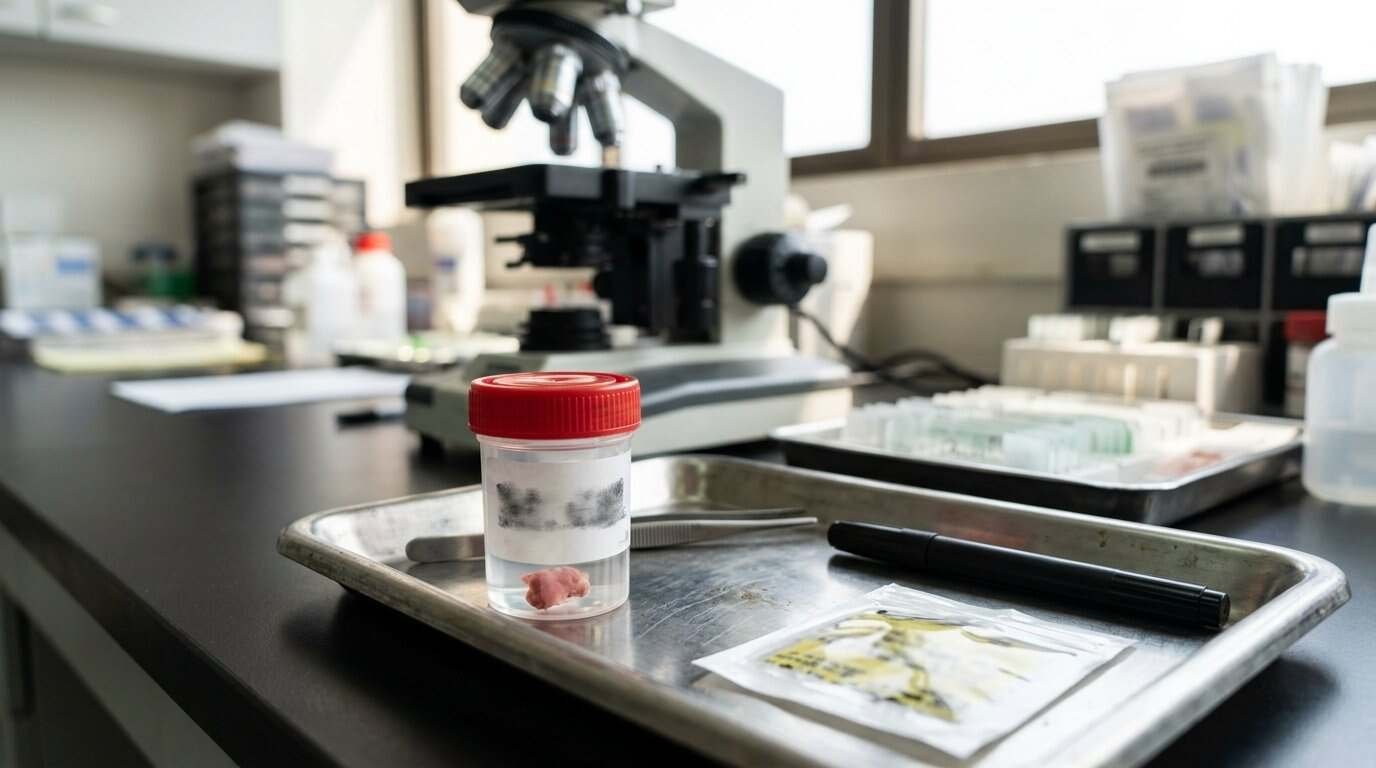
Under US law you generally have no ownership claim to cells removed from your body, but your doctor must disclose personal financial interests. Moore, HeLa and today's consent rules explained.
Who owns your cells once a surgeon removes them? In the United States, generally not you. The leading case, Moore v. Regents of the University of California, decided by the California Supreme Court on July 9, 1990, held that a patient had no conversion (property) claim over cells taken in surgery and turned into a patented cell line. The same court held, though, that a doctor who hides a personal research or financial stake from a patient can be sued for breach of fiduciary duty or lack of informed consent. Facts checked October 10, 2026; this article covers US law, with California as the main example.
So the law gives you no property in your excised tissue, but it gives you a right to honest disclosure. Federal research rules have since added a consent element about commercial profit. The HeLa story shows why people still find the arrangement unsatisfying.
The short version, in five points
- Cells removed during a procedure are generally not treated as the patient’s property under Moore.
- A physician must disclose personal research or economic interests that could affect medical judgment.
- Researchers can build patented products from tissue without paying the donor, as Moore and HeLa both illustrate.
- Federal rules for funded research now require consent forms to say, when appropriate, if biospecimens may be used for commercial profit and whether the donor will share.
- Many HeLa-related claims have ended in settlements, so courts have not produced a clear property rule.
The Moore case, step by step
John Moore was treated for hairy-cell leukemia in the mid-1970s. His doctor, David Golde, removed his spleen, and cells from it were developed into a patented cell line without Moore’s knowledge, according to the Inverse account and the court’s summary in Justia’s reproduction of the opinion. Moore sued.
The California Supreme Court split his claims. On conversion, the court said no reported decision had recognized a continuing ownership interest in excised cells, and it noted that statutes treat human biological materials as a distinct category. It also reasoned that the patented cell line and its derivative products could not be Moore’s property. Three policy points drove the ruling:
- Extending conversion would be a major expansion of tort law.
- Conversion is a strict liability tort, so it could reach innocent researchers who had no idea about any consent failure.
- Whether to regulate commercial use of tissue was better left to the Legislature.
On the second claim, the court sided with Moore. A doctor must disclose personal interests unrelated to the patient’s health that may affect his judgment. The complaint alleged Golde had such undisclosed interests before the surgery and during later sample collections, so that theory could go forward. Justice Arabian wrote separately about the moral problems of treating human tissue as property, while Justice Mosk dissented and would have recognized the conversion claim.
Why doctors, not property law, carry the duty
Moore protects the patient through the relationship and not through ownership. That distinction matters in practice. The right is to be told, not to be paid. A patient who learns afterwards that a physician had an undisclosed financial stake can sue over the consent failure, but a patient who was told everything has little claim to the profits.
It also leaves gaps. The ruling applies to the physician’s own conflicts. It says nothing about a hospital that sends leftover tissue to a lab, a lab that passes it to a company, or a researcher with no stake at all. The case does not tell you what rights exist in those situations, and the court itself pointed readers toward legislatures.
HeLa: the same question, a different era
Henrietta Lacks was diagnosed with aggressive cervical cancer in 1951. Doctors at Johns Hopkins took a tumor sample that became the HeLa line, used in work ranging from polio vaccine development to early Covid-19 research, according to the UK Human Rights Blog. She and her family did not consent to long-term use of her cells, and the family learned of the cells roughly twenty years after her death, per the Inverse article.
In October 2021 her estate sued Thermo Fisher Scientific, seeking disgorgement of profits. The UK Human Rights Blog noted the legal difficulty: disgorgement depends on the profits having come from the claimant’s property, and US law, like UK law, recognizes no property in the body. Per Wikipedia, Thermo Fisher settled on undisclosed terms on July 31, 2023, and the family reached a separate out-of-court settlement with Novartis in February 2026, with suits against other drug companies still pending. I could verify those settlement dates only from that secondary source.
The pattern is worth noticing. Courts have not announced that the Lacks family owns anything. Settlements may have given them money, but they set no precedent.
The 2013 genome agreement
A different Lacks dispute ended in an agreement instead of a lawsuit. After researchers published a HeLa genome sequence in March 2013, the family objected on privacy grounds, since DNA sequence reveals information about descendants. In August 2013 the family and the NIH announced an agreement giving the family some control over access to the sequence data, acknowledgment in scientific papers, and two seats on the six-member access committee. It did not give the family proceeds from commercial products, per Wikipedia’s summary.
That agreement is a useful model: control over access and data, not ownership of the cells.
Why “ownership” may be the wrong question
Lawyers who work in this area often point out that property is a bundle of rights: to use, to sell, to exclude, to control. The cases above suggest the law gives patients a few strands of that bundle, such as the right to refuse a procedure and the right to be told about a conflict of interest, without handing over the whole thing. The 2013 NIH arrangement for the HeLa genome followed the same logic by granting control over access instead of title.
Framed this way, the useful questions for a patient become practical ones. Who may use this tissue, for what, for how long, and will anyone tell me? Those are consent questions, and consent forms are where current law puts the answers.
What the federal consent rules require now
The Common Rule governs federally funded human subjects research. Its 2018 revisions, with a general compliance date of January 21, 2019, added consent provisions that bear on this question (HHS OHRP).
Under 45 CFR 46.116(c)(7), when appropriate, consent must say that the subject’s biospecimens, even with identifiers removed, may be used for commercial profit, and whether the subject will or will not share in that profit. The same section lets researchers obtain “broad consent” for storing and later using identifiable biospecimens. That consent must describe the types of research that may be done and the kinds of institutions that may do it. It can allow storage and use for an indefinite period, and it must say that subjects will not be told details of specific studies, and that clinically relevant results may not be disclosed (eCFR).
Notice the structure. The rule requires disclosure of whether you share in profit, not a right to share. The answer can be no.
What this means before you sign a form
This is general information, not advice for your situation. Still, the reading tips follow from the rules above.
- Look for language on storing tissue and using it in future research. Broad consent forms are built to allow indefinite storage.
- Look for the commercial-profit statement. If research is federally funded, the form should address it where appropriate.
- Ask whether your identifiers stay attached. The rule applies to biospecimens even with identifiers removed.
- Ask your doctor directly whether anyone involved in your care has a research or financial interest in the tissue. Moore makes that disclosure a duty.
Where the debate stands
Critics say a rule that treats the donor as a source and not an owner lets value flow to institutions and companies with nothing to the person who supplied it. The Inverse article notes that the American Medical Association has suggested physicians disclose commercial uses of tissue and consider sharing profits, but that this is not legally enforced. The court in Moore replied that strict property liability could burden research that benefits many patients. Neither argument is silly. As of today, no court I found has recognized a property right in excised cells, and the practical protections are consent, disclosure and negotiated settlements.
Common questions
Can I stop a hospital from using my leftover tissue?
You can decline consent where consent is requested. Whether leftover tissue can be used without it depends on the circumstances and rules I did not research, so ask the institution what its policy is.
Did the Lacks family win HeLa?
They settled lawsuits, reportedly including Thermo Fisher in 2023, on undisclosed terms. That is not a ruling that they own the cell line.
Is Moore still good law?
I found no source saying it was overturned, and the Wikipedia summary describes it as holding that discarded tissue is not the person’s property. Check a legal database for later history if you need a firm answer.
Is my DNA mine?
A cell’s genetic content is unique to you, which complicates ownership, as the Inverse article points out, but the sources I reviewed treat biological material as not belonging to the individual once removed.
This is general information about US law, not legal advice.
Sources
- Justia, Moore v. Regents of the University of California, 51 Cal. 3d 120 (1990)
- eCFR, 45 CFR 46.116
- HHS OHRP, Finalized revisions to the Common Rule
- UK Human Rights Blog, Henrietta Lacks and her immortal cells (Oct. 13, 2021)
- Inverse, Who owns your cells and DNA? (Nov. 17, 2019)
- Wikipedia, Henrietta Lacks
